How Can AI Assist in Early Breast Cancer Detection?
TL;DR
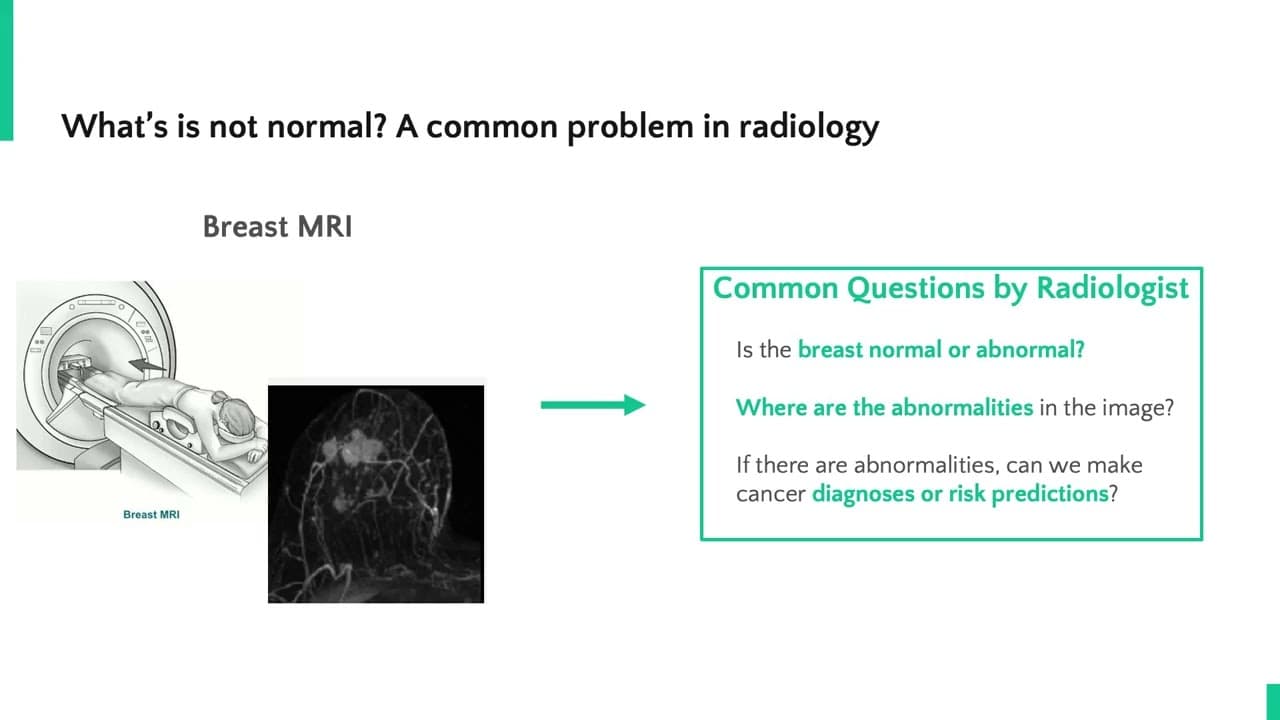
AI can assist in early breast cancer detection by using explainable machine learning models to analyze MRI scans. This tool has achieved over 90% accuracy in identifying cancer and over 80% in predicting five-year cancer risk, while reducing radiologists' workloads by over 80%. By quickly identifying abnormal areas, it enhances diagnostic efficiency without replacing medical professionals.
Transcript
hello my name is Felipe viedo I'm a senior research scientist at the Microsoft AI for good research lab I have a background in applying AI to Scientific problems such as computational chemistry biology and Medical Imaging and I'm very excited about the applications of AI in these non-traditional domains I would like to tell you about a medical imag... Read More
Key Insights
- ♋ Breast cancer is a common type of cancer worldwide, and early detection is crucial.
- ⌛ MRI scans are complex, and interpreting them can be time-consuming and challenging even for experienced radiologists.
- 🤱 Training a machine learning model for breast cancer detection is challenging due to the imbalance between positive and negative cases.
- 🤱 An explainable machine learning model can assist radiologists by quickly identifying abnormal areas in breast MRI scans and reducing their workload.
- ♋ The developed model achieved high accuracy in detecting existing cancer and predicting the five-year risk of cancer.
- 😷 AI-assisted tools like this can improve efficiency and outcomes in medical imaging but should not replace trained medical professionals.
- 🔨 Integrating such tools into the clinical workflow can further enhance their usability and impact.
Install to Summarize YouTube Videos and Get Transcripts
Explore YouTube Video Summarizer or Get YouTube Transcript Extractor
Questions & Answers
Q: What was the motivation behind developing an AI-assisted tool for breast cancer detection?
The motivation was to reduce the interpretation time, increase the accuracy of MRI exams, and assist radiologists in the early detection of breast cancer, ultimately improving patient outcomes.
Q: How did the team overcome the challenge of training a machine learning model with a limited number of positive cases?
The team used a careful approach by customizing the model for anomaly detection. They trained the model on abundant negative data to identify normal or negative images well and then looked for features that are absent or different in abnormal images.
Q: What were the results of the final model developed by the team?
The final model demonstrated over 90% accuracy in detecting existing cancer in patients and over 80% accuracy in predicting the five-year risk of cancer. These results are comparable to the accuracy of a trained radiologist reviewing MRI scans.
Q: How did the AI-assisted tool reduce the workload of radiologists?
By automatically analyzing images, the system reduced the workload of radiologists by over 80%, allowing them to focus on cases that require further analysis or a biopsy, thus improving efficiency and patient care.
Summary & Key Takeaways
-
Microsoft AI for Good Research Lab partnered with the University of Washington and the Fred Hutch Cancer Research Center to develop a system using deep learning to assist radiologists in the early detection of breast cancer.
-
The goal of the project was to develop an explainable machine learning model that can quickly identify abnormally areas in breast MRI scans, reducing the effort required for analysis and enabling better diagnosis and risk predictions.
-
By customizing the model for anomaly detection, the team achieved over 90% accuracy in detecting existing cancer and over 80% accuracy in predicting the five-year risk of cancer, while reducing the workload of radiologists by over 80%.
Read in Other Languages (beta)
Share This Summary 📚
Summarize YouTube Videos and Get Video Transcripts with 1-Click
Try YouTube Summary with ChatGPT & Claude or YouTube Transcript Generator
Explore More Summaries from DeepLearningAI 📚
![How Does the Logistic Regression Decision Boundary Work? — #33 Machine Learning Specialization [Course 1, Week 3, Lesson 1] thumbnail](/_next/image?url=https%3A%2F%2Fi.ytimg.com%2Fvi%2F0az8RjxLLPQ%2Fhqdefault.jpg&w=750&q=75)
Summarize YouTube Videos and Get Video Transcripts with 1-Click
Try YouTube Summary with ChatGPT & Claude or YouTube Transcript Generator