How to Build Sustainable Futures Trading Success
TL;DR
Profitable futures trading depends on self-belief, disciplined review, and a willingness to keep doing difficult work without immediate recognition. Journaling trades, recording video recaps, seeking feedback, and learning from profitable peers can expose weaknesses and strengthen execution. Sustainable progress also requires honest self-assessment, commitment to the long game, and learning to handle losses before pursuing greater profits.
Transcript
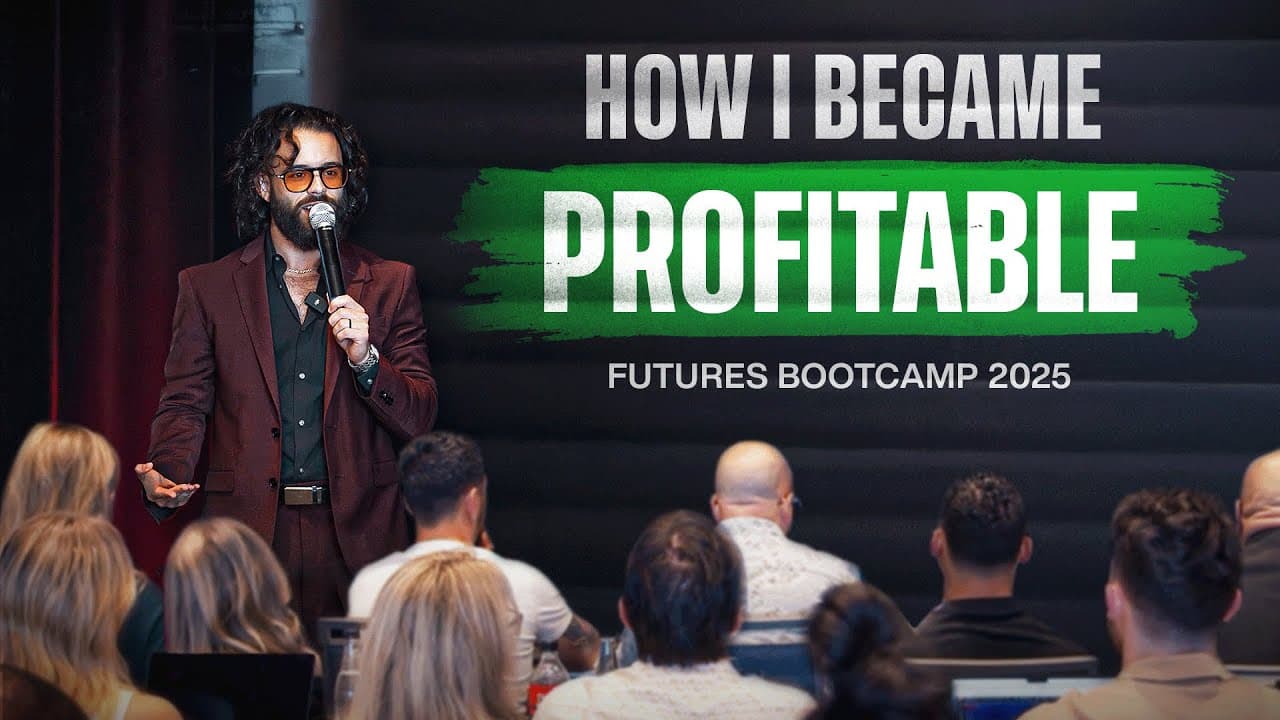
So, first thing we're going to do today, we're going to talk about why we're all here, but we're going to focus this conversation on futures trading. Who here has taken a payout from a prop firm so far in the future space? Awesome. Like half the room. So, what that tells me is that those of you that did not just raise your hand for a payout need to... Read More
Key Insights
- Belief is the foundation of trading progress because traders must continue working through losses, doubt, and limited outside support. The speaker connects sustainable success with believing in the process and in one’s capacity to improve before the desired financial results have appeared.
- Honest self-assessment is necessary for improvement because traders need to acknowledge whether they have received payouts, remain negative overall, or lack confidence in their records. Recognizing the current position is presented as a practical starting point rather than a reason for embarrassment.
- Networking is a direct learning opportunity because traders without payouts can speak with peers who have already achieved them. The event’s community is presented as a source of relationships, practical feedback, and examples of different approaches that can produce profitable outcomes.
- Trade review is as important as live execution because studying past decisions reveals missed opportunities, repeated errors, and useful patterns. The speaker says that reviewing and studying personal trading occupied an enormous part of his development and helped turn experience into actionable learning.
- A trading journal is a tool for accountability because detailed recaps preserve the reasoning, execution, and outcome of each trade. Avoiding a brief daily review may feel convenient, but the speaker argues that poor reflection leaves valuable information and potential improvement unused.
- Video reviews create stronger feedback loops because traders must explain their decisions clearly and expose their thinking to evaluation. Posting those reviews publicly can attract useful responses from viewers who might otherwise remain silent, although recording them privately still supports structured reflection.
- Repeated exposure to difficult trading conditions builds capability because showing up daily, streaming for long periods, and trading in front of other people demands preparation and emotional control. The speaker credits these stressful experiences with teaching lessons that later made public trading feel more familiar.
- Becoming a better loser is a prerequisite for becoming a stronger trader because sustainable performance is not simply about being right. The description emphasizes staying green, protecting the long-term process, and accepting that different traders and prop firms can reach payouts through different methods.
Install to Summarize YouTube Videos and Get Transcripts
Explore YouTube Video Summarizer or Get YouTube Transcript Extractor
Questions & Answers
Q: How can a futures trader build sustainable profitability?
A futures trader can pursue sustainable profitability by combining self-belief with honest performance review and consistent practice. The recommended process includes journaling trades, creating detailed recaps, reviewing decisions on video, and seeking feedback from other traders. It also means accepting that progress is difficult, learning to manage losses, and continuing useful work even when recognition or immediate results are absent.
Q: Why is self-belief important for trading success?
Self-belief matters because trading involves losses, uncertainty, difficult practice, and periods when other people may not understand or support the goal. The speaker presents belief as the foundation that allows a trader to keep reviewing, learning, and showing up. It is not described as a substitute for skill, but as the commitment needed to develop skill through sustained effort.
Q: How does journaling help improve trading performance?
Journaling helps by creating a reliable record of trades, decisions, outcomes, and recurring behavior. A trader can use that record to identify mistakes, evaluate whether a setup was followed correctly, and improve future execution. The speaker argues that traders who avoid even a short daily review are leaving valuable learning unused and reducing their ability to understand their own performance.
Q: Why should traders record video reviews of their trades?
Video reviews force traders to explain what they saw, why they acted, and how the trade developed. That process can reveal gaps in reasoning that may remain hidden in a simple list of results. Sharing reviews publicly may also attract constructive feedback from viewers, while recording them privately still creates a disciplined routine for reflection, accountability, and clearer self-evaluation.
Q: What can traders learn from trading live in front of others?
Trading live in front of others can strengthen preparation, consistency, and the ability to operate under pressure. The speaker describes public trading and extended live streams as highly stressful but also deeply educational. Repeated exposure made the demands of streaming and trading feel more familiar over time, showing how difficult practice can build confidence and practical resilience.
Q: How can networking help traders who have not received payouts?
Networking allows traders without payouts to speak directly with peers who have already achieved profitable outcomes through prop firms. Those conversations can reveal useful habits, review methods, and approaches to risk or execution. The speaker encourages attendees to identify experienced participants, form relationships, and use the community as a practical learning resource rather than working through every challenge alone.
Q: What role do losses play in becoming a profitable trader?
Losses are presented as part of the development process rather than proof that improvement is impossible. The speaker describes losing substantial personal money before building a trading education business and gaining deeper experience. The key lesson is to become a better loser by reviewing mistakes, protecting the long-term process, and focusing on profitable outcomes rather than needing every trade to be right.
Q: Is there one correct path to earning prop firm payouts?
There is no single path presented as the only way to earn prop firm payouts. The description notes that traders in the community achieved payouts through different firms and approaches. What matters is commitment to the long game, honest self-awareness, consistent review, and the ability to manage losing periods. Traders should learn from others while developing a process they can execute responsibly.
Summary & Key Takeaways
-
Sustainable trading success begins with an honest assessment of current results and genuine belief in the ability to improve. Traders should connect with peers who have earned payouts, learn from their habits, and treat community events as opportunities to build relationships with people who understand the challenges of futures and prop firm trading.
-
The speaker’s development came through financial losses, outside work, public trading, teaching, and repeated market review. Producing educational content and trading live created pressure, but it also forced consistent preparation and reflection. The broader lesson is that difficult, repeated practice can build skills that eventually make demanding trading situations feel more manageable.
-
Journaling, trade recaps, and video reviews are presented as essential tools for improvement. Sharing reviews publicly can invite useful feedback, while private reflection still helps traders recognize patterns and mistakes. Long-term success requires self-awareness, disciplined repetition, acceptance of losses, and commitment to useful work even when family or friends do not understand the goal.
Read in Other Languages (beta)
Share This Summary 📚
Summarize YouTube Videos and Get Video Transcripts with 1-Click
Try YouTube Summary with ChatGPT & Claude or YouTube Transcript Generator
Explore More Summaries from ASFX 📚

Summarize YouTube Videos and Get Video Transcripts with 1-Click
Try YouTube Summary with ChatGPT & Claude or YouTube Transcript Generator