How to Code an AI Voice Bot in Python for Conversations
TL;DR
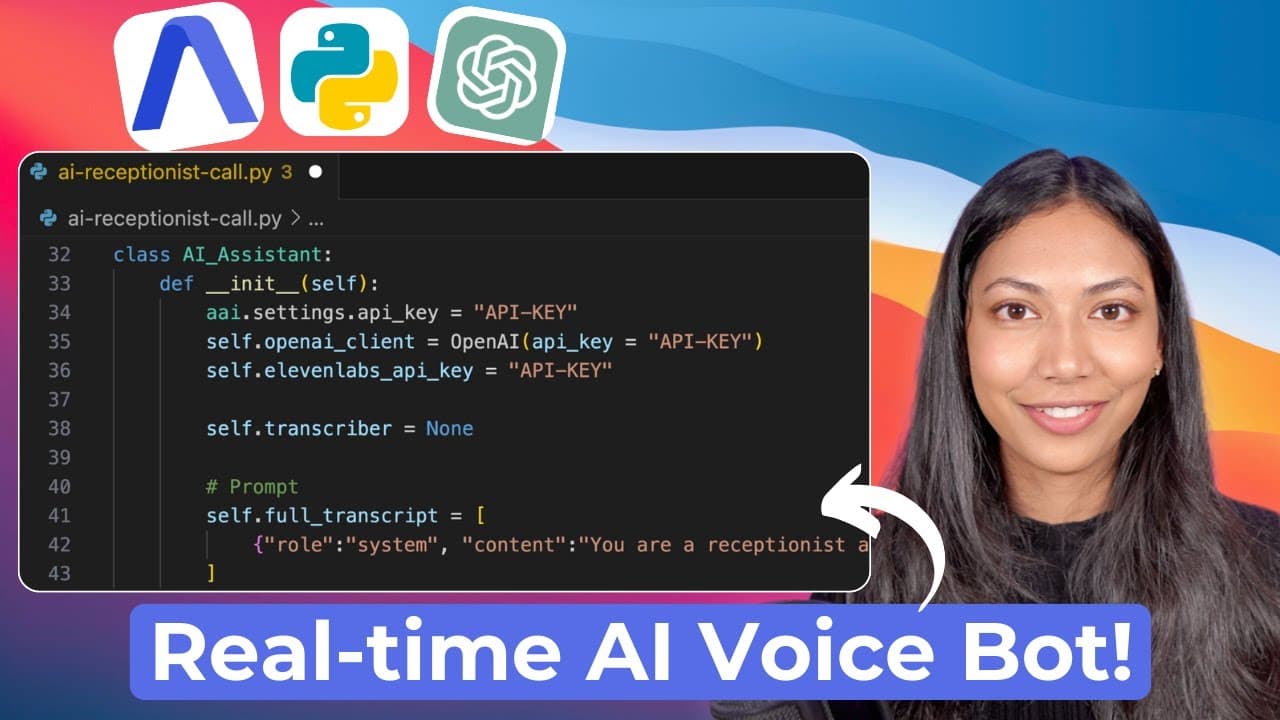
To build an AI voice bot in Python, install the necessary libraries like Assembly AI for speech-to-text, OpenAI for generating responses, and 11 Labs for audio output. Follow the steps to set up real-time transcription, handle user input, and produce audio responses that simulate a conversational AI, suitable for applications like scheduling appointments.
Transcript
in this video I'll show you how to build an AI voice bot in Python it will be able to understand realtime audio input and at the same time generate real-time audio responses here's the scenario where our AI voice bot is working at a dental clinic thank you for calling Vancouver dental clinic my name is Sandy how may I assist you hi Sandy my name is... Read More
Key Insights
- 🤩 Assembly AI, Open AI, and 11 Labs are key Python libraries for AI voice bot development.
- 🤖 Real-time transcription is crucial for capturing live audio input in the AI voice bot project.
- ⚾ Open AI generates text responses based on transcribed input, simulating human-like responses.
- ⌛ 11 Labs converts text responses from Open AI into real-time audio using specific voice options.
- 🤩 Proper API key management and streaming functions are essential for AI voice bot functionality.
- ⌛ Understanding the process of real-time transcription and audio generation is vital for Python-based AI projects.
- 🤖 The AI voice bot can efficiently handle tasks like booking appointments through natural language interaction.
Install to Summarize YouTube Videos and Get Transcripts
Explore YouTube Video Summarizer or Get YouTube Transcript Extractor
Questions & Answers
Q: What are the necessary Python libraries needed to build an AI voice bot?
The essential Python libraries include Assembly AI, Open AI, and 11 Labs for speech-to-text transcription and audio generation.
Q: How is real-time transcription achieved in the AI voice bot?
Real-time transcription is accomplished using Assembly AI's API with methods like start transcription and stop transcription to capture and process live audio input.
Q: What role does Open AI play in the AI voice bot project?
Open AI is utilized to generate text responses based on the transcribed input from Assembly AI, emulating how a dental assistant would interact in real-time.
Q: How is audio generated in the AI voice bot using 11 Labs?
11 Labs is employed to convert the text responses from Open AI into real-time audio responses using the generate function and various voice options like Rachel.
Summary & Key Takeaways
-
Learn to build an AI voice bot in Python for a dental clinic scenario.
-
Utilize Python libraries like Assembly AI, Open AI, and 11 Labs for speech-to-text transcription and audio generation.
-
Follow a step-by-step guide to install libraries, transcribe real-time audio, and generate AI responses.
Read in Other Languages (beta)
Share This Summary 📚
Summarize YouTube Videos and Get Video Transcripts with 1-Click
Try YouTube Summary with ChatGPT & Claude or YouTube Transcript Generator
Explore More Summaries from AssemblyAI 📚


Summarize YouTube Videos and Get Video Transcripts with 1-Click
Try YouTube Summary with ChatGPT & Claude or YouTube Transcript Generator