Ohm's Law Explained - Voltage, Current, Resistance, Power - Volts, Amps & Watts - Basic Electricity
TL;DR
Learn how to apply Ohm's Law to solve problems involving voltage, current, resistance, electric charge, and power.
Transcript
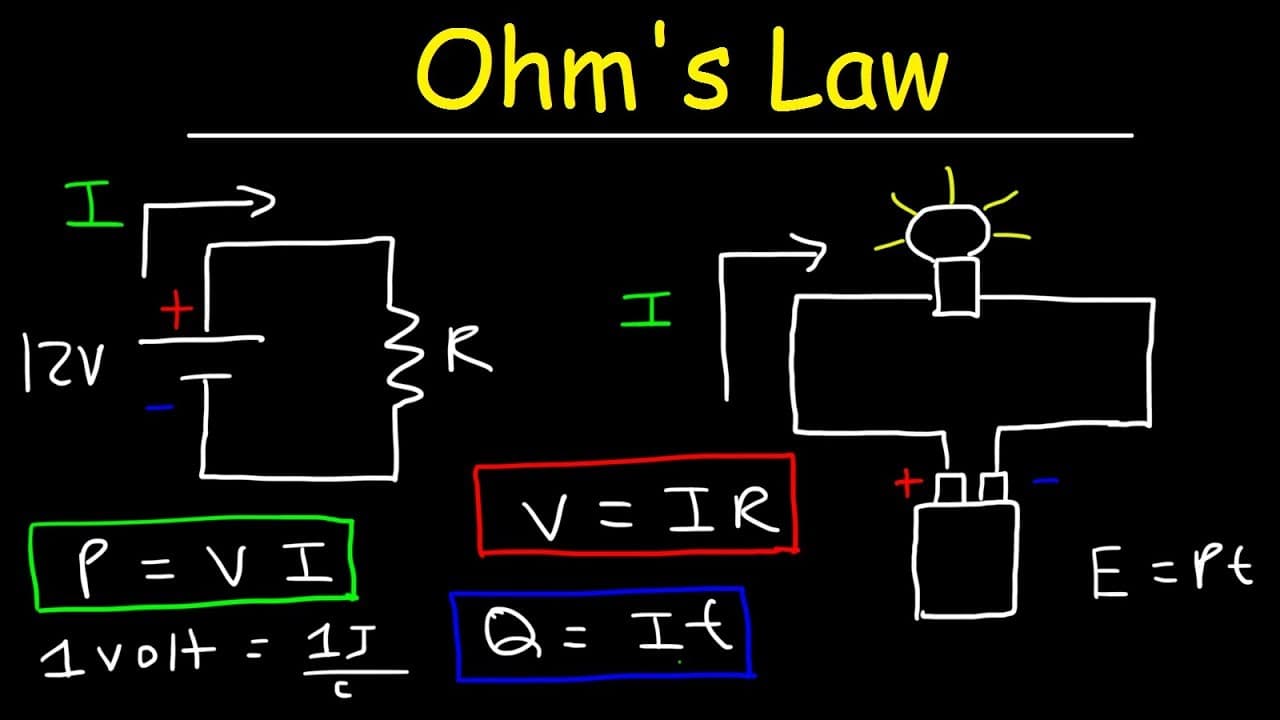
in this video we're going to focus on solving some problems associated with ohm's law so let's start with this one a 12 volt battery is connected across a 4 ohm resistor calculate the current flowing through the resistor so first let's draw a basic circuit so this is the battery and on the right we have the symbol of a resistor this is the positive... Read More
Key Insights
- ⚡ Ohm's Law (V = IR) is used to solve various problems involving voltage, current, and resistance.
- 🈂️ Electric charge can be calculated by multiplying current by time, and the unit of charge is coulombs.
- 🈂️ The number of electrons passing through a component can be found by dividing the charge by the charge of a single electron.
- ✊ Power consumed by a resistor can be calculated using the formula P = I^2 * R, where P is power, I is current, and R is resistance.
- ✊ Power is measured in watts, and energy is the product of power and time, measured in joules.
- ⚡ The voltage of multiple batteries connected in series is the sum of their individual voltages.
- ✊ The power delivered by a source is equal to the voltage multiplied by the current it supplies.
- ✊ The energy consumed by a device can be calculated by multiplying power by time, measured in joules.
Install to Summarize YouTube Videos and Get Transcripts
Explore YouTube Video Summarizer or Get YouTube Transcript Extractor
Questions & Answers
Q: How is current calculated in relation to voltage and resistance?
According to Ohm's Law, current can be calculated by dividing the voltage across a component by its resistance. For example, in a circuit with a 12-volt battery and a 4-ohm resistor, the current is 3 amps (12 volts / 4 ohms).
Q: How is the amount of charge flowing through a resistor calculated?
The amount of charge flowing through a resistor can be calculated by multiplying the current passing through it by the time. For instance, if the current is 3 amps and the time is 5 minutes (300 seconds), the charge would be 900 coulombs.
Q: How can the number of electrons passing through a resistor be determined?
To calculate the number of electrons passing through a resistor, convert the time to seconds and multiply it by the current. Then, divide this value by the charge of a single electron (-1.6 x 10^-19 coulombs) to get the number of electrons.
Q: What is the formula for power consumed by a resistor?
The power consumed by a resistor can be calculated using the formula P = I^2 * R, where P is power, I is current, and R is resistance. By substituting the given values, the power consumed can be determined.
Summary & Key Takeaways
-
The video begins by explaining a problem involving a 12-volt battery connected to a 4-ohm resistor. The current flowing through the resistor is calculated to be 3 amps.
-
The next problem involves finding the amount of charge that flows through the resistor in five minutes, resulting in an electrical charge of 900 coulombs.
-
Another problem focuses on determining the number of electrons that pass through a resistor in one hour, which is found to be 6.74 x 10^22 electrons.
-
The video also discusses calculating the voltage across a 25-ohm resistor with a current of 300 milliamps, resulting in a voltage of 7.5 volts.
-
It further explains how many AA batteries are needed to produce a voltage of 7.5 volts, which turns out to be 5 batteries.
-
The content moves on to calculating the electrical resistance of a light bulb connected to a 9-volt battery with a current of 180 milliamps, resulting in a resistance of 50 ohms.
-
The power consumed by the light bulb is then calculated, followed by the power delivered by the battery, both equal to 1.62 watts.
-
The next problem involves a 120-volt power source connected to a 60-ohm resistor, with the current through the resistor calculated to be 2 amps.
-
The power delivered by the source is determined to be 240 watts, while the energy consumed by the resistor in one day is found to be 20,736,000 joules.
-
The final problem focuses on calculating the total energy stored in a 12-volt battery with a storage capacity of 50 amp-hours, resulting in 2,160,000 joules.
Read in Other Languages (beta)
Share This Summary 📚
Summarize YouTube Videos and Get Video Transcripts with 1-Click
Try YouTube Summary with ChatGPT & Claude or YouTube Transcript Generator
Explore More Summaries from The Organic Chemistry Tutor 📚




Summarize YouTube Videos and Get Video Transcripts with 1-Click
Try YouTube Summary with ChatGPT & Claude or YouTube Transcript Generator