Why GPT-5 Underwhelmed and China Gained an Edge

TL;DR
GPT-5 received mixed reactions because its release appeared incremental, its presentation contained errors, and it did not emerge as the decisively best model. The broader discussion connects AI investment and energy demand with China's competitive advantage, government intervention, socialism, tariffs, chip smuggling, Apple's capital allocation, and its weak AI strategy.
Transcript
I just want to let Freeberg know. He told me to stop taking my nicotine pouches because I had brought too much energy. Freeberg, you see what I got here? Nick, blur that out. See what I got? We're not doing We're not doing promotions. We're not doing any of these promotions. What you need to know is he sent me my own flavors. Jason, just so the res... Read More
Key Insights
- GPT-5 received an underwhelming initial response despite topping some chatbot leaderboards. The release did not reproduce the perceived leaps associated with ChatGPT 3.5 or 4.0, leading the panel to consider whether OpenAI was encountering incremental progress, benchmark saturation, or diminishing returns.
- The GPT-5 presentation contained incorrect charts, miscalculations, and typographical errors. These visible problems made the launch feel less polished than a classic product keynote and complicated the reception of a model that still demonstrated competitive performance on certain public rankings.
- OpenAI released GPT-5 alongside two open-weight models. The panel carefully distinguishes open-weight models from open-source models, indicating that access to model weights should not automatically be treated as equivalent to releasing an entire system through an open-source approach.
- Grok 4 was described as holding the leading position before GPT-5 arrived. Gavin Baker argued that the jump from Grok 3 to Grok 4 was substantial and observed that GPT-5 was the first new OpenAI model that did not appear decisively superior upon release.
- AI's economic opportunity is evaluated through total addressable market, returns on invested capital, and energy implications. The discussion treats model development as part of a larger investment system in which market demand, financial returns, and the energy required for AI infrastructure are connected.
- China's competitive position is presented as a major strategic issue for the United States. The episode pairs that topic with Nvidia chips being smuggled into China, suggesting that access to advanced computing hardware remains central to the broader competition discussed by the panel.
- United States industrial and energy policy is examined through political winner selection, energy subsidy reversals, and the bureaucratic branch. The panel also connects these policy questions to socialism, the OBBB's effect on energy, tariffs, and the possibility of institutional reform.
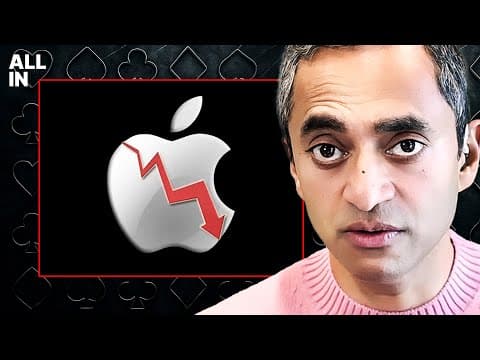
- Apple's capital allocation is contrasted with its AI strategy. The discussion highlights $700 billion in share buybacks since 2015 while characterizing the company's AI strategy as failing, making Apple an example in the episode's wider debate about investment priorities and technological execution.
Install to Summarize YouTube Videos and Get Transcripts
Explore YouTube Video Summarizer or Get YouTube Transcript Extractor
Questions & Answers
Q: Why did GPT-5 receive an underwhelming response?
GPT-5 received an underwhelming response because it appeared less transformative than the major jumps associated with ChatGPT 3.5 and 4.0. The presentation also contained incorrect charts, miscalculations, and typographical errors. Although GPT-5 topped some chatbot leaderboards, the panel emphasized that it did not emerge as decisively better than competing models, particularly after Grok 4 had taken the lead.
Q: Did GPT-5 outperform every competing AI model?
GPT-5 topped some leaderboards in the chatbot arena, but the panel did not view it as decisively superior to every competitor. Gavin Baker described its release as the first time a new OpenAI model had not clearly appeared to be the best. He contrasted that result with the substantial improvement he perceived between Grok 3 and Grok 4.
Q: What went wrong with the GPT-5 launch presentation?
The GPT-5 launch presentation was described as messy and included flat or incorrect charts, miscalculations, and typographical errors. Those problems weakened the sense of product excellence surrounding the announcement. Sam Altman's earlier Death Star image had also created significant expectations, so the presentation and the model's incremental reception did not match the anticipation generated before the release.
Q: Is AI model development showing diminishing returns?
The panel raises diminishing returns as a possibility rather than establishing it as a settled conclusion. GPT-5 felt incremental compared with the perceived advances of earlier ChatGPT releases, which prompted questions about benchmark saturation and a possible trough of disappointment. Gavin Baker countered that Grok 4 represented a substantial leap over Grok 3, suggesting progress may differ between developers.
Q: How does the episode assess the size of the AI market?
The episode assesses AI's opportunity through its total addressable market, returns on invested capital, and energy implications. This framing treats AI as more than a competition between model benchmarks. It asks how broad demand may become, whether large investments can produce adequate returns, and how the energy requirements of AI infrastructure affect the economics of continued expansion.
Q: What advantage does China have in the AI competition?
The episode identifies China's major advantage as a central topic and asks how the United States can counter it. The provided material does not specify the precise advantage or the panel's complete proposed response. It does, however, connect the competition with Nvidia chips being smuggled into China, United States industrial choices, energy policy, and government decisions about favored sectors.
Q: What tariff developments does the panel discuss?
The panel discusses tariffs that had generated more than $125 billion in revenue, with India and Switzerland described as being hit hard. It also characterizes President Trump's approach as ad hoc. The topic appears within a broader policy conversation about government intervention, political selection of winners, energy subsidies, institutional authority, and the economic consequences of changing national priorities.
Q: Why does the episode criticize Apple's AI strategy?
The episode contrasts Apple's capital allocation with what it characterizes as a failing AI strategy. It highlights that Apple conducted $700 billion in share buybacks since 2015, then places that spending beside the company's AI position. The comparison frames a strategic question about whether returning capital through buybacks corresponded with insufficient execution or investment in a major technological shift.
Summary & Key Takeaways
-
GPT-5 arrived four weeks after Grok 4 and topped some chatbot leaderboards, but its reception was underwhelming. The launch presentation included incorrect charts, miscalculations, and typographical errors. The panel contrasted this response with the major perceived advances of earlier ChatGPT releases and questioned whether benchmark saturation or diminishing returns were becoming visible.
-
The conversation broadens from model performance to AI's total addressable market, returns on invested capital, and energy implications. It then examines China's major competitive advantage and possible United States responses, including political decisions about preferred industries, changes to energy subsidies, and the development and potential reform of the bureaucratic branch of government.
-
Later topics include the rise of socialism, the energy effects of the OBBB, and whether socialism's American prospects depend on Mamdani in New York City. The panel also discusses more than $125 billion in tariff revenue, pressure on India and Switzerland, Nvidia chips smuggled into China, and Apple's AI strategy and buybacks.
Read in Other Languages (beta)
Share This Summary 📚
Summarize YouTube Videos and Get Video Transcripts with 1-Click
Try YouTube Summary with ChatGPT & Claude or YouTube Transcript Generator
Explore More Summaries from All-In Podcast 📚
Summarize YouTube Videos and Get Video Transcripts with 1-Click
Try YouTube Summary with ChatGPT & Claude or YouTube Transcript Generator