Safety in Numbers: Keeping AI Open
TL;DR
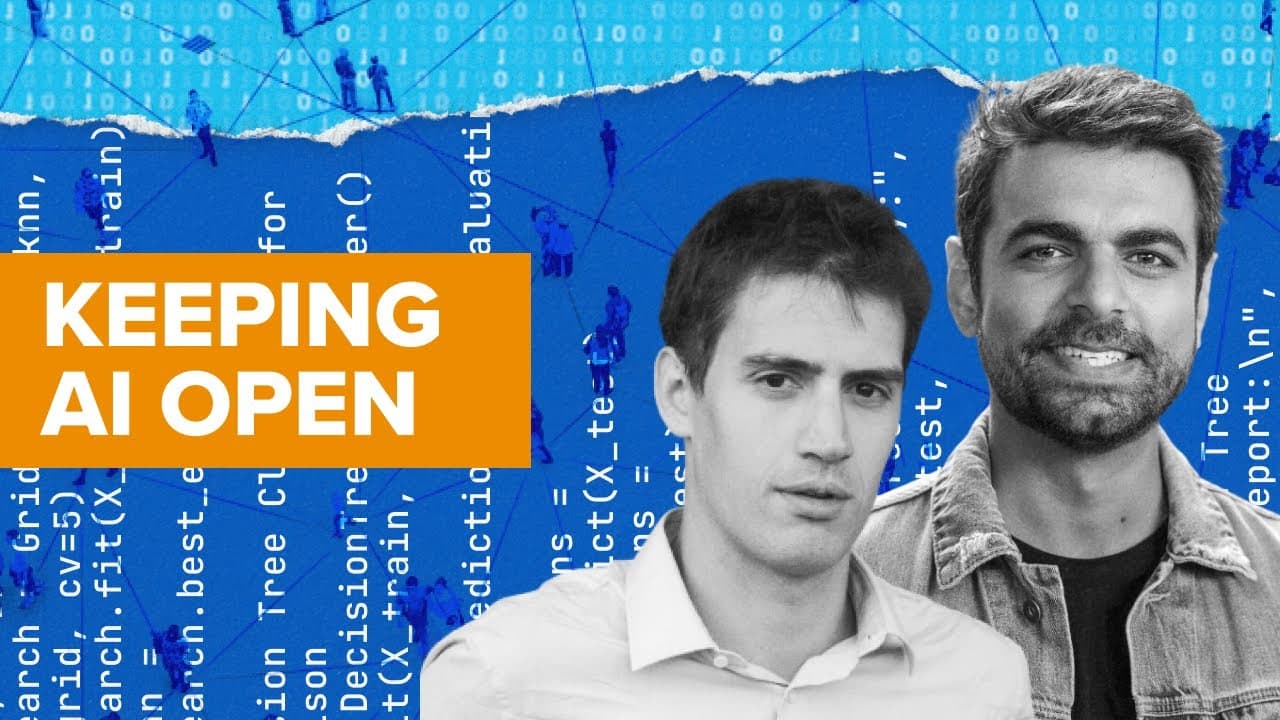
Keeping AI open can improve safety by giving developers greater control over model behavior, biases, compliance, and task-specific customization. MIST-OL’s open-source releases include MIST-OL 7B and MIX, a sparse mixture-of-experts model described as matching GPT-3.5 performance while lowering cost and accelerating inference. Read on for the scaling-law insight behind these models and the case for open development.
Transcript
scaling laws now these underpin the success of large language models today but the relationship between data sets compute and the number of parameters was not always clear in fact in 2022 a pivotal paper came out that changed the way that many people in the research Community thought about this very calculus and it demonstrated that data sets were ... Read More
Key Insights
- 😫 Data sets are crucial for optimal language model performance, debunking the belief that model size is the most important factor.
- 🤗 MIST-OL's founding team combined their expertise from DeepMind and Meta to develop open-source language models that offer competitive performance.
- 💨 The release of MIX demonstrates the advantages of the sparse mixture of experts architecture, providing cost-efficiency and faster inference.
- 🤗 Open-source language models allow developers to customize models, improving performance for specific tasks and increasing control over biases and behavior.
- 😌 The future of language models lies in improved data efficiency and reasoning capabilities.
- 🤗 Open-source models enable innovation and collaboration, enhancing the understanding and safety of AI systems.
- 😐 Regulating language models should focus on applications rather than the underlying math, as models are neutral tools used within specific contexts.
- 🤗 Open-source models will likely become widely adopted in the next five years, driving more interactive and efficient user experiences.
Install to Summarize YouTube Videos and Get Transcripts
Explore YouTube Video Summarizer or Get YouTube Transcript Extractor
Questions & Answers
Q: How can keeping AI open improve safety?
Open-source language models give developers greater control over biases, behavior, compliance, and safety. Open development also supports collaboration and a better understanding of AI systems.
Q: What did the 2022 Chinchilla paper reveal about scaling language models?
The paper challenged the view that model size should grow much faster than the training data. It found that data size should scale alongside model size for more compute-optimal training.
Q: How should model size and data size change when compute increases fourfold?
Arthur MCH says that multiplying compute capacity by four should approximately mean doubling the model size and doubling the data size. This replaced an earlier approach that would increase model size by about 3.5 times and data by only about 1.2 times.
Q: How was the Chinchilla scaling problem discovered?
By the end of 2021, the researchers had begun noticing problems with the prevailing scaling approach used in work including GPT-3 and Gopher. They revisited the underlying mathematics, examined empirical evidence, and ran multiple experiments before training Chinchilla and writing the paper.
Q: Who founded MIST-OL, and what experience did they bring?
Arthur MCH founded MIST-OL with Yam Lampo and Timate Laqua. Arthur had worked at DeepMind, while Yam and Timate were researchers at Meta and had worked on language models, including Llama-related work.
Q: How did the MIST-OL founders know one another?
Arthur and Yam had attended school together, while Arthur and Timate had studied together in a master’s program in Paris. Their careers later developed in parallel at DeepMind and Meta before they formed the company.
Q: What models did MIST-OL release?
The company released MIST-OL 7B in September as an open-source model that quickly became popular with developers. It then released MIX, a sparse mixture-of-experts model.
Q: What benefits does the MIX model offer?
MIX uses a sparse mixture-of-experts architecture that combines dense and expert layers. The existing page describes it as delivering performance equivalent to GPT-3.5 with lower cost and faster inference, while retaining the control available from an open-source model.
Summary & Key Takeaways
-
In 2022, a pivotal paper on scaling laws changed the perspective on the importance of data sets in language models.
-
MIST-OL, founded by Arthur MCH, Yam Lampo, and Timate Laqua, released MIST-OL 7B and a new sparse mixture of experts model called MIX.
-
Open-source models like MIX offer performance on par with closed models but with greater control, lower cost, and faster inference time.
Read in Other Languages (beta)
Share This Summary 📚
Summarize YouTube Videos and Get Video Transcripts with 1-Click
Try YouTube Summary with ChatGPT & Claude or YouTube Transcript Generator
Explore More Summaries from a16z 📚




Summarize YouTube Videos and Get Video Transcripts with 1-Click
Try YouTube Summary with ChatGPT & Claude or YouTube Transcript Generator