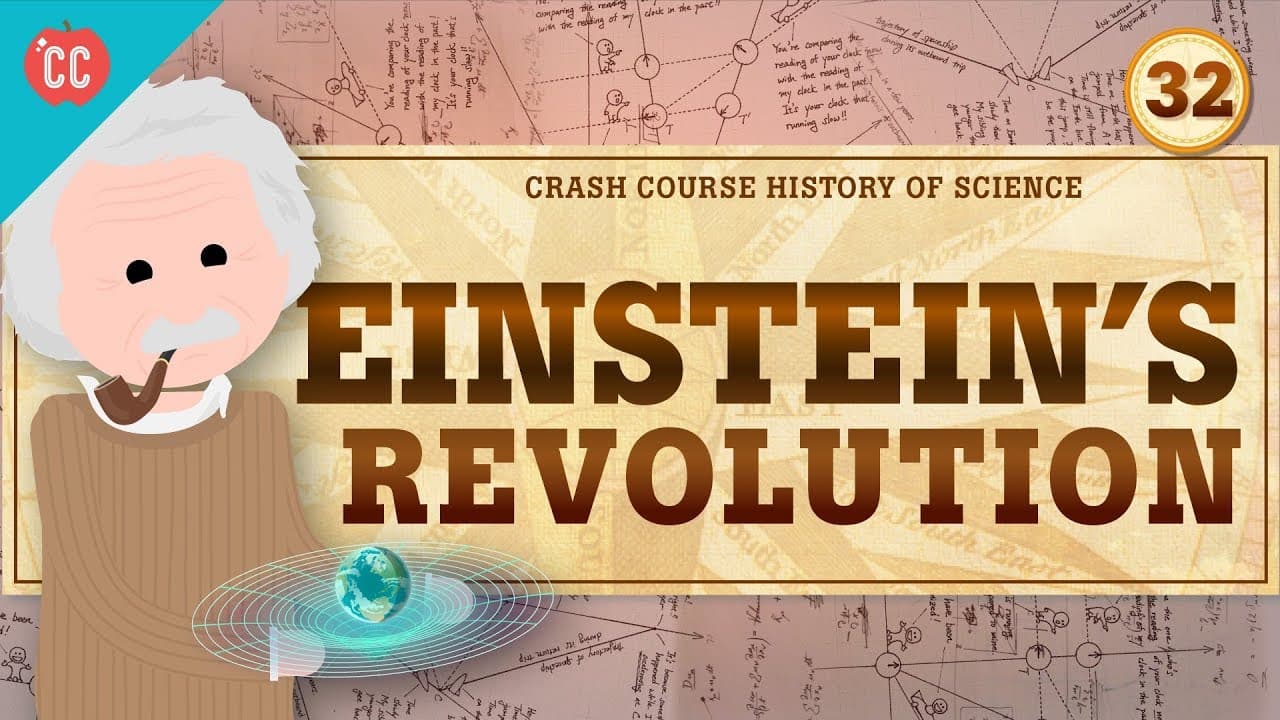
How Did Einstein Revolutionize Physics?
TL;DR
Einstein revolutionized physics by introducing concepts that challenged classical views, such as special relativity and the equivalence of mass and energy. His work led to a new understanding of space and time, ultimately contributing to the development of modern physics. Einstein's theories replaced the absolute concepts of Newtonian physics with a framework where measurements are relative, and mass and energy are interchangeable.
Transcript
There was physics before Einstein… in the same way that there was biology before Darwin. Einstein didn’t just add some new ideas to physics. And he didn’t just add a unifying framework for doing physics, like Newton. Einstein took what people thought was physics, turned it upside down, then turned it inside out. In the same way Darwin’s work made p... Read More
Key Insights
- Einstein's theories overturned classical physics by introducing relativity.
- The Michelson-Morley experiment failed to detect ether, supporting Einstein's ideas.
- Einstein's annus mirabilis in 1905 included groundbreaking papers on relativity and quantum theory.
- Special relativity established the constancy of light speed and relativity of time and space.
- General relativity redefined gravity as a curvature of spacetime, not a force.
- Einstein's E=mc2 formula showed mass-energy equivalence, a cornerstone of modern physics.
- Einstein opposed quantum mechanics' randomness, believing in a deterministic universe.
- Einstein's work influenced both theoretical physics and practical applications, like nuclear energy.
Install to Summarize YouTube Videos and Get Transcripts
Explore YouTube Video Summarizer or Get YouTube Transcript Extractor
Questions & Answers
Q: How did Einstein's theories change physics?
Einstein's theories, particularly special and general relativity, revolutionized physics by replacing the Newtonian concepts of absolute space and time with a framework where these are relative to the observer's motion. His work introduced the idea of spacetime and showed that mass and energy are interchangeable, fundamentally altering our understanding of the universe.
Q: What was the significance of the Michelson-Morley experiment?
The Michelson-Morley experiment attempted to detect the ether, a medium through which light was thought to travel. Its failure to find any variation in the speed of light supported Einstein's theory that light's speed is constant and does not depend on the motion of the observer, a key insight leading to the development of special relativity.
Q: What is special relativity?
Special relativity is a theory proposed by Einstein in 1905, which asserts that the laws of physics are the same for all non-accelerating observers and that the speed of light is constant regardless of the observer's motion. This theory introduced the concept of spacetime and led to the famous equation E=mc2, showing the equivalence of mass and energy.
Q: How did general relativity redefine gravity?
General relativity, published by Einstein in 1915, redefined gravity not as a force but as a curvature of spacetime caused by mass. This theory explains how massive objects like planets and stars bend the fabric of spacetime, influencing the paths of other objects and light, and was confirmed by observations of gravitational lensing.
Q: What is the mass-energy equivalence principle?
The mass-energy equivalence principle is encapsulated in Einstein's famous equation E=mc2, which states that mass and energy are interchangeable. This means that a small amount of mass can be converted into a large amount of energy and vice versa, a concept that underpins nuclear energy and has profound implications for physics and cosmology.
Q: Why did Einstein oppose quantum mechanics?
Einstein opposed quantum mechanics because it introduced inherent randomness and uncertainty into physical processes, which conflicted with his belief in a deterministic universe governed by clear laws. Despite his contributions to quantum theory, he famously rejected the idea that 'God plays dice' with the universe, seeking a more orderly explanation.
Q: How did Einstein's work influence modern physics?
Einstein's work laid the foundation for modern physics by introducing concepts that challenged classical ideas, such as relativity and the equivalence of mass and energy. His theories have influenced various fields, from cosmology to quantum mechanics, and have led to practical applications like nuclear energy, shaping our understanding of the universe.
Q: What was Einstein's 'annus mirabilis'?
Einstein's 'annus mirabilis,' or miracle year, was 1905, during which he published four groundbreaking papers that transformed physics. These papers covered the photoelectric effect, Brownian motion, special relativity, and mass-energy equivalence, establishing him as a leading figure in theoretical physics and laying the groundwork for future discoveries.
Summary & Key Takeaways
-
Einstein's contributions to physics fundamentally altered our understanding of the universe. His theories of special and general relativity challenged the classical notions of absolute space and time, introducing the concept of spacetime and the constancy of the speed of light. These ideas laid the groundwork for modern physics and changed how we perceive mass and energy.
-
The failure of the Michelson-Morley experiment to detect ether supported Einstein's revolutionary ideas, leading to the development of special relativity. This theory established that measurements of time and space are relative to the observer's frame of reference, fundamentally changing the way we understand the universe.
-
Einstein's general relativity redefined gravity as a curvature of spacetime caused by mass, rather than a force. This theory was confirmed by the observation of gravitational lensing during a solar eclipse in 1919, solidifying Einstein's place as a leading figure in physics and popular culture.
Read in Other Languages (beta)
Share This Summary 📚
Summarize YouTube Videos and Get Video Transcripts with 1-Click
Try YouTube Summary with ChatGPT & Claude or YouTube Transcript Generator
Explore More Summaries from CrashCourse 📚





Summarize YouTube Videos and Get Video Transcripts with 1-Click
Try YouTube Summary with ChatGPT & Claude or YouTube Transcript Generator