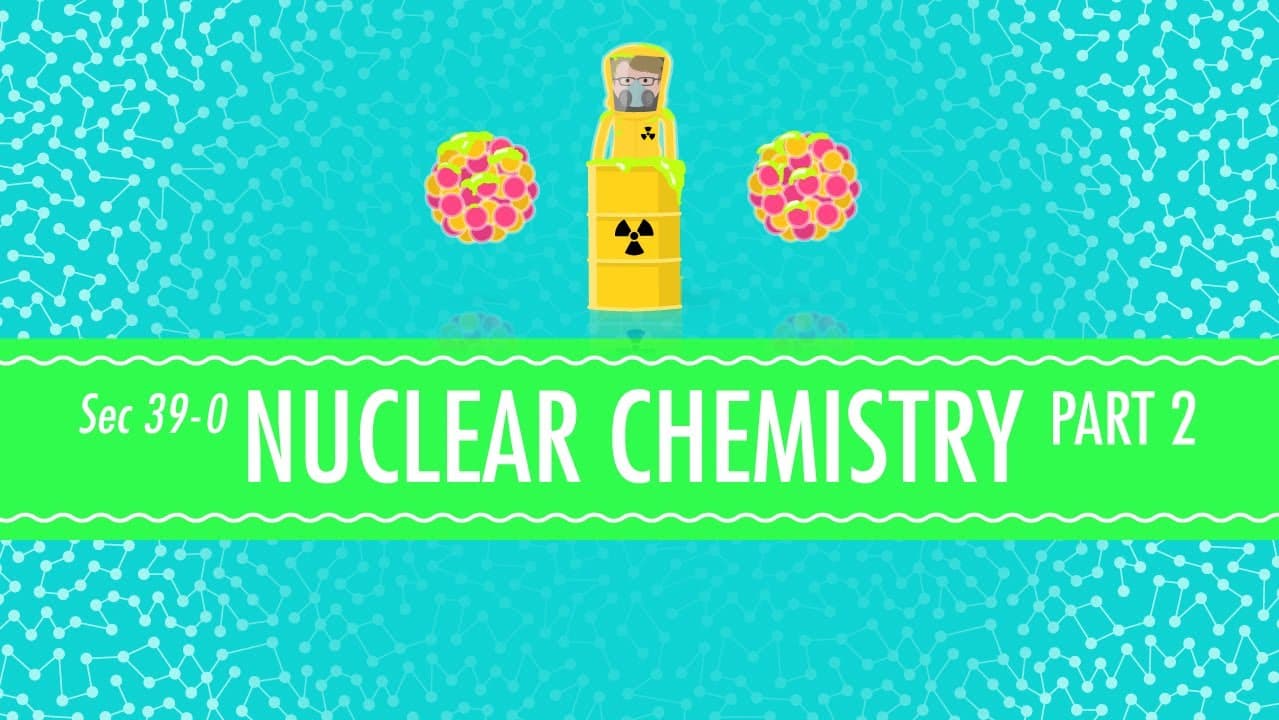
Nuclear Chemistry Part 2 - Fusion and Fission: Crash Course Chemistry #39
TL;DR
Explains nuclear fusion and fission, including E=mc2 and real-world applications.
Transcript
As I said before chemistry is, like many aspects of your own life, all about a search for stability. Last week we talked about radioactive decay and how atomic nuclei get rid of various particles in order to become more stable. But what is this illusive stability that all things seem to be striving for exactly? In nuclear chemistry it simply has to... Read More
Key Insights
- Nuclear chemistry seeks stability by understanding how atomic nuclei can release energy through binding energy, which is calculated using E=mc2.
- The mass-energy equivalence formula, E=mc2, shows that mass is interchangeable with energy, explaining powerful energy sources.
- Mass defect is the missing mass in a nucleus, existing as energy that holds nucleons together, crucial for nuclear reactions.
- Fission splits a large nucleus into lighter ones, while fusion combines light nuclei into a heavier one, both seeking stability.
- Fission is used in power plants and weapons, primarily with uranium-235, but requires control to prevent dangerous chain reactions.
- Fusion reactions release more energy than fission but are hard to control, making them impractical for energy generation currently.
- Fusion powers the sun through hydrogen and helium reactions, but requires extremely high temperatures and pressures.
- Nuclear reactions produce radioactive byproducts with varying half-lives, posing long-term environmental challenges.
Install to Summarize YouTube Videos and Get Transcripts
Explore YouTube Video Summarizer or Get YouTube Transcript Extractor
Questions & Answers
Q: What is the significance of E=mc2 in nuclear chemistry?
E=mc2, the mass-energy equivalence formula, is crucial in nuclear chemistry as it explains how mass can be converted into energy. This principle underlies the energy release in nuclear reactions, such as fusion and fission, where mass defects in nuclei are converted into binding energy, powering reactions and applications like nuclear power and weapons.
Q: How does mass defect relate to nuclear stability?
Mass defect refers to the difference between the mass of a nucleus and its individual nucleons. This 'missing mass' is present as binding energy, holding the nucleus together. A higher binding energy, indicated by a larger mass defect, generally means a more stable nucleus, as it requires more energy to break apart, influencing nuclear reaction dynamics.
Q: What are the main differences between fission and fusion reactions?
Fission involves splitting a large nucleus into smaller ones, releasing energy and often used in nuclear power and weapons. Fusion, conversely, combines light nuclei into a heavier one, releasing more energy than fission but requiring extreme conditions, like high temperatures and pressures, making it difficult to control for practical energy generation.
Q: Why is fusion considered a challenging energy source?
Fusion is challenging as it requires extremely high temperatures and pressures to overcome the repulsion between positively charged nuclei. These conditions are difficult to achieve and maintain on Earth, making controlled fusion reactions for energy generation impractical currently, despite their potential for producing large amounts of energy with minimal radioactive waste.
Q: What is the role of control rods in nuclear reactors?
Control rods in nuclear reactors are crucial for managing fission reactions. Made of materials that absorb neutrons, they are inserted between fuel rods to slow down the reaction by reducing the number of neutrons available to sustain the chain reaction, preventing runaway reactions and potential meltdowns by controlling the reactor's heat output.
Q: What environmental challenges do nuclear reactions pose?
Nuclear reactions produce radioactive byproducts with varying half-lives, posing long-term environmental challenges. Short-lived isotopes release intense radiation quickly, while long-lived isotopes persist, remaining hazardous for millions of years. Managing this radioactive waste safely is crucial to minimize environmental impact and ensure public safety, requiring secure storage and disposal solutions.
Q: How does the sun utilize fusion, and what are its byproducts?
The sun utilizes fusion by combining hydrogen nuclei into helium under high temperatures and pressures, releasing vast amounts of energy that powers the sun. This process involves intermediate steps, producing isotopes like deuterium and helium-3, and emits energy as gamma radiation. The fusion cycle is not self-sustaining, requiring continuous hydrogen fuel.
Q: What potential innovations could arise from nuclear chemistry?
Nuclear chemistry holds potential for innovations in energy production, particularly if controlled fusion becomes feasible. Fusion offers a cleaner, more abundant energy source with minimal radioactive waste compared to fission. Advances in materials and technology to achieve and contain the extreme conditions needed for fusion could revolutionize sustainable energy solutions, reducing reliance on fossil fuels.
Summary & Key Takeaways
-
Nuclear chemistry is about achieving stability through reactions like fusion and fission, explained by binding energy and E=mc2. Fusion combines light nuclei, releasing vast energy but is hard to control. Fission splits heavy nuclei, used in power plants and weapons, requiring control to prevent chain reactions.
-
Mass defect represents the missing mass in a nucleus, existing as binding energy. Fission reactions use uranium-235, producing radioactive byproducts with long half-lives. Fusion, though powerful, is hard to harness due to extreme conditions needed, unlike fission, which is more manageable but risky.
-
Fusion powers the sun by combining hydrogen into helium, requiring high temperatures and pressures. Nuclear reactions produce radioactive waste, posing environmental challenges. Understanding these processes opens opportunities for innovation in energy production, balancing benefits with risks.
Read in Other Languages (beta)
Share This Summary 📚
Summarize YouTube Videos and Get Video Transcripts with 1-Click
Try YouTube Summary with ChatGPT & Claude or YouTube Transcript Generator
Explore More Summaries from CrashCourse 📚




Summarize YouTube Videos and Get Video Transcripts with 1-Click
Try YouTube Summary with ChatGPT & Claude or YouTube Transcript Generator