How to Write a Cover Letter That Gets Interviews
TL;DR
Hook the recruiter with a researched, relatable connection to the company, then support that interest with achievements directly tied to the role. Remove information already covered by your resume, use concise paragraphs and generous white space, and include the relevant job title below your name so automated scans can recognize an important keyword.
Transcript
- When it comes to landing a first round interview, your resume might be more important than a cover letter in all ways but one. A good cover letter evokes emotion in the reader. Something even the best resume cannot do. So in this video, I'm gonna show you the three key things my friend Amanda did in her cover letter that ultimately landed her mul... Read More
Key Insights
- A strong cover letter creates an emotional impression that a resume may not provide. It cannot guarantee an offer, but a poor letter can prevent an applicant from reaching the first-round interview, making relevance and execution important from the opening sentence.
- The opening paragraph is the most important part of the cover letter because it determines whether the recruiter continues reading. A useful hook identifies a common perception, challenges it, and introduces a specific reason the applicant believes the target company stands apart.
- Company research is essential for producing a credible hook. Applicants should speak with a minimum of three industry professionals and ask targeted questions, such as what they find most rewarding about their roles, to gather concrete examples instead of generic descriptions.
- Customer-review platforms can accelerate product research when the target role involves software such as Google Ads, Facebook Ads, Office 365, Amazon AWS, or Salesforce CRM. Testimonials and reviews on G2 or Capterra can provide a basic understanding of the product in a short time.
- A company connection must be relatable to the recruiter or hiring manager. An Apple applicant, for example, could discuss the company's emphasis on privacy and its effect on advertising instead of claiming they will invent the next major iPhone idea.
- Every sentence in a cover letter should serve a clear purpose. Basic introductions, current employment details, and statements that merely announce the application can be omitted when the resume and online form already provide that information.
- Relevant achievements should match the responsibilities and evaluation criteria of the target role. Amanda highlights two consulting internships, work on a $2 million project, problem-solving ability, project management, and reliable deadline performance rather than listing every skill she possesses.
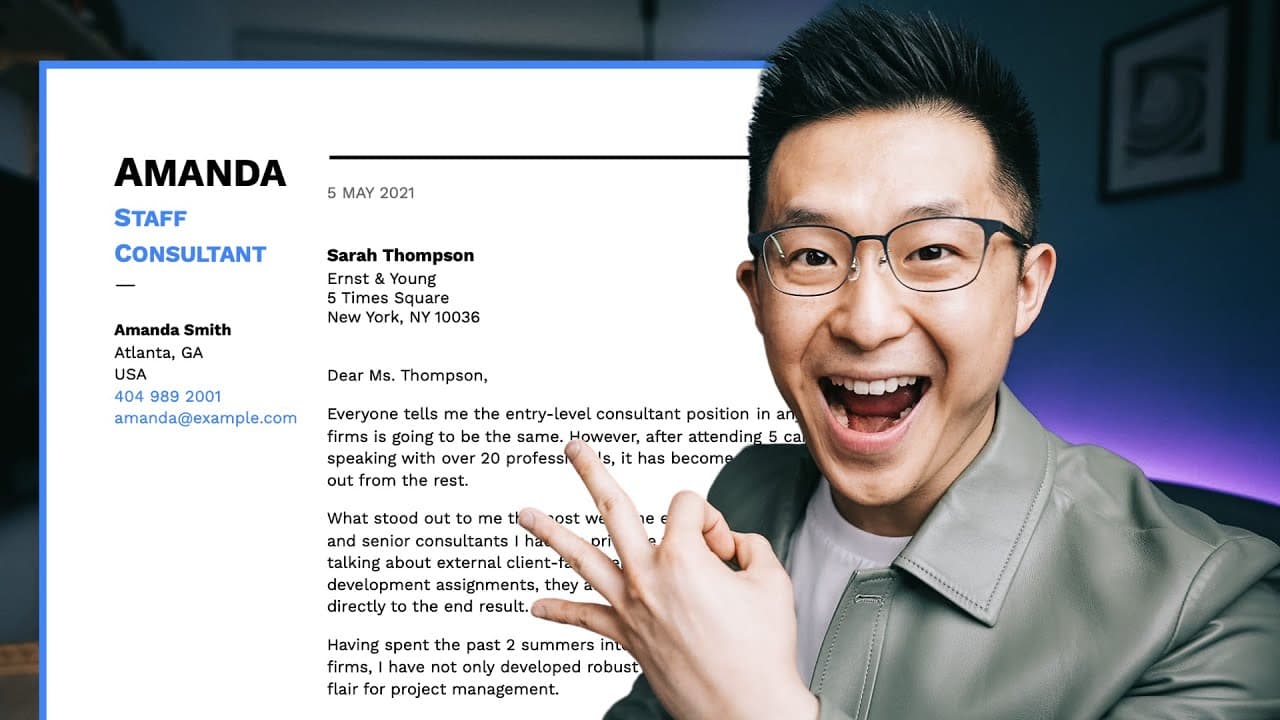
- Simple formatting and white space improve readability while preserving room for essential information. A separate name-and-address column, restrained colored accents, a relevant job title, and a header with smaller letters after each initial can create a distinctive but professional presentation.
Install to Summarize YouTube Videos and Get Transcripts
Explore YouTube Video Summarizer or Get YouTube Transcript Extractor
Questions & Answers
Q: How do you write a cover letter that gets interviews?
Begin with a researched connection to the company that gives the recruiter a reason to continue reading. Expand that connection in the next paragraph, then present achievements that directly match the role's responsibilities. Remove facts already visible in the resume or application, keep every sentence purposeful, and use a concise template with clear structure and generous white space.
Q: How should you hook a recruiter in a cover letter?
Open with a company-specific observation that challenges a familiar assumption or reveals a meaningful distinction. Amanda notes that people describe entry-level positions at Big 4 firms as similar, then explains that career fairs and conversations with more than 20 professionals showed her that EY stood apart. This structure demonstrates curiosity, initiative, and informed interest while creating anticipation.
Q: What research should you do before writing a cover letter?
Speak with a minimum of three industry professionals and ask targeted questions that produce specific examples. Instead of requesting a generic description of daily work, ask what the person finds most rewarding about the role. If the position involves a software product, review customer testimonials on G2 or Capterra to develop a basic understanding of that product quickly.
Q: What information should a cover letter include?
Include a compelling connection to the company, evidence explaining why that connection matters, and achievements aligned with the position's central responsibilities. Amanda uses two consulting internships, a $2 million project, problem-solving and project-management experience, and recognition for meeting deadlines. Close by thanking the reader, reaffirming interest, and briefly reinforcing the value you could bring to the company.
Q: What information should you remove from a cover letter?
Remove introductions and background facts that the recruiter can already find in the resume or online application. Statements such as your name, current workplace, and the fact that you are applying consume space without strengthening your candidacy. Also omit secondary skills when more relevant evidence is available, because each sentence should support the case for a first-round interview.
Q: How can a recent graduate improve a cover letter?
A recent graduate should invest particular effort in the opening paragraph, especially when lacking some of the experience requested for the position. The letter needs to show that motivation, energy, willingness to learn, and genuine company knowledge can make the applicant a stronger addition than someone with more experience whose application fails to communicate clear interest or personality.
Q: How should a professional cover letter be formatted?
Use a simple, concise layout with enough white space to make the document inviting and easy to scan. A separate column for the name and address can avoid awkward empty areas, while restrained colored accents can add personality without undermining professionalism. The content should remain structured, readable, and limited to information that directly supports the application.
Q: Why should a job title appear below your name?
A relevant job title below the applicant's name can provide a useful keyword when the uploaded cover letter is scanned by automated systems. The title also immediately connects the document to the intended role. For an additional visual detail, the first letters in the header can remain two font sizes larger than the following letters, creating a distinctive but professional appearance.
Summary & Key Takeaways
-
A strong opening connects the applicant to the company through specific research rather than generic enthusiasm. Speaking with at least three industry professionals, asking targeted questions, and reviewing customer feedback for software products can uncover concrete details that make the connection credible, relevant, and interesting enough to keep a recruiter reading.
-
Every sentence should advance the case for granting a first-round interview. The body should expand on the opening connection and present achievements that match the position's central responsibilities. Amanda emphasizes a $2 million project, project management, problem solving, and dependable deadline performance because those details matter for the consulting role.
-
A simple, concise template with generous white space makes the letter easier to read. A separate column can organize the name and address, while restrained color adds personality without losing professionalism. Placing a relevant job title below the applicant's name supplies a keyword that automated scanning systems may identify.
Read in Other Languages (beta)
Share This Summary 📚
Summarize YouTube Videos and Get Video Transcripts with 1-Click
Try YouTube Summary with ChatGPT & Claude or YouTube Transcript Generator
Explore More Summaries from Jeff Su 📚
Summarize YouTube Videos and Get Video Transcripts with 1-Click
Try YouTube Summary with ChatGPT & Claude or YouTube Transcript Generator