Erik Brynjolfsson on AI, Growth, and Society
TL;DR
Digital technologies can improve exponentially, while people, organizations, and institutions adapt much more slowly. Understanding compounding helps people anticipate both rapid benefits, such as expanding computer power, and rapid dangers, such as viral spread, but every exponential trend eventually slows, saturates, or stops.
Transcript
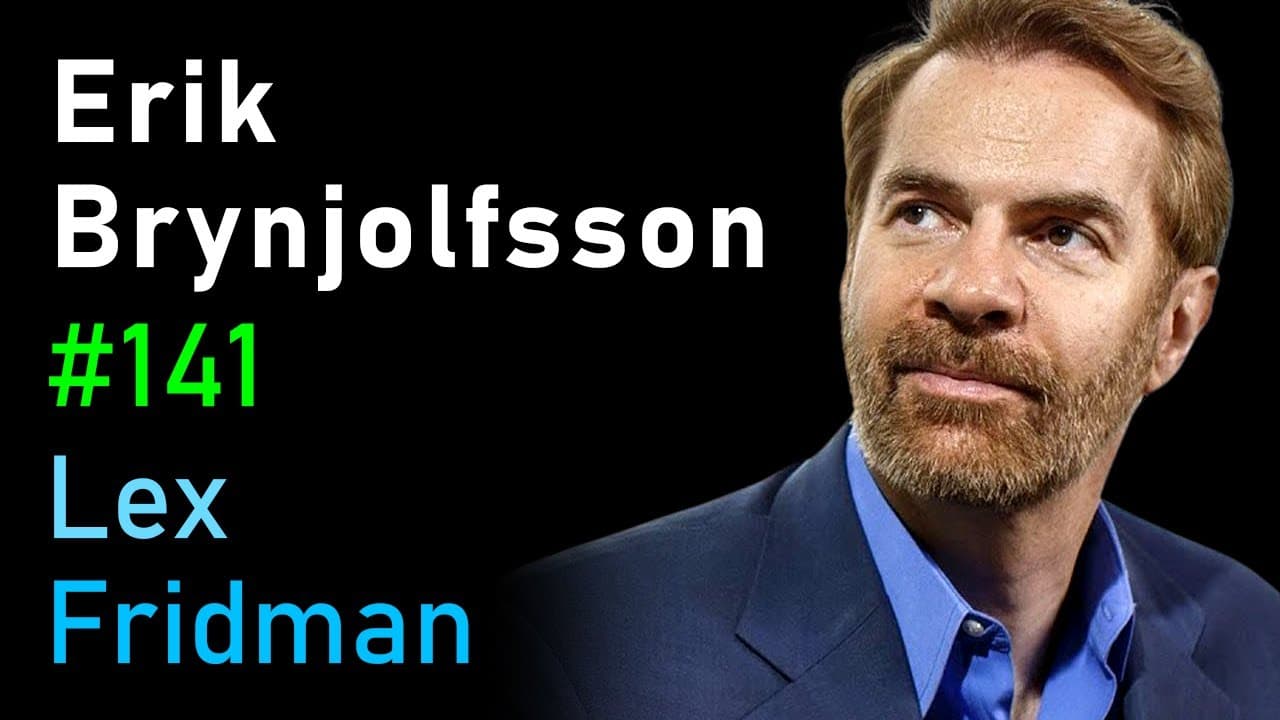
The following is a conversation with Erik Brynjolfsson. He's an economics professor at Stanford and the director of Stanford's Digital Economy Lab. Previously, he was a long, long time professor at MIT, where he did groundbreaking work on the economics of information. He's the author of many books, including The Second Machine Age and Machine Platf... Read More
Key Insights
- Exponential growth is difficult to intuit because human experience is usually linear. Walking for ten times longer produces roughly ten times the distance, while extending a sequence of doublings can produce changes of several orders of magnitude.
- Repeated doubling creates enormous outcomes from modest beginnings. Brynjolfsson recognized the danger of COVID in early March because a small number of cases doubling every two or three days could rapidly become thousands of times larger.
- Digital technologies are making exponential change more common. Growing computer power and rapid improvements in natural-language systems illustrate why assumptions based on calm, gradual progress can lead people to underestimate how quickly capabilities may develop.
- Human adaptation is not exponential. Learning, organizational change, and institutional evolution generally move more slowly than digital technologies, creating a widening mismatch between technical capabilities and society's capacity to use, govern, or respond to them.
- The technology-institution mismatch is a source of social problems. Brynjolfsson links rapidly changing technologies and slowly adapting systems to growing inequality and dysfunction within political and economic institutions, rather than treating technical progress as automatically beneficial.
- First-principles thinking improves decisions about exponential trends. Understanding the underlying mathematics and questioning assumptions can reveal plausible outcomes that initially feel counterintuitive, including explosive viral spread or order-of-magnitude improvements in technological performance.
- Experience with fast-moving technology can strengthen exponential intuition. People working around Silicon Valley, artificial intelligence, and computer research encounter compounding progress frequently, although Brynjolfsson emphasizes that even experienced observers can still underestimate advances such as GPT-3.
- Every exponential trend eventually stops or becomes an S-curve. A specific technology cannot compound forever because it encounters limits, but continued progress can emerge from a succession of distinct technological revolutions stacked upon earlier advances.
- More videos with Erik Brynjolfsson:
Install to Summarize YouTube Videos and Get Transcripts
Explore YouTube Video Summarizer or Get YouTube Transcript Extractor
Questions & Answers
Q: Why is exponential growth difficult for people to understand?
Exponential growth conflicts with the linear patterns people commonly experience. If someone walks for ten minutes instead of one minute, the distance is roughly ten times greater. A process that doubles across ten comparable periods grows by about a thousand times instead. Because ordinary intuition is shaped by linear physical experiences, repeated doubling can produce outcomes that feel implausible until the mathematics is calculated directly.
Q: How did exponential thinking reveal the danger of COVID?
Brynjolfsson became alarmed in early March when there were only a small number of known cases because they appeared to be doubling every two or three days. He understood that continuing this pattern would quickly multiply cases by thousands. His concern came from calculating the compounding process rather than judging the immediate situation, which still looked calm enough that few people around him were wearing masks.
Q: How do digital technologies create exponential change?
Digital technologies can improve through repeated increases in computing capability, creating progress that compounds rather than advancing at a constant rate. Brynjolfsson saw this pattern while plotting computer power across industries as a graduate student in the late 1980s and early 1990s. Extending those curves suggested that the economy would eventually have orders of magnitude more computing power, which later occurred.
Q: Why can technological progress feel linear in the moment?
Technological change can feel calm and gradual because people experience it one day at a time and adapt their expectations as new capabilities arrive. Over several years, however, accumulated changes in the internet, artificial intelligence, social media, and computing can be substantial. Looking only at the present moment obscures the compounding process, so retrospective comparison and explicit mathematical reasoning are needed to recognize its scale.
Q: What is the mismatch between technology and institutions?
The mismatch arises because digital technologies can change at exponential rates while people, organizations, and institutions generally adapt much more slowly. Human learning and institutional reform do not automatically keep pace with rapidly expanding technical capabilities. Brynjolfsson argues that this difference contributes to inequality and dysfunction in economic and political systems, particularly when society continues using assumptions and structures designed for a slower technological environment.
Q: How does first-principles thinking help with exponential growth?
First-principles thinking helps by replacing inherited assumptions and unreliable intuition with direct examination of underlying facts and mathematics. A person can calculate what repeated doubling implies even when the result feels surprising. Brynjolfsson connects this approach to Elon Musk's habit of questioning past assumptions, seeking order-of-magnitude improvements, and setting ambitious deadlines, while acknowledging that Musk's initial delivery estimates are often too optimistic.
Q: Does exponential growth continue forever?
Exponential growth does not continue forever. Brynjolfsson says that every exponential process eventually stops, changes form, or encounters saturation, producing an S-shaped curve rather than endless acceleration. COVID growth, for example, could not keep expanding at the same rate once it began saturating the available population. Recognizing limits is therefore as important as recognizing the powerful early effects of repeated doubling.
Q: How can technological progress continue if individual trends stop?
Broader progress can continue when a sequence of technological revolutions creates multiple S-curves that build upon one another. A particular method is developed, improved, and pushed toward its limits. Researchers and engineers then search for another innovation that opens a new path for advancement. What appears to be one long exponential curve can therefore represent several distinct waves of improvement stacked over time.
Summary & Key Takeaways
-
Erik Brynjolfsson argues that people routinely underestimate exponential change because everyday experience encourages linear intuition. A quantity that repeatedly doubles quickly reaches scales that feel implausible at first. COVID provided a dangerous example, while decades of increasing computer power demonstrate how the same mathematical pattern can produce valuable technological capabilities.
-
Digital progress creates a mismatch because technology can change exponentially while human learning, organizational practices, and social institutions move much more slowly. Brynjolfsson connects this gap to inequality and dysfunction in political and economic systems. Better mathematical understanding and repeated exposure to rapid technological development can improve judgment, although intuition remains imperfect.
-
Exponential growth never continues forever. Individual technologies eventually encounter limits and form S-curves, but broader progress can continue when successive innovations create overlapping waves of improvement. First-principles reasoning helps reveal these possibilities by testing inherited assumptions, calculating consequences directly, and considering whether a new approach could deliver an order-of-magnitude improvement.
Read in Other Languages (beta)
Share This Summary 📚
Summarize YouTube Videos and Get Video Transcripts with 1-Click
Try YouTube Summary with ChatGPT & Claude or YouTube Transcript Generator
Explore More Summaries from Lex Fridman 📚



Summarize YouTube Videos and Get Video Transcripts with 1-Click
Try YouTube Summary with ChatGPT & Claude or YouTube Transcript Generator