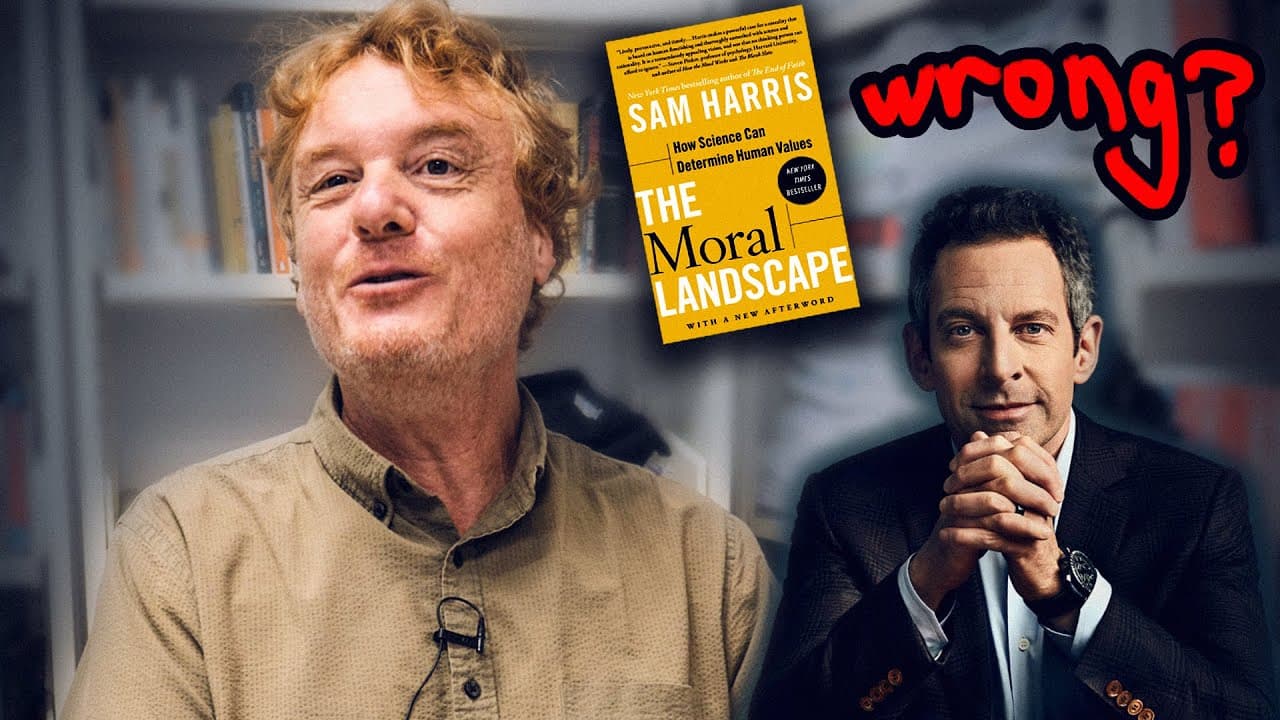
Why Is Sam Harris Wrong About Morality in 'The Moral Landscape'?
TL;DR
Sam Harris confuses morality with well-being, suggesting that understanding human flourishing equates to moral truths, which is flawed. Wittgenstein's insights reveal that morality is a relative and communicative discourse rather than an absolute truth. This approach highlights the dangers of moral absolutism and affirms the value of amoral perspectives in law and society.
Transcript
you mentioned the definition of moralities kind of problematic in the moral landscape in the book so can you tell me about this um yes i think what the book does it conflates two things on the one hand um really one major intention of harry's is is to point out that there are moral truths and that there is something like a universal morality that i... Read More
Key Insights
- 💁 Morality is a form of communication that often burdens legal processes unnecessarily with moral judgment.
- 🪩 Harris's secular moral reasoning mirrors religious absolutism, causing confusion and inconsistency.
- 👋 Wittgenstein's distinction between relative and absolute "good" underscores the fallacy in Harris's approach.
- 👮 Law stabilizes expectations in society without moralizing actions, showcasing the efficacy of amoral regulation.
Install to Summarize YouTube Videos and Get Transcripts
Explore YouTube Video Summarizer or Get YouTube Transcript Extractor
Questions & Answers
Q: How does Harris conflate morality and well-being in "The Moral Landscape"?
Harris equates moral truths with scientific truths, combining universal morality and well-being, thereby creating confusion and logical errors.
Q: What is the difference between relative and absolute notions of "good" according to Wittgenstein?
Wittgenstein distinguishes between relative "good" concerning specifics like tasks and absolute "good" unrelated to any specific criterion, highlighting the error in conflating the two, as Harris does.
Q: Why is Harris critiqued for his utilitarian calculus approach to morality?
Harris's utilitarian calculus fails to consider the limitations of relative well-being assessments and mistakenly assumes an absolute moral truth that can be optimized, a flawed approach to morality.
Q: How does Harris's approach to morality relate to his critique of religion?
While Harris effectively critiques religious fundamentalism, his moralizing approach replicates religious tendencies, signaling a need for better discernment in his moral theory.
Summary & Key Takeaways
-
Harris's book 'The Moral Landscape' combines moral truths and scientific truths causing confusion.
-
Wittgenstein's distinction between relative and absolute "good" highlights the confusion Harris creates.
-
Understanding morality as communication, not absolute truth, provides a new perspective.
Read in Other Languages (beta)
Share This Summary 📚
Summarize YouTube Videos and Get Video Transcripts with 1-Click
Try YouTube Summary with ChatGPT & Claude or YouTube Transcript Generator
Explore More Summaries from Carefree Wandering 📚
Summarize YouTube Videos and Get Video Transcripts with 1-Click
Try YouTube Summary with ChatGPT & Claude or YouTube Transcript Generator