How ts-rust rewrites TypeScript in Rust and speeds up checks
TL;DR
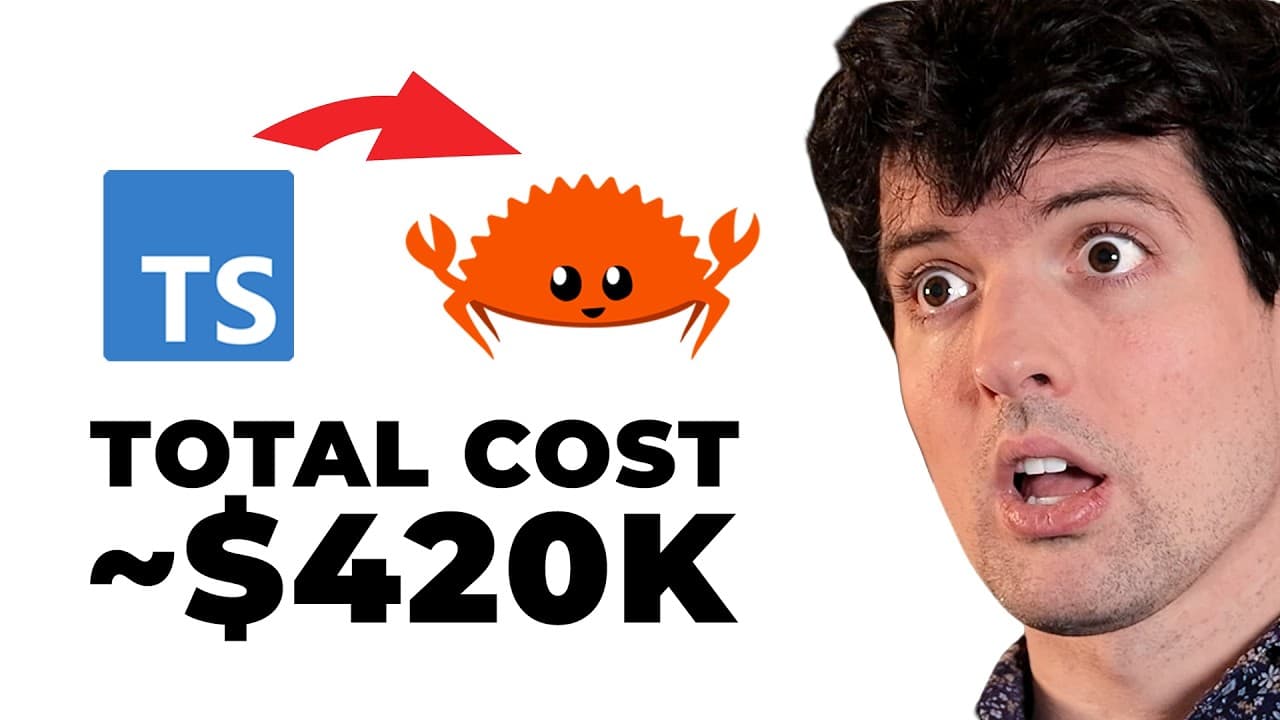
ts-rust is a Rust rewrite of the TypeScript compiler, checker, and LSP, claimed to be faster than TypeScript v6 and v7. The creator spent about $420k on tokens to build it, highlights a quick two week path with Opus funds, and compares its speed to Bun and official Microsoft tools, while noting open source, npm availability, and a live demo.
Transcript
Announcing TSC RS aka Typescript Rust. My complete rewrite of the TypeScript compiler, Type Checker, and LSP all in Rust. This is a project I've had agents working on for 5 months now. I burned $400,000 of codeex tokens and got nowhere. I burned $20,000 of Opus 5.5 and I got there in 2 weeks. An important note, I have not read a single line of code... Read More
Key Insights
- ts-rust is a complete rewrite of the TypeScript compiler in Rust.
- the author reports spending 420000 on tokens and 20000 on another token in pursuit of the project
- the rewrite aims to improve speed, particularly in type checking, not just transpiling
- the project is compared to Bun and official TypeScript implementations for performance
- the goal was to achieve high compatibility with TypeScript despite the rewrite
- the video frames the project as a playground for trying new model capabilities
- the author notes a secret reason beyond RAM and speed for building the project
- the project is released with an npm package and is open for use by others
Install to Summarize YouTube Videos and Get Transcripts
Explore YouTube Video Summarizer or Get YouTube Transcript Extractor
Questions & Answers
Q: How does ts-rust claim to speed up TypeScript workflows compared to v6 and v7?
ts-rust claims it speeds up the TypeScript workflow by rewriting the TypeScript compiler, type checker, and LSP in Rust, which allows faster processing and checks than the original TypeScript implementations. The video notes measurements like 12.5x faster than TS v6 and roughly 2x faster than TS v7, suggesting significant reductions in compile and check times. This improvement is attributed to Rust performance and different internal architecture.
Q: What is the stated cost associated with developing ts-rust?
The creator states spending 420000 dollars of tokens to work on ts-rust, which is presented as the primary cost of development. Additionally, there is mention of 20000 dollars spent on another token, highlighting substantial financial inputs into the project. These figures are used to emphasize the scale of the effort and resources dedicated to the rewrite.
Q: What components of TypeScript does ts-rust rewrite, and why is this important?
ts-rust rewrites the TypeScript compiler, the type checker, and the LSP in Rust. This is important because these components handle turning TS into JavaScript, validating types, and editor tooling, which are the core performance bottlenecks. Reimplementing them in Rust aims to improve speed while preserving functionality, potentially offering faster feedback and better hot reloading.
Q: How does ts-rust compare to Bun and Microsoft’s tsc in terms of speed?
According to the video, ts-rust is faster than Bun check and around two times faster than Microsoft’s TypeScript implementation for v7. The comparison positions ts-rust as a competitive faster alternative in the TypeScript tooling space, leveraging Rust’s performance advantages over Go and JavaScript-based implementations.
Q: What sponsorship and tools are mentioned in relation to the project?
The video mentions a sponsor, Quadrant, used to illustrate vector search and retrieval benefits, and provides a link for sponsorship opportunities. It also references an npm package for ts-rust and notes that the project is open source, with a live demo and a GitHub repository where the code can be explored.
Q: What is the significance of the live vibe coding demo shown in the video?
The live vibe coding demo is presented as a demonstration of ts-rust in action, illustrating how the rewrite operates beyond theory. It serves to showcase practical performance or capabilities, offering viewers a tangible example of ts-rust handling code and potentially highlighting its speed and reliability in a real-world scenario.
Q: Why did the creator start the ts-rust project, according to the transcript?
The creator started ts-rust after encountering high inference costs and limitations with early access models, using the project as a bold playground to explore model capabilities and edge cases. The motivation included exploring impossible-feeling goals and pushing the model limits, not merely for runtime performance but to test what models could achieve in software engineering.
Q: What broader implications does the video suggest about engineering going forward with ts-rust?
The video implies ts-rust could influence how future engineering approaches compiler and tooling design, encouraging language rewrites in systems languages for performance gains. It suggests that model-driven experimentation may unlock new capabilities and affect whether companies favor native implementations, open source collaboration, or alternative runtimes for critical tools like the TypeScript checker and compiler.
Summary & Key Takeaways
-
ts-rust is a Rust rewrite of the TypeScript toolchain including the compiler, type checker, and LSP.
-
the project claims substantial speed improvements over TypeScript v6 and v7, with 12.5x faster than TS v6 and about 2x faster than TS v7
-
the video discusses costs, motivation, and a demonstration while acknowledging sponsor Quadrant and open source availability
Read in Other Languages (beta)
Share This Summary 📚
Summarize YouTube Videos and Get Video Transcripts with 1-Click
Try YouTube Summary with ChatGPT & Claude or YouTube Transcript Generator
Explore More Summaries from Theo - t3․gg 📚






Summarize YouTube Videos and Get Video Transcripts with 1-Click
Try YouTube Summary with ChatGPT & Claude or YouTube Transcript Generator