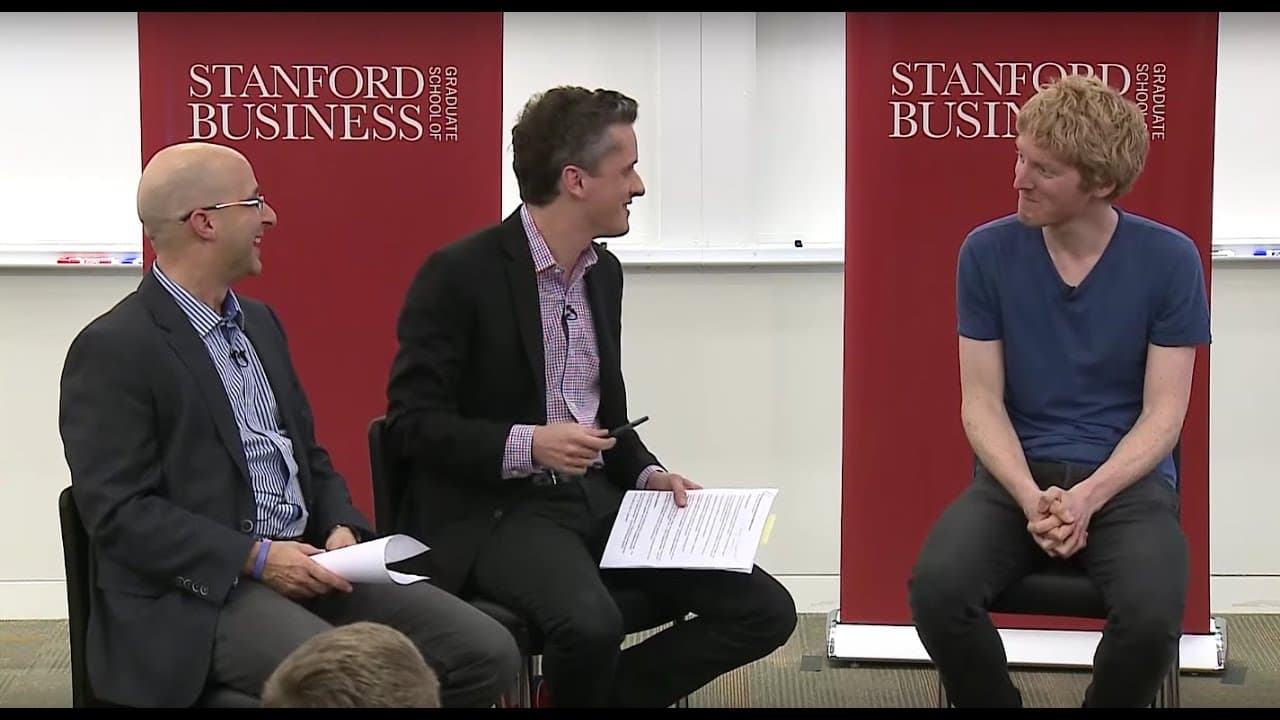
The Industrialist's Dilemma: Patrick Collison, CEO of Stripe
TL;DR
Patrick Collison and his co-founder built Stripe because, as developers, they were frustrated that accepting credit-card payments online still required bank applications, paperwork, faxes, and weeks of setup. After eight to nine months, they recognized a larger opportunity: only around 2–3% of consumer spending occurred through the internet. Read on to see how Stripe lowered that barrier and grew to roughly 350 people.
Transcript
[MUSIC] [LAUGH] Patrick Collison, CEO of Stripe, Co-Founder of Stripe. Welcome to the class. >> Thank you for having me. >> Yes. [LAUGH] Okay, so, we will get into that. I will have a way of bringing that up at the end. So just to set context, we just obviously went over some of the business and obviously the forces at play. Why don't you level set... Read More
Key Insights
- Stripe builds APIs that make it easy to build an internet business, serving technology companies whose customers purchase remotely through the internet rather than in person, acting as the conduit for those businesses' revenue and customer data.
- Before Stripe, getting access to charge a credit card programmatically involved a mortgage-like application process at a bank, requiring you to describe your idea, convince them to support it, then endure weeks of setup, paperwork, and faxes.
- The founders started Stripe out of frustration and surprise that no simple credit-card-charging tool existed, initially not believing it was a big deal while simultaneously building iPhone apps on the side under the early name /debt/payments.
- The market opportunity became clear when the founders realized only around 2-3% of total consumer spending happens through the internet, meaning roughly 97-98% is yet to be enabled, revealing massive future growth despite online commerce's veneer of maturity.
- Stripe's primary competitive advantage is simply being a better product: faster to set up and easier to understand, which lowers activation energy so more people actually experiment and pursue ideas rather than not bothering to integrate.
- Product quality traits like polish, smooth animations, and ambient superiority matter enormously even without a rigorous structural framework to describe them, which Collison argues Clayton Christensen's disruption theory struggles to explain with Apple.
- Silicon Valley is a graveyard as much as a cradle: companies like Wang and Osborne grew to billions in annualized revenue with tens of thousands of employees, yet failed so completely (Wang's 1992 bankruptcy) that people no longer even recognize their names.
- Stripe's scale as of the talk: roughly 350 people, about five years old, processing tens of billions of dollars, with 27% of Americans having bought from a Stripe user in the past year, up from 3.8% two years prior.
Install to Summarize YouTube Videos and Get Transcripts
Explore YouTube Video Summarizer or Get YouTube Transcript Extractor
Questions & Answers
Q: Why did Patrick Collison build Stripe?
Collison and his co-founder were developers who could not find a simple way to charge a credit card online. Surprised that no easy tool existed, they began building Stripe out of frustration, initially without believing it was a major opportunity.
Q: What does Stripe do?
Stripe builds APIs that make it easier to create an internet business. Its customers are technology companies that integrate those APIs into software-enabled services for purchases made remotely through the internet.
Q: How did businesses accept online payments before Stripe?
Businesses obtained payment tools and infrastructure from banks through what Collison describes as a mortgage-like application process. They had to explain their idea, persuade the bank to support it, and endure paperwork, faxes, and weeks of setup before they could programmatically charge a credit card.
Q: What was Stripe called before it became Stripe?
The project was initially known as /debt/payments. Collison and his co-founder worked on it alongside some iPhone apps because they did not initially think the payment project was a big deal.
Q: When did Stripe's founders recognize the larger opportunity?
They recognized that Stripe might be substantively interesting after about eight to nine months of work. That realization led them to take leave from school.
Q: How much consumer spending happened through the internet at the time?
Collison estimated that only around 2–3% of total consumer spending took place on or through the internet. That meant roughly 97–98% did not, suggesting that much more commerce could move online despite the appearance that online commerce was already mature.
Q: How big was Stripe at the time of the talk?
Stripe had roughly 350 people and was around five years old. Press estimates cited during the discussion said the company was processing tens of billions of dollars, though Collison framed that figure as the estimate reported in the circulated article.
Q: Why did Patrick Collison mention Wang and Osborne?
He used Wang and Osborne to emphasize that Silicon Valley can be a graveyard as well as a cradle for companies. Both reached billions of dollars in annualized revenue and tens of thousands of employees before failing, and Wang went bankrupt in 1992.
Summary
In this video, Patrick Collison, CEO of Stripe, discusses the founding and growth of Stripe and the company's disruption of the payments industry. He talks about the challenges of setting up payments before Stripe and highlights the company's focus on providing a better product and user experience. Collison also discusses the potential of the digital economy and how Stripe is enabling new types of online experiences and business models. He emphasizes the importance of staying lean and agile as the company continues to scale and navigate relationships with larger incumbents in the industry. Collison touches on the value of data and network effects in the competitive landscape and explains how Stripe benefits from a network effect within the developer community.
Questions & Answers
Q: What are the key features of Stripe's APIs?
Stripe builds APIs that make it easy for businesses to build an Internet business. These APIs enable businesses to go beyond simple online transactions and create more sophisticated payment processes, such as storing payment details for frictionless billing and supporting multiple payment mechanisms.
Q: Why did Patrick Collison and his brother start Stripe?
The Collison brothers were developers themselves and were frustrated by the lack of an easy-to-use and set-up payment solution. They couldn't understand why a simple task like charging a credit card didn't have a streamlined solution. This frustration led them to create Stripe.
Q: How did the payments process work before Stripe?
Before Stripe, online transactions were enabled by banks. Businesses had to go through a complex and time-consuming process to gain access to the tools and infrastructure needed to charge credit cards programmatically. This involved mortgage-like application processes, convincing banks to support their ideas, and extensive paperwork.
Q: What was the initial traction for Stripe?
Stripe gained initial traction because it provided a better product and user experience compared to existing solutions. It was easier to understand and set up, lowering the activation energy for businesses to experiment with it. Once businesses started using Stripe, it was also easier for them to operate ongoing business transactions.
Q: How big and successful is Stripe currently?
Stripe is around five years old, has raised significant funding, and processes tens of billions of dollars in transactions. The company has around 350 employees and has experienced significant growth. An estimated 27% of Americans bought from a Stripe user in the last year, up from 3.8% two years ago.
Q: Who are Stripe's customers?
Stripe's customers are primarily new technology companies and startups. The company is focused on supporting these businesses as they integrate payment solutions into their products and services.
Q: How does Stripe approach relationships with larger incumbents in the industry?
Stripe acknowledges that the economy is not a zero-sum game and believes there is room for both incumbents and disruptors to thrive. Rather than trying to compete with larger companies, Stripe focuses on providing a better product and experience. By bringing new transaction volume to the card networks, Stripe benefits the industry as a whole.
Q: How does Stripe think about digitizing the offline world?
Stripe sees itself as a bet on human laziness and the preference for doing things digitally rather than going to physical places. The company enables industries such as car sales to be done online through its payment solutions. Stripe believes that as the world becomes increasingly digital, more industries will adopt digital solutions, and Stripe aims to be at the forefront of this transformation.
Q: How does Stripe plan to stay lean and agile as it grows?
Stripe recognizes the challenge of maintaining agility and responsiveness as it scales. While it may not be entirely possible to avoid the risks and challenges of larger organizations, Stripe aims to leverage its position as a technology-driven company to stay nimble and innovative. The company also focuses on avoiding unnecessary risks and being deliberate with its strategy.
Q: What are the competitive advantages of Stripe?
Stripe's competitive advantage lies in providing a better product and experience for developers. The company has built a network effect within the developer community, making it easier for businesses to integrate Stripe and find developers with knowledge of the platform. Stripe is also able to expand its functionality and offer services that are not available elsewhere, such as instant payments to debit cards.
Takeaways
Stripe was founded to address the lack of an easy-to-use and set-up payment solution. The company has disrupted the payments industry by providing better products and experiences for businesses, particularly in the digital economy. Stripe enables the digitization of offline industries and aims to make transactions and interactions more convenient and efficient. As the company continues to grow, it focuses on staying agile and responsive while also maintaining relationships with larger incumbents. Stripe's competitive advantage lies in its network effect within the developer community and its ability to offer unique functionality and services.
Summary & Key Takeaways
-
Stripe builds APIs that let technology companies charge credit cards over the internet. The founders, themselves developers, were astonished nothing simple existed and started building out of frustration, initially treating it as a side project alongside iPhone apps under the early name /debt/payments.
-
Before Stripe, online payment access came through banks via a mortgage-like application process involving paperwork, faxes, and weeks of setup. The founders realized only 2-3% of consumer spending happens online, exposing vast untapped growth, prompting them to take leave from school about eight to nine months in.
-
Stripe's advantage is being a better, easier-to-set-up product that lowers activation energy, sitting at a key revenue nexus for businesses. At the talk it had about 350 people, processed tens of billions of dollars, and 27% of Americans had bought from a Stripe user, up from 3.8%.
Read in Other Languages (beta)
Share This Summary 📚
Summarize YouTube Videos and Get Video Transcripts with 1-Click
Try YouTube Summary with ChatGPT & Claude or YouTube Transcript Generator
Explore More Summaries from Stanford Graduate School of Business 📚






Summarize YouTube Videos and Get Video Transcripts with 1-Click
Try YouTube Summary with ChatGPT & Claude or YouTube Transcript Generator