Nestjs Full Course 2022 | Beginner Nestjs Tutorial
TL;DR
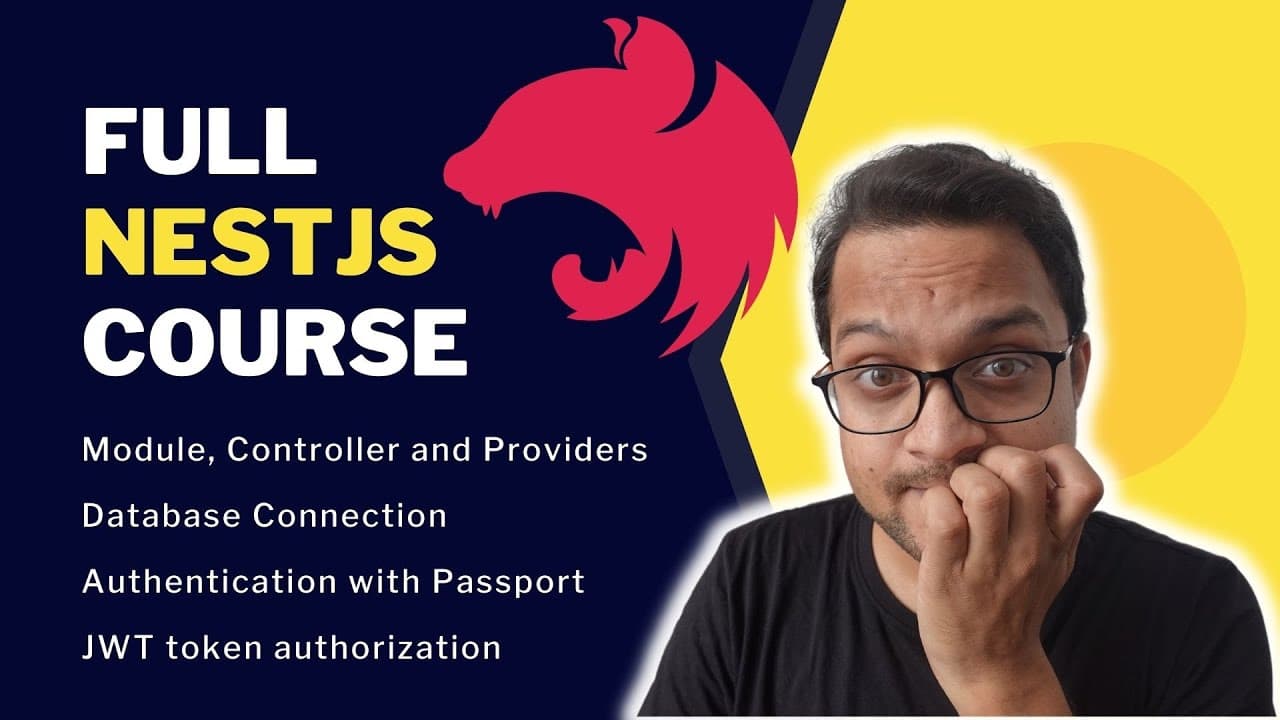
A comprehensive course on NestJS that covers topics such as getting started, directory structure, modules, controllers, dependency injection, request payloads, and more.
Transcript
welcome to this nest js amazing course where we will talk about not just how to get started with nest js but we will connect with mysql database we will understand the core component of nest js and we will also do the authentication with the passport package and the jwt to create the token everything in this episode but let's first see exactly what... Read More
Key Insights
- 🏗️ NestJS is a progressive Node.js framework for building efficient, scalable server-side applications.
- 📁 NestJS leverages TypeScript and offers features such as a structured directory layout, dependency injection, and integration with common technologies.
- *️⃣ Modules, controllers, and providers are key components of NestJS, helping organize and structure applications.
- 🏛️ Dependency injection simplifies object creation and management by allowing classes to be injected as dependencies.
- ⚾ Working with request payloads in NestJS can be simplified using decorator-based syntax and data transfer objects (DTOs).
- 📚 NestJS provides seamless integration with popular databases like MySQL, using libraries such as TypeORM.
- 👻 Authentication can be implemented using packages like passport and JWT, allowing secure access to protected routes.
Install to Summarize YouTube Videos and Get Transcripts
Explore YouTube Video Summarizer or Get YouTube Transcript Extractor
Questions & Answers
Q: What topics are covered in this NestJS course?
The course covers an introduction to NestJS, creating a new project, directory structure, modules, controllers, providers, dependency injection, working with request payloads, connecting with MySQL database, and implementing authentication using passport and JWT.
Q: How is the course structured?
The course is a mixture of hands-on training and slides with animations. It provides step-by-step instructions and examples to help learners understand and implement the concepts.
Q: Why should I use NestJS?
NestJS is a progressive Node.js framework that offers features such as efficient and scalable server-side application development, support for TypeScript, directory structure organization, and integration with common technologies and concepts. It is suitable for building large-scale applications and provides a robust framework for web development.
Q: How does dependency injection work in NestJS?
Dependency injection in NestJS allows classes to be injected as dependencies into other classes through the constructor. This simplifies object creation and management, making it easier to test and extend applications.
Q: What is the role of modules, controllers, and providers in NestJS?
Modules provide a way to organize and structure an application. Controllers handle request-response logic, and providers (or services) contain the business logic of an application. They can be injected into other classes to provide functionality.
Q: How can I connect NestJS with a MySQL database?
The course covers the topic of connecting NestJS with a MySQL database using the TypeORM library. It explains how to perform CRUD operations and work with entities using TypeORM.
Q: How is authentication implemented in NestJS?
The course demonstrates how to implement authentication using the passport package and JWT (JSON Web Tokens). It covers creating a JWT token, handling token-based authentication, and creating protected routes that require authentication.
Q: Why should I enroll in this NestJS course?
This course provides a comprehensive overview of NestJS, covering all the essential topics needed to get started with the framework. The hands-on approach, detailed explanations, and example implementations make it suitable for beginners and experienced developers alike.
Key Insights:
- NestJS is a progressive Node.js framework for building efficient, scalable server-side applications.
- NestJS leverages TypeScript and offers features such as a structured directory layout, dependency injection, and integration with common technologies.
- Modules, controllers, and providers are key components of NestJS, helping organize and structure applications.
- Dependency injection simplifies object creation and management by allowing classes to be injected as dependencies.
- Working with request payloads in NestJS can be simplified using decorator-based syntax and data transfer objects (DTOs).
- NestJS provides seamless integration with popular databases like MySQL, using libraries such as TypeORM.
- Authentication can be implemented using packages like passport and JWT, allowing secure access to protected routes.
- The course offers a comprehensive curriculum, combining hands-on training with slides and animations to facilitate learning and understanding of NestJS.
Summary & Key Takeaways
-
The course provides a hands-on training approach with slides and animations.
-
Topics covered include understanding NestJS, creating a new project, exploring the directory structure, working with modules, controllers, and providers.
-
The course also covers topics such as dependency injection, handling request payloads, connecting with MySQL database, and implementing authentication using passport and JWT.
Read in Other Languages (beta)
Share This Summary 📚
Summarize YouTube Videos and Get Video Transcripts with 1-Click
Try YouTube Summary with ChatGPT & Claude or YouTube Transcript Generator
Explore More Summaries from Bitfumes 📚
Summarize YouTube Videos and Get Video Transcripts with 1-Click
Try YouTube Summary with ChatGPT & Claude or YouTube Transcript Generator