How to Protect an Inheritance From Family Claims
TL;DR
Recorded deeds and a living trust proved that the eight rental properties already belonged to Tegan, so her family could not give them to Ryan. Grandma Margaret had transferred the assets after finding evidence that Ryan had diverted more than $400,000 in rental income, and Tegan protected her ownership by relying on documents, refusing manipulation, and maintaining firm boundaries.
Transcript
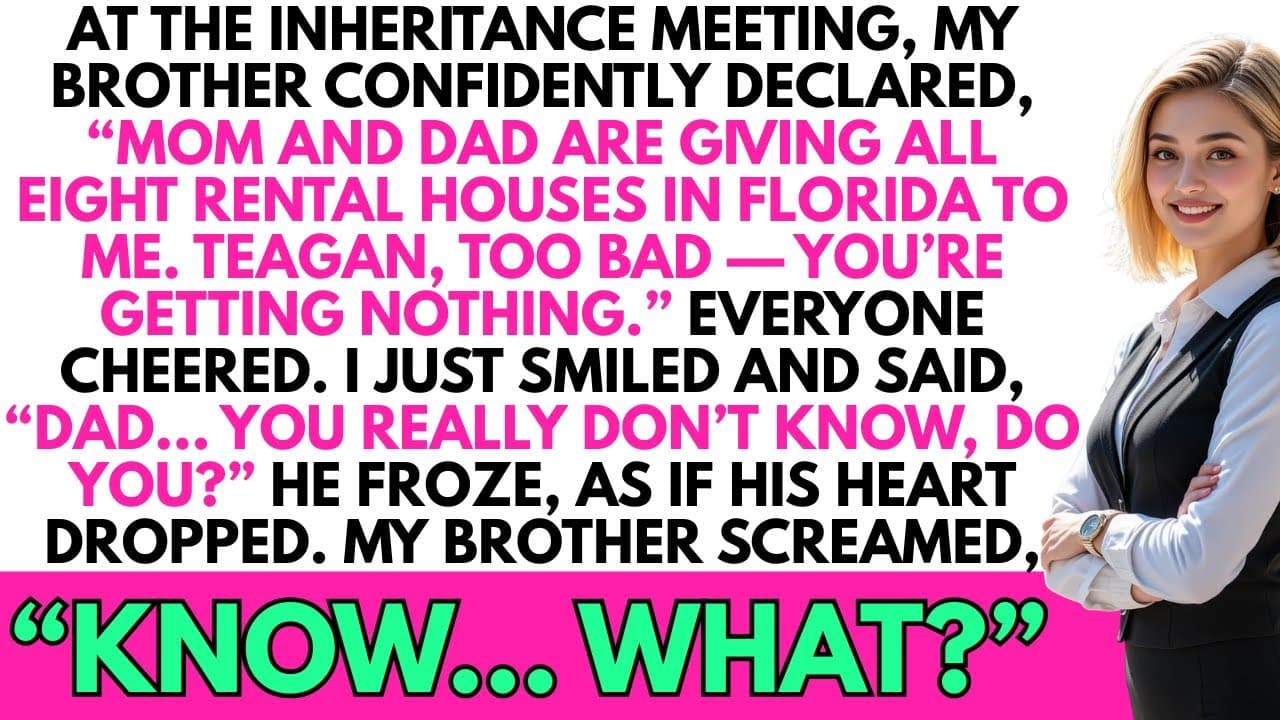
At the inheritance meeting in our family home in Tampa, my older brother Ryan stood up like he owned the room, tapped his glass, and announced with the biggest grin. Mom and dad decided to leave all eight rental properties in Florida to me. Tegan, sorry you get nothing. The room exploded. Cheers, whistles. Someone even shouted. Finally, cousins cla... Read More
Key Insights
- Tegan’s legal position is based on recorded documents, not on the family’s expectations or public announcement. The living trust and eight quit claim deeds showed that Grandma Margaret had transferred the rental properties before the inheritance gathering, leaving the family without authority to award them to Ryan.
- Grandma Margaret’s decision is driven by evidence of financial mismanagement. Bank statements, rental income logs, and expense reports showed that more than $400,000 had disappeared over 18 months through maintenance, emergency repair, and management categories with missing or illegible supporting receipts.
- Ryan’s favored status shaped the family conflict long before the inheritance dispute. Relatives praised him, parents prioritized his needs, and the family treated him as the future of the Whitaker name, while Tegan learned to build a life outside his shadow.
- Tegan’s professional knowledge is central to her ability to understand the transfer. Her commercial real estate work taught her about deeds, trusts, ownership, cap rates, and lease records, giving Grandma Margaret confidence that Tegan could understand both the documents and the responsibilities attached to the properties.
- Grandma Margaret viewed the properties as homes supporting 32 tenant families, not merely as wealth. She chose Tegan because she believed Tegan would preserve that stability instead of risking the portfolio on boats, parties, or other personal spending associated with Ryan’s behavior.
- Secrecy protected Grandma Margaret’s plan until the transfer could no longer be undone through family pressure. Tegan promised not to disclose the trust and deeds until someone attempted to claim assets that were no longer available for the family to distribute.
- Tegan’s response demonstrates that firm boundaries do not require an emotional confrontation. She remained calm when Ryan announced that she would receive nothing, relied on the ownership records, refused manipulation, and walked away without seeking reconciliation from relatives who had celebrated her exclusion.
- The story’s central principle is that paper beats promises when ownership is disputed. Family assumptions, praise, and rehearsed announcements could not override the trust and recorded deeds that documented Grandma Margaret’s decision and established Tegan’s ownership of all eight rental properties.
Install to Summarize YouTube Videos and Get Transcripts
Explore YouTube Video Summarizer or Get YouTube Transcript Extractor
Questions & Answers
Q: How did Tegan prove that the rental properties belonged to her?
Tegan relied on a revocable living trust and eight quit claim deeds prepared at Grandma Margaret’s direction three years before the inheritance gathering. Tegan signed the documents with two witnesses and a trusted notary present, and the deeds were recorded with the county. Those records listed Tegan as the owner, so Ryan’s announcement and the family’s plans could not change the documented transfer.
Q: Why did Grandma Margaret transfer the properties to Tegan?
Grandma Margaret believed Tegan understood both real estate and the responsibilities of ownership. She emphasized that the properties housed 32 families whose children depended on stable homes and schools. She also trusted Tegan not to gamble away the portfolio on boats, parties, or new toys. Tegan’s commercial real estate experience and clear judgment made her the person Margaret considered capable of protecting the properties.
Q: What financial problems did Grandma Margaret discover?
Grandma Margaret showed Tegan bank statements, rental income logs, and expense reports covering the eight properties. The records indicated that more than $400,000 in rent money had disappeared during the previous 18 months. The funds were assigned to maintenance, emergency repairs, and management fees, but receipts were missing or repeatedly photocopied until illegible, and handwriting on the remaining documents matched Ryan’s.
Q: Why did Grandma Margaret keep the property transfer secret?
Grandma Margaret expected Tegan’s parents to defend Ryan if she confronted him about the missing rental income. She believed they would excuse his conduct, say he would repay the money someday, and allow the portfolio to keep losing value. Keeping the trust and deeds private prevented family pressure from interfering before the ownership transfer was completed and recorded.
Q: How did Tegan’s career prepare her for the inheritance conflict?
Tegan worked at a commercial real estate firm in Atlanta, beginning as a junior analyst and later becoming a senior property analyst. Her work taught her how deeds, trusts, lease abstracts, cap rates, and ownership transfers functioned. That experience allowed her to review the rental records, recognize suspicious expenses, understand Grandma Margaret’s documents, and appreciate the obligations connected to managing tenant homes.
Q: Why did Ryan believe he would receive all eight properties?
Ryan had long been treated as the favored child and the future of the Whitaker family name. He stayed in Florida, helped manage Grandma Margaret’s rentals after graduation, collected rent checks, and publicly described the portfolio as his own. Tegan’s parents and relatives praised his supposed responsibility, while nobody checked the county records showing that ownership had already moved to Tegan.
Q: How did Tegan respond when Ryan publicly claimed the inheritance?
Tegan did not clap, argue, or react emotionally when Ryan announced that he would receive all eight rental properties and that she would get nothing. She looked directly at her father and calmly asked whether he had forgotten something. She then relied on the recorded deeds and living trust proving that the properties already belonged to her, refused further manipulation, and protected her boundaries.
Q: What lesson does Tegan’s inheritance dispute teach about family boundaries?
The dispute shows that protecting personal rights does not make someone selfish, especially when relatives benefit from that person’s silence. Tegan did not seek revenge or approval after her family celebrated her exclusion. She used valid documents, refused pressure, protected the tenants and properties, and walked away without forcing reconciliation. Her response placed self-respect and responsibility above preserving a false appearance of family peace.
Summary & Key Takeaways
-
Tegan grew up in Ryan’s shadow, receiving little recognition from parents who consistently favored her older brother. She eventually left Tampa, earned a full scholarship, built a commercial real estate career in Atlanta, and maintained a close relationship with Grandma Margaret, the only relative who respected her judgment without comparing her to Ryan.
-
Grandma Margaret discovered that more than $400,000 in rental income had disappeared over 18 months through questionable maintenance, repair, and management expenses linked to Ryan. Expecting Tegan’s parents to defend him, she created a revocable living trust and recorded eight quit claim deeds that transferred the rental properties to Tegan.
-
When Ryan publicly claimed the eight properties at the family inheritance gathering, Tegan calmly revealed that recorded deeds and the trust had already established her ownership. She rejected the family’s manipulation, protected the tenants and properties, and returned to her independent life. Ryan later faced tax penalties and other financial consequences.
Read in Other Languages (beta)
Share This Summary 📚
Summarize YouTube Videos and Get Video Transcripts with 1-Click
Try YouTube Summary with ChatGPT & Claude or YouTube Transcript Generator
Explore More Summaries from Revenge Dark 📚


Summarize YouTube Videos and Get Video Transcripts with 1-Click
Try YouTube Summary with ChatGPT & Claude or YouTube Transcript Generator