Misorientation and orientation matrix
TL;DR
The video explains the relationship between orientation matrices and misorientation using matrix and quaternion approaches.
Transcript
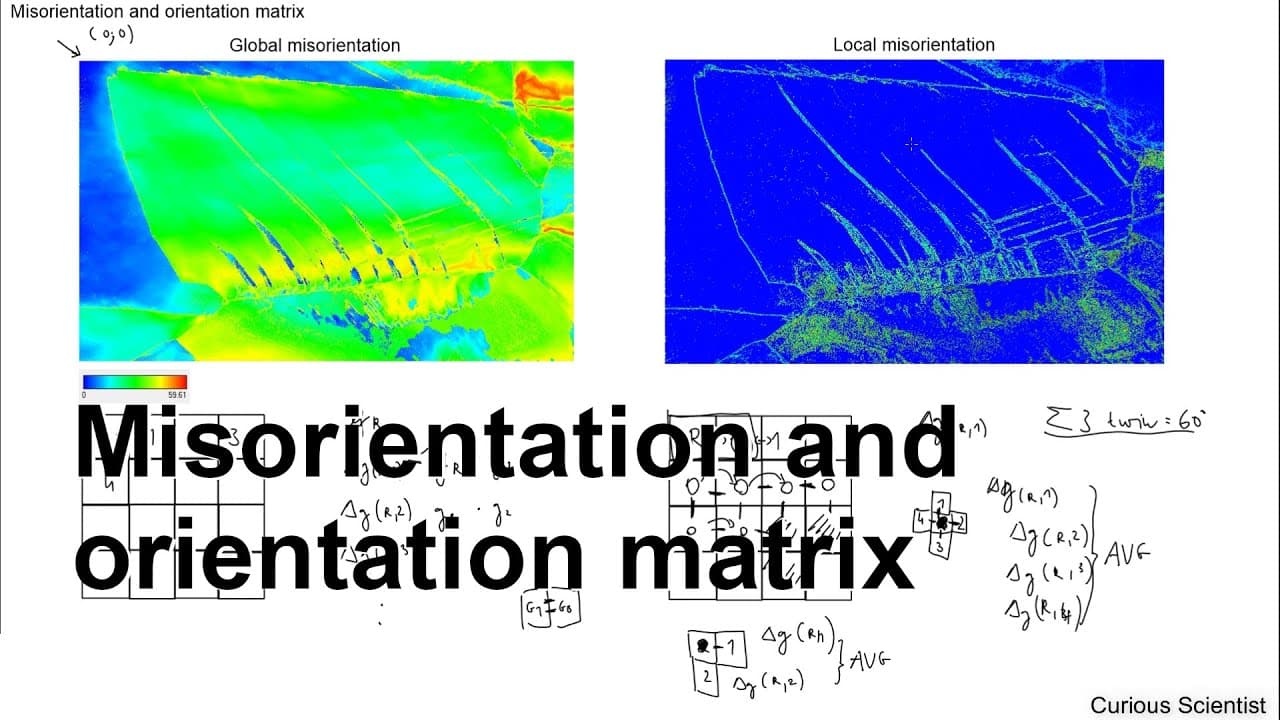
welcome everyone in this video I'm going to talk about the relationship between the orientation matrix and the miss orientation so for example we would like to know the mystery intention between two neighbor pixels on our EBS the image or two neighboring points or two different joints so we will define this by defining the miss orientation between ... Read More
Key Insights
- ❓ Misorientation is critical for understanding material properties and identifying relationships between neighboring pixels or grains.
- ❓ The matrix approach for calculating misorientation, while standard, is computationally intensive and less efficient compared to alternative methods.
- 🪡 Quaternions simplify the calculations needed for misorientation, reducing processing load and memory usage, thus appealing to computational advantages.
- 🌐 Global misorientation analysis provides an overall insight into the orientation relationships within materials, while local misorientation focuses on immediate neighborhood interactions.
- 🦾 Identifying grain boundaries using misorientation helps in discerning structural integrity, material phase transitions, and mechanical properties.
- 🔬 The quaternion approach is more elegant and expedient for computational software used in materials science, promoting better performance during data processing.
- 🔺 Angles derived from misorientation calculations can aid in categorizing grain boundaries as low or high angle, serving important roles in microstructural analysis.
Install to Summarize YouTube Videos and Get Transcripts
Explore YouTube Video Summarizer or Get YouTube Transcript Extractor
Questions & Answers
Q: What is the main purpose of calculating misorientation between pixels?
The primary goal of calculating misorientation is to understand the relationship between neighboring pixels in materials science, particularly to identify the orientation differences that can affect material properties. This information is crucial for characterizing grain boundaries and understanding the structural integrity of materials.
Q: How does the matrix approach for calculating misorientation function?
The matrix approach involves multiplying orientation matrices corresponding to neighboring pixels. It requires handling 24 symmetry matrices for each orientation, leading to 1152 calculations for a pair of neighboring orientations, which can be computationally intensive and memory-heavy due to the multiple matrix multiplications involved.
Q: Why is the quaternion approach considered more advantageous than the matrix approach?
The quaternion approach is preferred because it simplifies calculations by involving fewer operations. The inversion of quaternions is straightforward compared to that of matrices. Moreover, quaternion multiplication is less computationally taxing, making it easier to implement in software without overwhelming system resources.
Q: What are global and local misorientations, and how do they differ?
Global misorientation is determined using a fixed reference pixel and comparing it with all other pixels, which helps identify overall orientation trends. Local misorientation, on the other hand, involves moving the reference point to each pixel and comparing adjacent pixels, which provides a more detailed view of orientation changes and helps identify grain boundaries.
Q: How can misorientation help in identifying grain boundaries?
Misorientation calculations reveal the angular differences between neighboring pixels. When a significant misorientation angle is detected, it often indicates the presence of a grain boundary, which typically shows distinct orientation characteristics. By mapping these angles, one can classify the type and behavior of the boundary.
Q: What is the significance of using Euler angles in the quaternion approach?
Euler angles provide a way to represent the orientation of a pixel or grain in three-dimensional space. They can be converted into quaternion components easily. By using these angles, one can effectively compute quaternion values, facilitating the efficient calculation of misorientation while retaining the spatial relationships of the material.
Q: What role does the trace of a matrix play in finding misorientation angles?
The trace of a matrix, which is the sum of its diagonal elements, is used in calculating misorientation angles by providing critical information about the orientation relationships. By applying specific equations to the trace, one can derive the cosine of the angle, leading to the determination of the misorientation angle required for further analysis.
Summary & Key Takeaways
-
The video introduces the concepts of misorientation, focusing on how it is calculated between two neighboring points or pixels using orientation matrices.
-
It discusses two main methods for calculating misorientation: the matrix approach, which involves extensive calculations, and the quaternion approach, which simplifies the process significantly.
-
A comparison between global and local misorientations is provided, illustrating how these concepts can be applied to understand grain boundaries in materials science.
Read in Other Languages (beta)
Share This Summary 📚
Summarize YouTube Videos and Get Video Transcripts with 1-Click
Try YouTube Summary with ChatGPT & Claude or YouTube Transcript Generator
Explore More Summaries from Curious Scientist 📚
![Building a coil winder [Part 6] - A few improvements thumbnail](/_next/image?url=https%3A%2F%2Fi.ytimg.com%2Fvi%2F3eyxG_g2iUA%2Fhqdefault.jpg&w=750&q=75)



Summarize YouTube Videos and Get Video Transcripts with 1-Click
Try YouTube Summary with ChatGPT & Claude or YouTube Transcript Generator