Noam Chomsky: Deepest Property of Language
TL;DR
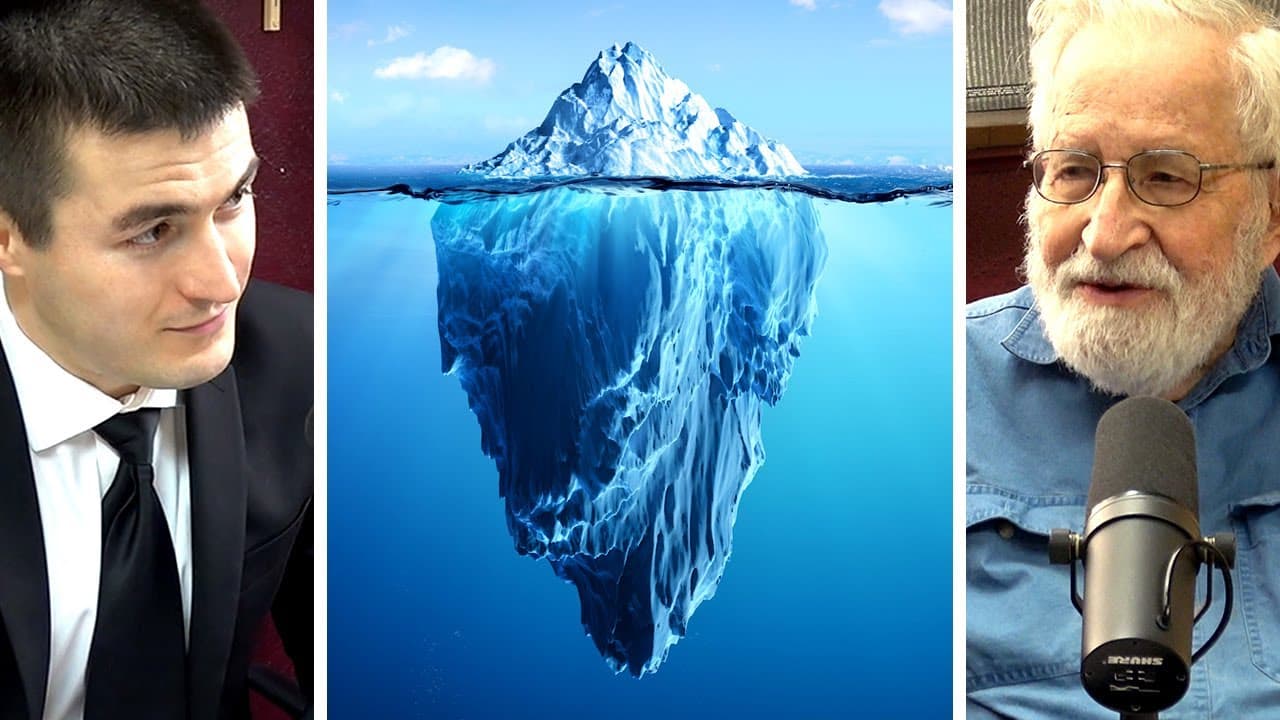
The deepest and most puzzling property of language is structure dependence: people interpret words through a sentence’s syntactic structure rather than their linear proximity. Noam Chomsky illustrates it with “The guy who fixed the car carefully packed his tools,” where “carefully” may describe fixing or packing. This pattern is universal across constructions and languages, and its neural basis is somewhat understood. Read on to see how the example reveals it.
Transcript
what are the most beautiful or fascinating aspects of language our ideas and linguistics or cognitive science that you've seen in a lifetime of studying language and studying the human mind well I think the deepest property of language and puzzling property that's been discovered is what are sometimes called structure dependence we know understand ... Read More
Key Insights
- 👻 Structure dependence is a fundamental property of language that allows for the interpretation of meaning beyond linear proximity.
- 🉑 Despite only hearing linear information, we are able to perform complex computations on the syntactic structure to assign meaning.
- ❓ Structure dependence is universal across all languages, indicating its importance in human language processing.
Install to Summarize YouTube Videos and Get Transcripts
Explore YouTube Video Summarizer or Get YouTube Transcript Extractor
Questions & Answers
Q: What is the deepest property of language according to Noam Chomsky?
Chomsky identifies structure dependence as the deepest and most puzzling property of language. It means that interpretation follows the structure of a sentence rather than simply connecting words that are closest together in the spoken sequence.
Q: What is structure dependence in language?
Structure dependence is the tendency to interpret a word according to its structurally closest relationship within a sentence. That relationship may involve something farther away in the linear sequence, even though the sequence is all that a listener directly hears.
Q: How does the sentence about the guy who fixed the car demonstrate structure dependence?
“The guy who fixed the car carefully packed his tools” is ambiguous because “carefully” can describe either fixing the car or packing the tools. The example shows that the placement of a word interacts with the sentence’s phrase structure to determine its interpretation.
Q: What happens when “carefully” is moved to the front of the example sentence?
In “Carefully, the guy who fixed the car packed his tools,” “carefully” describes the packing rather than the fixing. The interpretation selects the structurally closest element even though it is more remote in the linear order.
Q: Does structure-dependent interpretation still apply when the result makes no sense?
Yes. Chomsky says listeners are compelled to connect the fronted “carefully” with the structurally appropriate, linearly more remote element even when the resulting meaning makes no sense.
Q: Why is structure dependence considered puzzling?
Listeners hear only words in a linear sequence and never directly hear the underlying structure. Yet they instantly perform what appears to be a more complex computation over that unheard structure while ignoring the simpler interpretation suggested by linear proximity.
Q: Is structure dependence universal across languages?
Yes. Chomsky states that this pattern is universal across all constructions and all languages, compelling people to interpret sentences through structure rather than merely through the order of heard words.
Q: Is there a neural basis for structure dependence?
Chomsky says there is a neural basis for structure dependence that is somewhat understood. He also says good theories now explain why the property holds, making it a deep insight into the surprising nature of language.
Summary & Key Takeaways
-
Language exhibits structure dependence, where interpretation is determined by the syntactic structure rather than linear proximity.
-
This property can be seen in sentences like "The guy who fixed the car carefully packed his tools," where "carefully" can modify either the act of fixing or the act of packing.
-
This phenomenon is universal across all languages and requires us to perform complex computations on the syntactic structure, ignoring the linear information we hear.
Read in Other Languages (beta)
Share This Summary 📚
Summarize YouTube Videos and Get Video Transcripts with 1-Click
Try YouTube Summary with ChatGPT & Claude or YouTube Transcript Generator
Explore More Summaries from Lex Fridman 📚

Summarize YouTube Videos and Get Video Transcripts with 1-Click
Try YouTube Summary with ChatGPT & Claude or YouTube Transcript Generator