How to Focus on Four Tasks That Grow Your Business
TL;DR
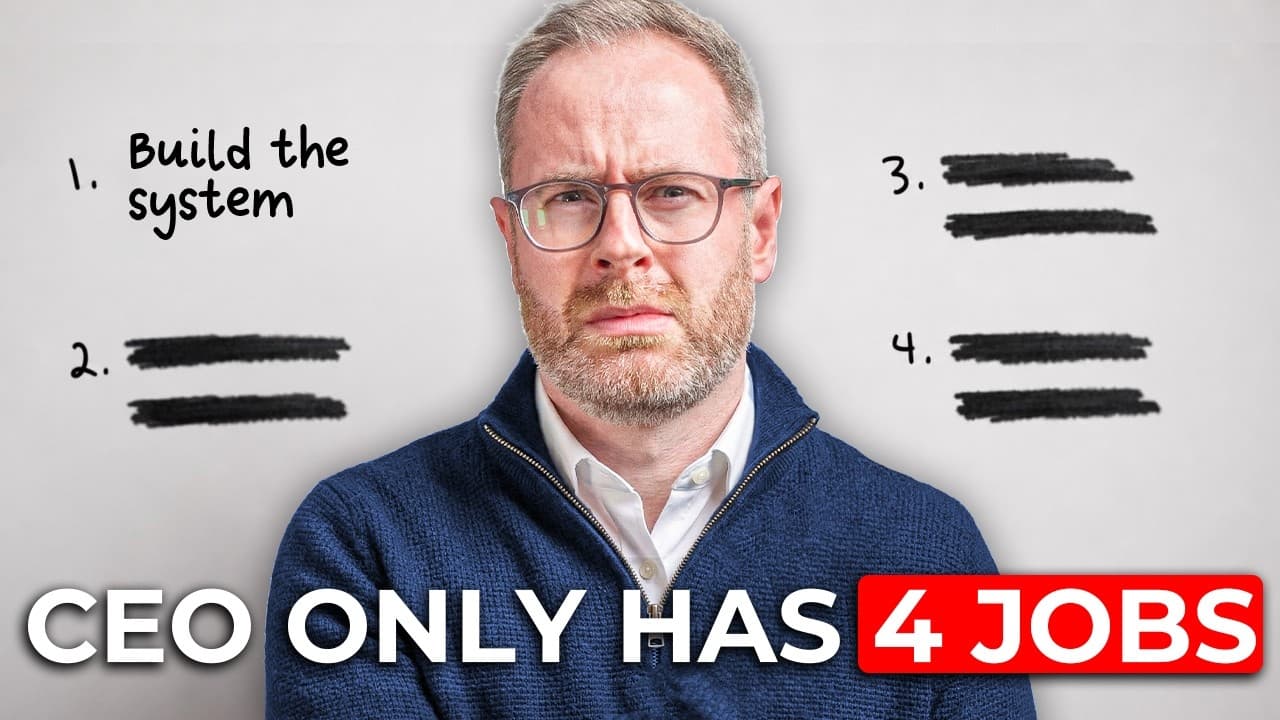
Focus on building a documented sales system, measuring its performance, creating a team that can run it, and improving your own mindset. Separating ownership from routine employee work makes revenue generation more predictable, reduces dependence on memory and mood, and helps remove the owner as the business bottleneck.
Transcript
Most business owners are doing about 20 jobs inside the business. And that right there is why it feels so hard. You're doing the work. You're managing the people. You're sorting invoices. You're sending out the emails. You're putting out whatever fire popped up this morning. And somewhere beneath all of that, you're supposed to be finding the next ... Read More
Key Insights
- Business owners are often overloaded because they perform numerous operational, administrative, delivery, and sales duties simultaneously. Continuing the habits required at startup can leave a growing company dependent on its owner and prevent that person from concentrating on predictable client generation and service delivery.
- The owner’s job is to build a business that generates clients and delivers its service predictably. Treating oneself as the company’s most senior employee keeps attention on daily execution, while revenue-producing responsibilities are postponed until routine work and unexpected problems have been handled.
- A sales system is a documented sequence covering the buyer’s journey from first awareness through payment. It should define how prospects become leads, which questions reveal their problems, how the service is positioned, what follows a successful call, and what happens when a prospect becomes unresponsive.
- An improvised sales process depends on the owner’s memory, mood, and personal judgment. Inconsistent follow-ups, quotation timing, and proposals may produce occasional results, but the process cannot be reliably repeated or transferred while its rules remain only inside the owner’s head.
- Documented sales procedures make delegation possible because another person can follow a defined process. The intended standard is a system clear enough for a newly hired salesperson to begin driving revenue quickly instead of spending months reconstructing the owner’s unwritten methods.
- Sales measurement replaces feelings with actionable evidence. Tracking weekly conversations, discovery calls, opportunities awaiting decisions, closed sales, and total pipeline value gives an owner visibility into likely results and identifies where prospects are becoming stuck.
- Feast-and-famine revenue is linked to poor pipeline visibility in the speaker’s framework. When owners cannot see what is likely to close, they cannot respond early, so revenue shortages become apparent only after conditions have deteriorated and panic-driven selling begins.
- The four ownership priorities are building the sales system, making it measurable, building the team that runs it, and working on personal mindset. Together, these priorities are presented as the route to predictable revenue, lower stress, and removing the owner as the business bottleneck.
Install to Summarize YouTube Videos and Get Transcripts
Explore YouTube Video Summarizer or Get YouTube Transcript Extractor
Questions & Answers
Q: How can a business owner stop doing too many jobs?
A business owner can reduce overload by separating the owner’s responsibilities from work that belongs to an employee or a repeatable operating process. The owner should concentrate on building a predictable system that generates clients and delivers the service. The four stated priorities are documenting sales, measuring sales, building the team that runs the system, and improving the owner’s mindset.
Q: How do you build a documented sales system?
Map every step a prospective client takes from first hearing about the business to paying an invoice. Document how people discover the brand, become leads, answer questions that clarify their problems, evaluate the proposed solution, receive follow-up, and proceed after a successful call. Also define the response when a prospect goes quiet, creating one clear sequence instead of improvising each opportunity.
Q: Why should a sales process be written down?
A written sales process prevents selling from depending entirely on the owner’s memory, mood, and moment-to-moment judgment. It creates a repeatable sequence for calls, qualification, proposals, follow-up, and closing. It also makes delegation possible because a salesperson cannot reliably follow a process that exists only as an undocumented collection of decisions inside the owner’s head.
Q: What sales metrics should a service business track?
A service business should track how many sales conversations occur each week, how many lead to discovery calls, how many opportunities remain stuck at the decision stage, and how many ultimately close. The owner should also know the total pipeline value, which opportunities are likely to close during the month, and which prospects have stopped responding.
Q: Can a small business measure sales with a spreadsheet?
A spreadsheet can be sufficient for some small businesses, particularly in the example given for companies producing less than a million dollars in annual revenue. The specific tool matters less than the shift from intuition to visible data. A spreadsheet, dashboard, or CRM should reveal pipeline activity, likely outcomes, stalled opportunities, and closed sales.
Q: Why do service businesses experience feast-and-famine sales?
Feast-and-famine sales arise when owners lack visibility into what is happening in their pipeline, according to the speaker’s explanation. Work may be arriving and revenue may appear adequate, but without measurements the owner cannot see an approaching shortage. The problem becomes visible only when it is urgent, prompting a burst of panic-driven selling followed by another period of neglect.
Q: How does sales documentation make delegation easier?
Sales documentation converts the owner’s personal approach into standard operating procedures that another person can follow. A salesperson can see the required sequence, questions, follow-ups, proposals, and responses to stalled prospects instead of guessing how the owner would act. This reduces reliance on one person and supports the goal of building a team capable of operating the sales system.
Q: What are the four main jobs of a business owner?
The four main jobs presented are building the sales system, making that system measurable, building the team needed to run it, and working on the owner’s mindset. These responsibilities shift attention away from performing every routine task personally. Their shared purpose is to create predictable client generation and service delivery while preventing the owner from remaining the central bottleneck.
Summary & Key Takeaways
-
Business feels unnecessarily difficult when an owner performs many unrelated jobs while treating sales as an afterthought. The owner’s actual responsibility is to build a business that predictably generates clients and delivers its service. Work that does not advance that outcome distracts the owner from the role the business requires.
-
The first priority is documenting every stage between a prospect discovering the business and paying an invoice. Questions, calls, proposals, follow-ups, and responses to stalled opportunities should form a consistent sequence. Documentation makes sales less dependent on improvisation and creates a process that another person can eventually follow.
-
The second priority is making sales measurable through a dashboard, CRM, or spreadsheet. Owners should track conversations, discovery calls, stalled decisions, closed opportunities, and pipeline value. The remaining priorities are building a team to operate the system and developing the owner’s mindset so the owner stops constraining growth.
Read in Other Languages (beta)
Share This Summary 📚
Summarize YouTube Videos and Get Video Transcripts with 1-Click
Try YouTube Summary with ChatGPT & Claude or YouTube Transcript Generator
Explore More Summaries from Will Barron 📚

Summarize YouTube Videos and Get Video Transcripts with 1-Click
Try YouTube Summary with ChatGPT & Claude or YouTube Transcript Generator