How Deepseek V4.1 Achieved Unmatched AI Efficiency
TL;DR
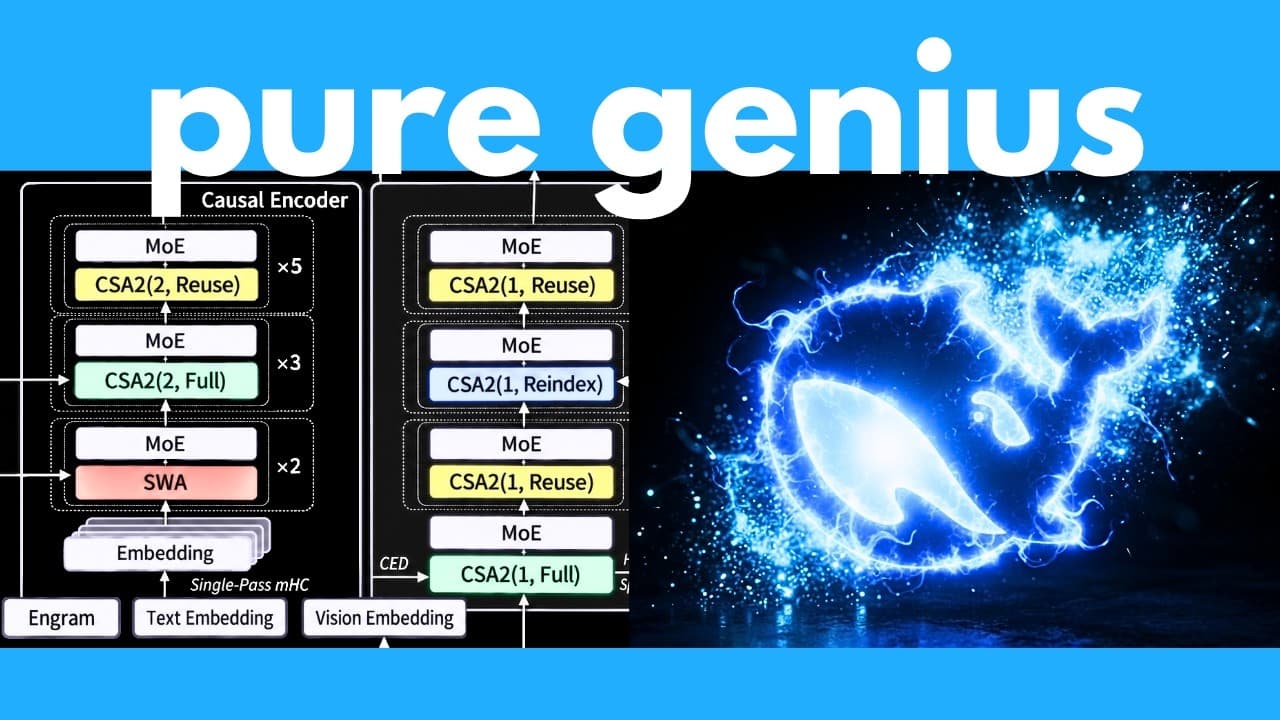
Deepseek V4.1 Flash is an AI model that achieves unprecedented efficiency and performance despite limited resources. By leveraging innovative architecture and techniques like sliding window attention, hierarchical sparse indexing, and compressed sparse attention, it reduces computational demands and memory usage significantly. The model's design allows it to handle massive context windows without increasing computational load, setting new standards in AI model efficiency.
Transcript
Deepseek did it again. They've released a new model and not only is this among the frontier models out there, but it's also the most optimized, efficient, and frictionless AI model we've seen so far. As always, not only have they open- sourced the model, but they've also released a technical paper on this. And how they designed this is just really ... Read More
Key Insights
- Deepseek V4.1 Flash is among the most efficient AI models, optimized for performance despite limited resources.
- The model uses a novel architecture, splitting into causal encoder and decoder components to reduce computational load.
- Sliding window attention allows the model to focus on immediate context, improving efficiency.
- Compressed sparse attention 2 (CSA2) reduces memory usage by enabling layers to share notes.
- Hierarchical sparse indexing narrows down relevant information, enhancing processing speed.
- SWA bounded replay deletes short-term memory, relying on recalculating recent conversation parts.
- Single pass MHC aligns operations to reduce memory traffic, speeding up processing.
- The engram component stores static facts in RAM, freeing GPU memory for active reasoning.
Install to Summarize YouTube Videos and Get Transcripts
Explore YouTube Video Summarizer or Get YouTube Transcript Extractor
Questions & Answers
Q: How does Deepseek V4.1 Flash achieve high efficiency?
Deepseek V4.1 Flash achieves high efficiency through a unique architecture that includes splitting the model into causal encoder and decoder components, reducing computational demands. It uses sliding window attention to focus on immediate context, hierarchical sparse indexing for faster information retrieval, and compressed sparse attention to minimize memory usage. These innovations allow it to handle large context windows without increasing computational load.
Q: What is the role of sliding window attention in Deepseek V4.1?
Sliding window attention in Deepseek V4.1 Flash allows the model to focus on the most immediate and relevant context, improving processing efficiency. By concentrating on a smaller set of recent tokens, the model reduces the computational burden and memory usage associated with processing large amounts of data, enabling it to operate more efficiently even with extensive context windows.
Q: Why is compressed sparse attention 2 (CSA2) important?
Compressed sparse attention 2 (CSA2) is crucial because it reduces the memory footprint of Deepseek V4.1 Flash by enabling layers to share notes, or KV cache. This mechanism prevents redundancy in note-taking across layers, significantly decreasing the total memory required for processing, which is vital for maintaining efficiency when handling large datasets or complex tasks.
Q: How does hierarchical sparse indexing enhance Deepseek V4.1's performance?
Hierarchical sparse indexing enhances Deepseek V4.1's performance by narrowing the search space for relevant information at the start of the decoding phase. This process generates a candidate pool of the most pertinent concepts, allowing the model to focus on essential data and significantly improving processing speed and efficiency, even with large volumes of input data.
Q: What is SWA bounded replay and its impact on memory?
SWA bounded replay in Deepseek V4.1 Flash addresses memory issues by deleting the model's short-term memory after each interaction, avoiding storage in SSDs. Instead, it recalculates the last 128 tokens of conversation on the fly. This approach reduces storage requirements and speeds up processing, as recalculating is faster than retrieving data from slower storage devices.
Q: How does single pass MHC improve Deepseek V4.1's processing speed?
Single pass MHC improves Deepseek V4.1's processing speed by aligning multiple operations to occur simultaneously, reducing the need for memory traffic within the GPU. By combining steps instead of executing them sequentially, this approach minimizes latency from data transfers, allowing the model to process tasks more quickly and efficiently.
Q: What is the function of the engram component in Deepseek V4.1?
The engram component in Deepseek V4.1 serves as a separate memory module that stores static facts, such as historical dates and fixed data, in the server's RAM instead of the GPU's memory. This design choice frees up the GPU's expensive memory for active reasoning tasks, enhancing the model's efficiency by preventing its memory from being clogged with static information.
Q: How does DSpark contribute to Deepseek V4.1's efficiency?
DSpark contributes to Deepseek V4.1's efficiency by allowing the model to output multiple words at a time, rather than one word at a time, as is typical with traditional AI models. This capability significantly speeds up the response generation process, making the model faster and more efficient in delivering outputs, particularly in scenarios requiring rapid processing.
Summary & Key Takeaways
-
Deepseek V4.1 Flash sets a new benchmark in AI model efficiency by employing a unique architecture that splits into causal encoder and decoder components, reducing computational demands. Techniques like sliding window attention and hierarchical sparse indexing further optimize memory usage and processing speed.
-
The model's compressed sparse attention 2 (CSA2) mechanism allows layers to share notes, significantly decreasing memory requirements. SWA bounded replay eliminates short-term memory storage, opting for on-the-fly recalculation, which enhances efficiency without compromising performance.
-
Additional innovations such as single pass MHC and the engram component streamline data processing and storage, enabling Deepseek V4.1 Flash to handle large context windows with minimal computational increase, achieving state-of-the-art performance at a fraction of the cost.
Read in Other Languages (beta)
Share This Summary 📚
Summarize YouTube Videos and Get Video Transcripts with 1-Click
Try YouTube Summary with ChatGPT & Claude or YouTube Transcript Generator
Explore More Summaries from AI Search 📚





Summarize YouTube Videos and Get Video Transcripts with 1-Click
Try YouTube Summary with ChatGPT & Claude or YouTube Transcript Generator