Turing Test: Can Machines Think?
TL;DR
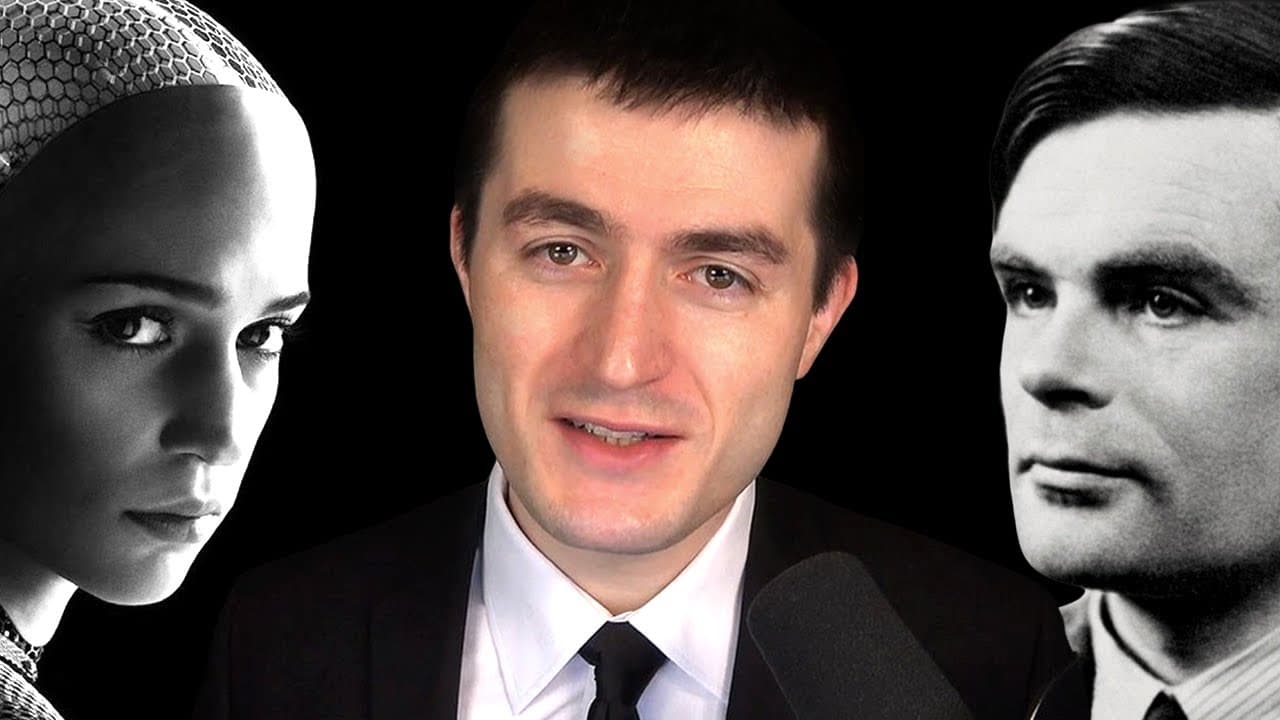
The Turing Test, introduced by Alan Turing in 1950, assesses whether machines can exhibit human-like intelligence through conversation. It raises critical questions about the nature of consciousness and the benchmarks for machine intelligence, while inspiring ongoing debates and alternative tests aimed at understanding AI capabilities.
Transcript
in this video I proposed to ask the question that was asked by Alan Turing almost seventy years ago in his paper Computing Machinery and intelligence can machines think this is the first paper in a paper reading club that we started focused on artificial intelligence but also including mathematics physics computer science you know science all the s... Read More
Key Insights
- 🛰️ The Turing Test served as a catalyst for advancements in artificial intelligence, stimulating research and development in the field.
- 📠 The Turing Test focuses on the appearance of intelligence, rather than delving into the internal processes of machines.
- ❓ Challenges in implementing the Turing Test include the role of anthropomorphism, the limitations of natural language communication, and the impact of the interrogator's skill.
- 🧪 Alternative tests, such as the Winograd Schema Challenge, prioritize reasoning and semantic understanding over mere conversation.
Install to Summarize YouTube Videos and Get Transcripts
Explore YouTube Video Summarizer or Get YouTube Transcript Extractor
Questions & Answers
Q: What is the Turing Test?
The Turing Test is a test proposed by Alan Turing in which a human interrogator engages in written conversations with a machine and a human. The interrogator aims to determine which entity is human and which is a machine based on their responses.
Q: What were some objections to the Turing Test?
Some objections raised included the requirement for consciousness in machines, the limitations of computation according to Gödel's Incompleteness Theorem, and the inability of machines to perform tasks requiring human-like qualities such as love, humor, and creativity.
Q: How has the Turing Test evolved over time?
Variations and extensions of the Turing Test have been proposed, such as the Lovelace Test, Winograd Schema Challenge, and Total Turing Test. These tests aim to capture different aspects of intelligence, reasoning, and understanding in machines.
Q: Has the Turing Test been successfully passed?
While there have been claims of passing the Turing Test, they have been met with criticism and skepticism. Current chatbot systems, such as Mitsuku and Rose, have shown promise but still fall short of convincingly passing the test.
Key Insights:
- The Turing Test served as a catalyst for advancements in artificial intelligence, stimulating research and development in the field.
- The Turing Test focuses on the appearance of intelligence, rather than delving into the internal processes of machines.
- Challenges in implementing the Turing Test include the role of anthropomorphism, the limitations of natural language communication, and the impact of the interrogator's skill.
- Alternative tests, such as the Winograd Schema Challenge, prioritize reasoning and semantic understanding over mere conversation.
Overall, the Turing Test continues to be a relevant and thought-provoking concept in the field of artificial intelligence, challenging researchers to strive for human-level capabilities and understand the nature of intelligence.
Summary
In this video, the speaker discusses Alan Turing's paper "Computing Machinery and intelligence" and its significance in the field of artificial intelligence. The paper introduces the concept of the Turing test, which is a benchmark to determine if a system can exhibit human-level intelligence. The speaker provides an overview of the paper, discusses objections and alternatives to the test, and explores the idea of measuring intelligence through compression and other challenges.
Questions & Answers
Q: What is the significance of Alan Turing's paper in the field of artificial intelligence?
Alan Turing's paper is considered one of the most impactful papers in the history of artificial intelligence. It introduced the concept of the Turing test, which provides a benchmark to determine if a system has achieved human-level intelligence. The paper has inspired researchers from both inside and outside of the field of computer science, leading to significant advancements in the creation of intelligent systems.
Q: What is the Turing test?
The Turing test is a test of a machine's ability to exhibit human-level intelligence. It involves a human interrogator communicating with two entities, one a machine and one a human, through written language. After a conversation, the interrogator must determine which entity is the human and which is the machine. The test aims to determine if a machine can successfully mimic human intelligence.
Q: How does the Turing test convert the question of whether machines can think into a concrete test?
The Turing test takes the abstract question of whether machines can think and formulates it into a concrete test called the imitation game. In this game, a human interrogator communicates with a machine and a human through written language and must determine which is which. By focusing on the ability to mimic human intelligence in a conversational context, the test serves as a benchmark for evaluating a system's intelligence.
Q: What are some objections to the Turing test mentioned in the video?
Some objections to the Turing test include religious objections regarding the concept of thinking and the soul, skepticism about the ability of machines to achieve consciousness, and doubts about whether machines can exhibit certain human qualities like love, humor, and creativity. There are also objections related to the limitations of computation and deterministic algorithms in capturing the complexity of human intelligence.
Q: How does the Lovelace test and the Winograd schema challenge extend the Turing test?
The Lovelace test proposes that a machine should be able to do something surprising that its creator cannot explain. It emphasizes the importance of creativity and the ability to generate impressive artistic work. The Winograd schema challenge tests a machine's ability to reason and exhibit common-sense understanding through resolving ambiguous sentences. These challenges extend the Turing test by focusing on specific aspects of intelligence beyond language comprehension.
Q: What is the Amazon Alexa Prize and why is it relevant to the Turing test?
The Amazon Alexa Prize is a challenge to build conversational AI agents that can engage in open domain conversations with humans for at least 20 minutes. The challenge aims to create a system that can pass the Turing test by providing a conversational experience that is indistinguishable from human conversation. It serves as a practical implementation of the Turing test in the context of voice-based interaction.
Q: What is the Compression Challenge and how is it related to intelligence?
The Compression Challenge, also known as the Hutter Prize, is a competition that tests the intelligence of systems by measuring their ability to compress knowledge. The idea is that the better a system can compress information, the more intelligent it is. This challenge quantifies intelligence by reducing it to hard file size numbers and highlights the correlation between compression and intelligence.
Q: What is the Abstraction and Reasoning Corpus (ARC) challenge?
The ARC challenge is a benchmark for measuring intelligence based on reasoning and abstraction in a grid world. It aims to mimic IQ tests by testing the ability to reason about patterns and apply common-sense understanding. The challenge focuses on the core elements of intelligence, such as object persistence, spatial contiguity, and color-based contiguity. It provides a more basic and fundamental test of reasoning capabilities compared to the Turing test.
Q: How does the concept of surprise relate to intelligence?
Surprise is considered a key aspect of intelligence. Intelligence involves the ability to go beyond predictable and expected behavior. A machine that can surprise humans with its actions or responses demonstrates a level of intelligence. The idea of surprise is often associated with creativity, humor, and the ability to think outside the box. Testing machines for their capacity to surprise can provide insights into their intelligence.
Q: Can machines truly mimic human-level intelligence?
While machines can mimic human-level intelligence to some extent, the question of whether they truly possess intelligence is still open. Mimicking intelligence does not necessarily equate to having true consciousness or understanding. Machines can exhibit behaviors and responses that appear intelligent, but the question of whether they possess true comprehension or consciousness remains unresolved. The ongoing research and development in artificial intelligence aims to explore and understand the limits of machine intelligence.
Takeaways
The paper "Computing Machinery and intelligence" by Alan Turing has had a significant impact on the field of artificial intelligence. The Turing test introduced in the paper provides a benchmark for evaluating machine intelligence. There are objections to the effectiveness of the test, such as religious and philosophical concerns, limitations of computation, and doubts about the ability of machines to exhibit certain human qualities. However, alternative tests and challenges, such as the Lovelace test, the Winograd schema challenge, the Amazon Alexa Prize, the Compression Challenge, and the ARC challenge, offer different ways to assess intelligence and push the boundaries of AI research. Understanding and replicating human-level intelligence in machines is an ongoing pursuit that requires further exploration and innovation.
Summary & Key Takeaways
-
Alan Turing's 1950 paper, "Computing Machinery and Intelligence," proposes the Turing Test, which serves as a benchmark for evaluating the intelligence of machines.
-
The Turing Test involves a human interrogator attempting to distinguish between a machine and a human through written communication.
-
The paper addresses objections and alternative tests, such as the Lovelace Test and Winograd Schema Challenge, to further explore artificial intelligence and human-level capabilities.
-
Insights from the paper include the need for machines to appear intelligent, the challenges of defining consciousness and intelligence, and the importance of social and natural language interaction.
Read in Other Languages (beta)
Share This Summary 📚
Summarize YouTube Videos and Get Video Transcripts with 1-Click
Try YouTube Summary with ChatGPT & Claude or YouTube Transcript Generator
Explore More Summaries from Lex Fridman 📚


Summarize YouTube Videos and Get Video Transcripts with 1-Click
Try YouTube Summary with ChatGPT & Claude or YouTube Transcript Generator