How to Detect Collisions in Python with Operator Overloading
TL;DR
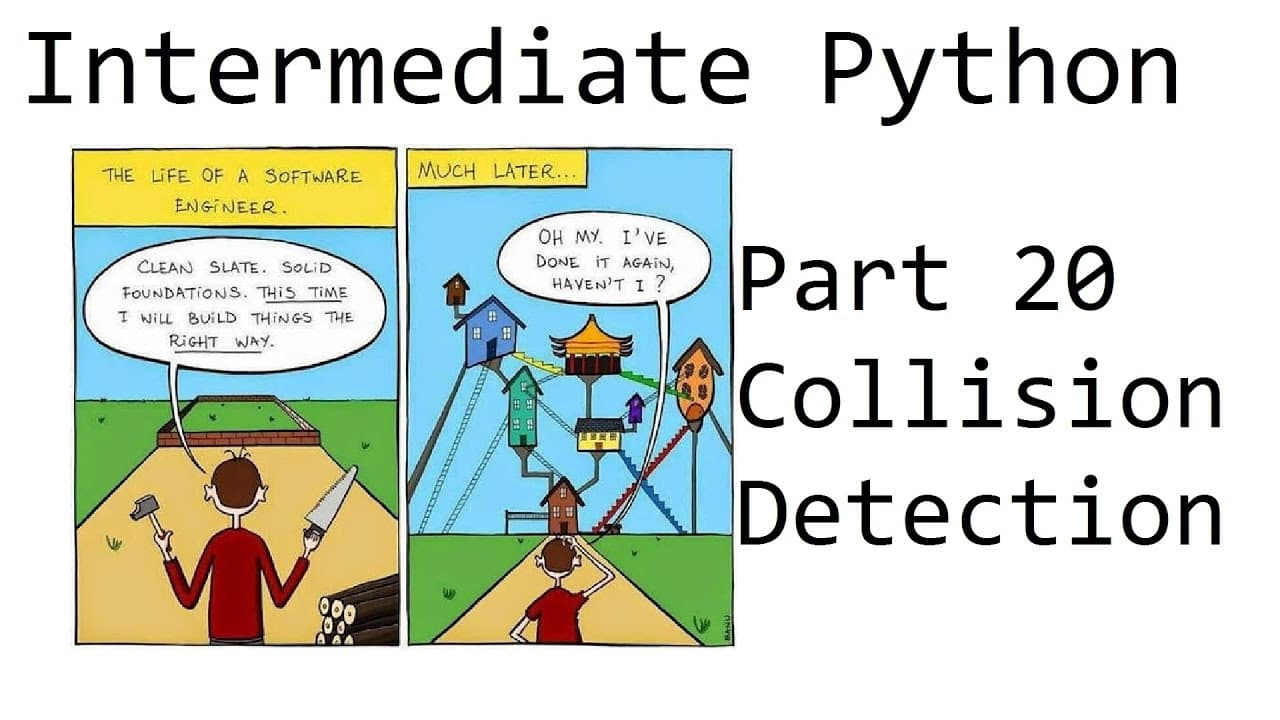
To detect collisions in Python, implement operator overloading for custom addition and use Euclidean distance to determine if two objects, or 'blobs,' are touching. If the distance between two blobs is less than the sum of their radii, a collision occurs. Remove any blobs that reach a size of zero or less to maintain simulation integrity.
Transcript
what's up everybody welcome to part 20 of our intermediate Python series in this video we're gonna be building on the last video which we talked about how we could do operator overloading create our own dunder add method which would allow us to let's just use these to you know self is the object itself and then other blob would be the second parame... Read More
Key Insights
- 👻 Operator overloading allows us to define custom behavior for operators like addition in Python.
- 😥 Euclidean distance or norm is used to calculate the distance between points in a plane, making it useful for determining if blobs are touching.
- 💥 Collision handling is essential for accurate simulation and preventing bugs in the blob world.
- 0️⃣ Removing blobs that reach a size of zero or less helps maintain the integrity of the simulation.
- 💥 There may be room for improvement in the collision detection and handling algorithms.
- 🥺 The tutorial demonstrates how understanding and implementing core concepts in Python can lead to more dynamic and interactive programs.
- 🌍 Python's flexibility and object-oriented features make it suitable for simulating complex scenarios like the blob world.
Install to Summarize YouTube Videos and Get Transcripts
Explore YouTube Video Summarizer or Get YouTube Transcript Extractor
Questions & Answers
Q: How does operator overloading work in Python?
Operator overloading allows us to define how an operator should behave when used with custom objects. By implementing the dunder add method, we can specify the behavior of the addition operator for our objects.
Q: What is Euclidean distance or norm?
Euclidean distance, or norm, is a way of calculating the distance between two points on a plane. It is used in this tutorial to determine the distance between the centers of two blobs to check if they are touching.
Q: Why do we need to handle collisions in the blob world?
Handling collisions is important to prevent bugs and ensure the accurate simulation of the blob world. By detecting when two blobs are touching and removing blobs that reach a size of zero or less, we can properly handle collisions and update the state of the blobs.
Q: Is there a more efficient way to calculate if blobs are touching?
Although the current implementation works, there might be more efficient ways to calculate if blobs are touching. It would be interesting to explore different approaches and see if there are simpler or more optimized solutions available.
Summary & Key Takeaways
-
The video teaches how to use operator overloading to perform addition on objects in Python without using parentheses or passing parameters.
-
The tutorial explains the concept of calculating distance between two points on a plane using Euclidean distance or norm.
-
The video demonstrates how to handle collisions between objects in a blob world by detecting when two blobs are touching each other and removing blobs that reach a size of zero or less.
Read in Other Languages (beta)
Share This Summary 📚
Summarize YouTube Videos and Get Video Transcripts with 1-Click
Try YouTube Summary with ChatGPT & Claude or YouTube Transcript Generator
Explore More Summaries from sentdex 📚
Summarize YouTube Videos and Get Video Transcripts with 1-Click
Try YouTube Summary with ChatGPT & Claude or YouTube Transcript Generator