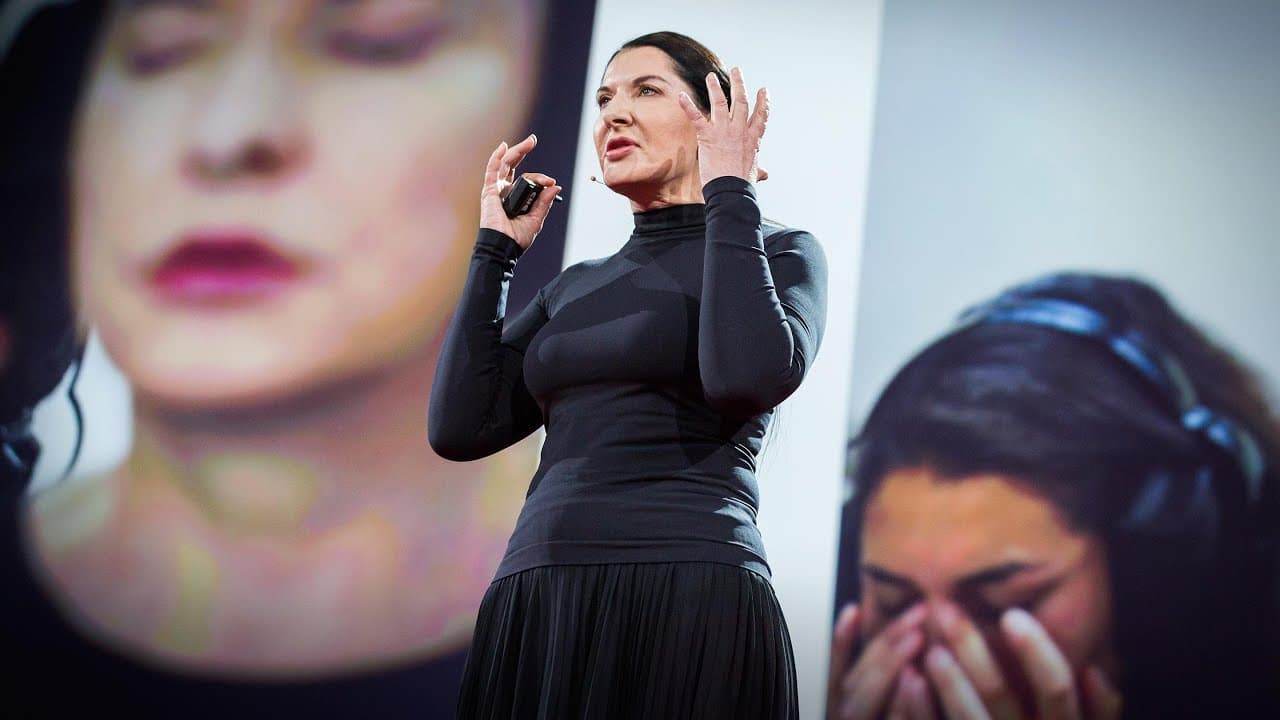
An Art Made of Trust, Vulnerability and Connection | Marina Abramović | TED Talks
TL;DR
Performance art is a unique form of expression that engages both the performer and the audience in real-time, creating a shared emotional experience. It differs from traditional theater by using real tools and confronting fears, allowing for personal transformation. Marina Abramović emphasizes that personal change is essential for broader societal transformation.
Transcript
Now... let's go back in time. It's 1974. There is the gallery somewhere in the world, and there is a young girl, age 23, standing in the middle of the space. In the front of her is a table. On the table there are 76 objects for pleasure and for pain. Some of the objects are a glass of water, a coat, a shoe, a rose. But also the knife, the razor bla... Read More
Key Insights
- 💥 Performance is a mental and physical construction in a specific time and space in front of an audience, where energy dialogue happens between the performer and the audience.
- 💥 In performance, the blood is the material and the tools are real; it's about being present in the moment, as you can't rehearse performance.
- 💔 Artists stage their fears in performances to push their bodies to the limit and liberate themselves from that fear.
- 💔 Marina and her partner created performances together for 12 years, exchanging violence for trust and love.
- 💔 "Balkan Baroque" was a performance that symbolizes the irreducible and shameful nature of war, while also representing the universal aspects of conflict.
- 💭 Performance art can create intense and transformative experiences for both the performer and the audience, as seen in Marina's performance at MoMA, where people sat for hours in front of her.
- 💭 Marina's goal is to establish an institute of immaterial performing arts where visitors can spend a full six hours experiencing different activities and artwork.
- 💭 Marina believes that personal change is necessary to transform the world, and encourages individuals to step out of their comfort zone, face their fears, and embrace failure in order to grow and make a difference.
Install to Summarize YouTube Videos and Get Transcripts
Explore YouTube Video Summarizer or Get YouTube Transcript Extractor
Questions & Answers
Q: What is the purpose of the performance described in the video?
The purpose of the performance described in the video is to confront and stage fears, such as suffering, pain, and mortality, in front of an audience. The performer uses the audience's energy to push their body to the limits and ultimately liberate themselves from these fears. The performance serves as a mirror for the audience, showing them that they too can confront their fears and liberate themselves.
Q: How does the performer differentiate performance from theater?
The performer differentiates performance from theater by emphasizing the realness and physicality of performance. In performance, the blood and objects used are real and serve as materials and tools. The audience experiences the performance in real-time and there is no possibility for rehearsal. In contrast, theater often uses props and effects that do not fully embody the reality of the objects or actions they represent.
Q: What is the significance of the performer's relationship with Ulay?
The performer's relationship with Ulay was significant because it helped them develop a deep level of trust. The performer and Ulay created performances together for 12 years, exploring subjects related to male and female energy. Their relationship came to an end, but they marked its conclusion by walking the Great Wall of China, each starting from opposite ends and meeting in the middle. This experience changed the performer's perspective on the audience.
Q: How did the performer's performance at MoMa change their perception of the audience?
The performer's performance at MoMa, where they sat in a chair for three months and allowed members of the public to sit in front of them, changed their perception of the audience. Initially, the curator believed that no one would sit in front of the performer, but many people did. The one-to-one relation between the performer and the individual sitting in front of them created moments of pain, loneliness, and connection. It made the performer realize their strong mission to communicate this experience to others.
Q: What is the concept behind the proposed institute of immaterial performing arts?
The concept behind the proposed institute of immaterial performing arts is to provide an experience that emphasizes time-based art and immateriality. Visitors would have to commit to spending a full six hours at the institute and surrender their digital and electronic devices. The institute would include various experiences such as slow walking, crystal chambers, eye-gazing chambers, and long duration chairs. The goal is to help individuals reconnect with simplicity and provide them with a unique, immersive experience in the arts.
Summary
Marina Abramović, a performance artist, shares her experiences and insights in the world of performance art. She discusses the power of performance to confront fears and push boundaries, the importance of trust in collaborations, and the transformative impact of her own performances. She also introduces her idea for an Institute of Immaterial Performing Arts and the need for individuals to experience simplicity and change on a personal level.
Questions & Answers
Q: What is performance art?
Performance art, according to Marina Abramović, is a mental and physical construction that a performer creates in a specific time and space in front of an audience. It involves a dialogue of energy between the performer and the audience, with both parties actively participating in shaping the piece. Unlike theater, performance art aims to create a real-time experience, using materials and tools in a raw and authentic way.
Q: What does Abramović aim to achieve through her performances?
Abramović aims to confront and stage fears in front of an audience. She believes that all human beings are afraid of suffering, pain, and mortality, and by pushing her own body and boundaries in her performances, she hopes to liberate herself from these fears. Through her experiences, she serves as a mirror for the audience, encouraging them to face their own fears and liberate themselves.
Q: How did Abramović's collaboration with Ulay influence her work?
Abramović and Ulay collaborated for 12 years, working on various subjects related to both male and female energy. Their performances involved elements of trust, as they exchanged objects such as knives, pistols, and bullets in a symbolic way. The trust between them was crucial, as they were putting their lives in each other's hands. Their collaboration eventually came to an end, marked by a journey where they walked the Great Wall of China from opposite ends to meet in the middle and say goodbye.
Q: How did Abramović's performance in the MoMA change her perspective on the public?
Abramović's performance at the MoMA involved her sitting in a chair for three months, with an empty chair in front for any member of the public to sit and engage with her. Initially, there were doubts about whether anyone would take the time to sit with her. However, the experience proved to be transformative for both her and the participants. People would wait for hours to have the chance to sit in front of her, and in that intimate gaze, a profound connection would occur. This experience made Abramović realize the power of one-on-one interactions and changed her perception of the public.
Q: What is the concept behind Abramović's Institute of Immaterial Performing Arts?
Abramović envisions an institute that focuses on immaterial art forms and aims to give people the experience of simplicity and time for themselves. Visitors will enter the institute and undergo various activities to prepare themselves mentally and physically, from slow walking to eye-gazing exercises. Afterward, they will have the opportunity to witness long-duration performances, such as music, theater, or movies. The goal is to cultivate a deeper connection with oneself and the art, requiring a commitment of six hours of one's time, which is seen as a valuable resource in today's digital age.
Takeaways
Marina Abramović's insights into performance art highlight its power to confront fears, push boundaries, and create transformative experiences. Her emphasis on trust and collaboration in her work with Ulay underscores the importance of mutual respect and vulnerability in any artistic endeavor. Abramović's vision for an Institute of Immaterial Performing Arts emphasizes the need for individuals to embrace simplicity, change, and personal transformation in order to effect positive change in the world.
Summary & Key Takeaways
-
The speaker describes a performance she did in 1974, where audience members were invited to interact with objects on a table, some of which were harmful.
-
She explains that performance art is different from traditional theater because it is more real and involves the audience in creating the piece.
-
The speaker discusses her recent performance at MoMa, where she sat for three months and allowed people to sit in front of her, creating a personal and intimate experience.
Read in Other Languages (beta)
Share This Summary 📚
Summarize YouTube Videos and Get Video Transcripts with 1-Click
Try YouTube Summary with ChatGPT & Claude or YouTube Transcript Generator
Explore More Summaries from TED 📚




Summarize YouTube Videos and Get Video Transcripts with 1-Click
Try YouTube Summary with ChatGPT & Claude or YouTube Transcript Generator