Mark Zuckerberg on Meta's AI Vision and Challenges
TL;DR
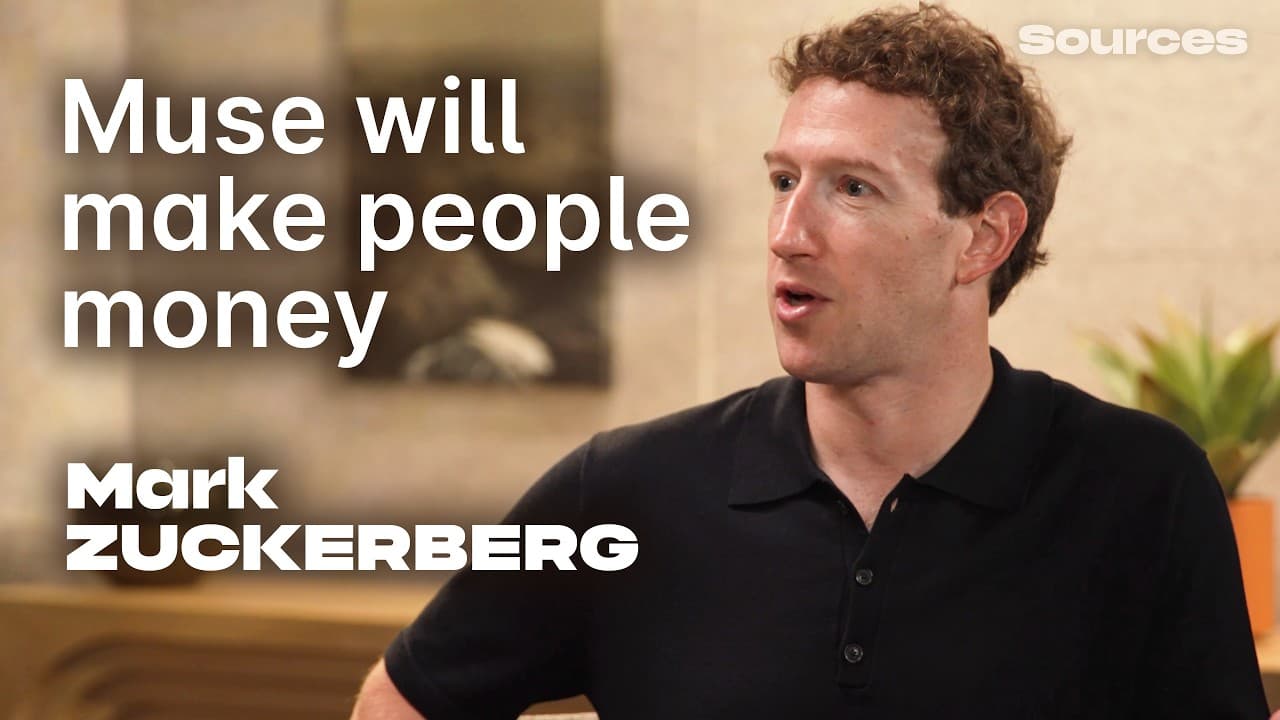
Mark Zuckerberg discusses Meta's vision for AI, emphasizing the importance of distributing AI technology widely to ensure broad-based prosperity. He highlights the potential risks of concentrating AI power in a few hands and outlines Meta's commitment to open-source principles. Zuckerberg also touches on the privacy concerns related to Meta's smart glasses and the company's approach to youth safety on social media platforms.
Transcript
Mark, last time we spoke, you called me. It was on the weekend. Well, you called me through the glasses, which was the interesting part. >> Was it loud in the background? >> You were You were going to fish. I wasn't going to say it, but yeah, it was on the weekend. >> The noise cancellation actually is pretty good. >> Oh, it's great. >> Yeah, it's ... Read More
Key Insights
- Mark Zuckerberg believes empowering people with AI technology is crucial for global prosperity.
- Meta's AI strategy focuses on distributing technology widely, contrary to industry norms of restricting access.
- Zuckerberg emphasizes the importance of open-source models to maintain competition and transparency.
- Meta's personal AI agent, Muse, aims to provide users with a 24/7 personal assistant to enhance daily life.
- Privacy and security are central to Muse's design, with measures to ensure user data remains confidential.
- Meta's AI lab has been restructured to focus on talent density and advanced compute investments.
- Zuckerberg argues that a broad-based distribution of AI technology is essential to avoid concentration of power.
- Meta is committed to addressing privacy concerns with its smart glasses and ensuring youth safety on its platforms.
Install to Summarize YouTube Videos and Get Transcripts
Explore YouTube Video Summarizer or Get YouTube Transcript Extractor
Questions & Answers
Q: How does Mark Zuckerberg view the distribution of AI technology?
Mark Zuckerberg believes that distributing AI technology widely is crucial for global prosperity. He argues that concentrating AI power in a few hands poses significant risks, and emphasizes the importance of open-source models to maintain competition and transparency. By empowering individuals with AI tools, Zuckerberg envisions a future where technology benefits a broader population, rather than a select few.
Q: What is Meta's personal AI agent, Muse?
Muse is Meta's personal AI agent designed to serve as a 24/7 assistant for users. It aims to enhance daily life by understanding user goals and assisting with tasks around the clock. Privacy and security are central to Muse's design, with measures in place to ensure user data remains confidential. The agent is part of Meta's broader vision to empower individuals with advanced AI tools.
Q: How does Meta address privacy concerns with its smart glasses?
Meta has designed its smart glasses with privacy considerations in mind, incorporating a visible light that flashes whenever the glasses are recording. This feature aims to address privacy concerns by ensuring that people are aware when they are being recorded. Meta has also implemented measures to prevent tampering with the light, reinforcing its commitment to privacy and user trust.
Q: What challenges does Meta face with data center expansion?
Meta faces challenges related to community concerns about data center expansion. Zuckerberg highlights the importance of long-term investment in local communities, noting that Meta's commitment to building data centers can bring economic benefits, such as job creation and increased tax revenue. However, speculative development by companies not invested in community well-being can lead to negative perceptions and opposition.
Q: How has Meta restructured its AI lab?
Meta's AI lab has been restructured to focus on talent density and advanced compute investments. Zuckerberg emphasizes the importance of having a small, highly skilled team capable of managing complex projects. The lab's restructuring aims to enhance Meta's ability to push the frontier of AI technology, with significant investments in data centers and computing power to support advanced model training.
Q: What is Meta's approach to youth safety on social media?
Meta is committed to addressing youth safety on social media through measures such as limiting usage time for teens and restricting notifications during school hours and sleep times. The company seeks to establish industry-wide standards by collaborating with other platforms like YouTube and TikTok. Meta's recent settlement aims to create a legally binding framework to improve youth safety across the industry.
Q: Why is open-source important to Meta's AI strategy?
Open-source is a key component of Meta's AI strategy because it helps maintain competition and transparency in the industry. Zuckerberg believes that open-source models allow for broader scrutiny and collaboration, leading to more robust and secure AI systems. By supporting an open-source ecosystem, Meta aims to ensure that AI technology benefits a wider population, rather than being controlled by a few companies.
Q: How does Meta plan to ensure the security of user data with Muse?
Meta plans to ensure the security of user data with Muse by implementing robust privacy measures, including a confidential virtual machine (VM) that even Meta cannot access. The design emphasizes least privilege access, where Muse only gains access to the minimum necessary data to perform tasks. The use of sentinel agents to monitor data flow further enhances security, ensuring that user information remains protected.
Summary & Key Takeaways
-
Mark Zuckerberg discusses the importance of distributing AI technology widely to ensure broad-based prosperity and avoid concentrating power in a few hands. He outlines Meta's commitment to open-source principles and the development of Muse, a personal AI agent designed to assist users around the clock. Privacy and security are emphasized, with measures to keep user data confidential.
-
Zuckerberg addresses privacy concerns related to Meta's smart glasses and highlights the company's approach to youth safety on social media platforms. He also explains how Meta's AI lab has been restructured to focus on talent density and advanced compute investments, positioning the company to push the frontier of AI technology.
-
Meta's vision for AI involves empowering individuals by providing them with advanced tools and technology. Zuckerberg believes that open-source models and a broad distribution of AI capabilities are essential for maintaining competition and transparency in the industry. The conversation also touches on the challenges of data center expansion and the importance of long-term community investment.
Read in Other Languages (beta)
Share This Summary 📚
Summarize YouTube Videos and Get Video Transcripts with 1-Click
Try YouTube Summary with ChatGPT & Claude or YouTube Transcript Generator
Explore More Summaries from Sources Podcast 📚


Summarize YouTube Videos and Get Video Transcripts with 1-Click
Try YouTube Summary with ChatGPT & Claude or YouTube Transcript Generator