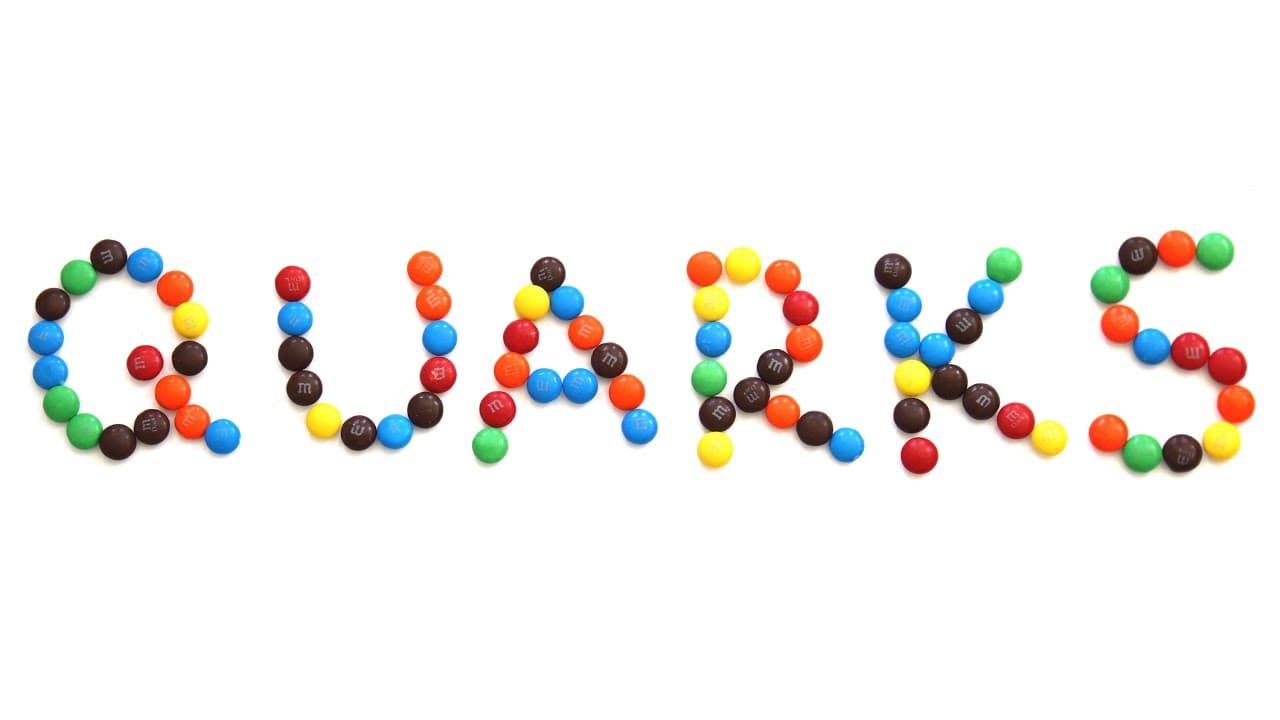
What Are Quarks and How Do They Make Up Protons?
TL;DR
Quarks are fundamental particles that compose protons, consisting of three valence quarks — two up quarks and one down quark — along with a sea of quark-antiquark pairs. The mass of a proton arises not just from these quarks but also from the energy of the gluons and quark interactions within it, as encapsulated by Einstein's equation E=mc².
Transcript
When you're a kid, you're told that all the stuff around is made of atoms and that atoms are made of protons and neutrons and electrons. And if you're lucky, you're told what protons and neutrons are made of. They're made of three quarks each. But if they're both made of quarks, how are protons and neutrons different? You're not usually told this a... Read More
Key Insights
- 🤢 Protons are not composed of only three quarks; they also contain a sea of other quarks and antiquarks.
- 💆 The total mass of a proton comes from the energy of the quarks and gluons inside it, according to Einstein's equation E=mc².
- 🈂️ Quarks have color charge, analogous to electric charge, but they also obey color conservation rules.
- ❓ Quarks cannot be observed directly since they exist in a bound state within protons, requiring tremendous energy to separate them.
Install to Summarize YouTube Videos and Get Transcripts
Explore YouTube Video Summarizer or Get YouTube Transcript Extractor
Questions & Answers
Q: What determines the charge of a proton?
The charge of a proton is determined by the combination of its two up quarks (charge +2/3) and one down quark (charge -1/3), which add up to a positive charge of +1.
Q: Can protons contain other types of quarks besides up and down quarks?
Yes, protons can also contain additional quarks, such as strange, charm, or bottom quarks, along with their corresponding antiquarks.
Q: How are quarks held together within a proton?
Quarks are held together by the strong force, which is carried by particles called gluons. The gluons bind the quarks together, creating a dynamic and energetic system.
Q: Can quarks spontaneously appear and disappear within a proton?
Yes, quarks and antiquarks can appear and disappear within a proton due to quantum fluctuations. However, these fluctuations must conserve properties like charge, spin, and color.
Summary & Key Takeaways
-
Protons are made up of three valence quarks - two up quarks and one down quark - which determine their charge.
-
Protons can also contain additional quark-antiquark pairs, such as up-anti-up or strange-anti-strange quarks.
-
The mass of a proton comes from the energy of the quarks and gluons within it, as given by Einstein's equation E=mc².
Read in Other Languages (beta)
Share This Summary 📚
Summarize YouTube Videos and Get Video Transcripts with 1-Click
Try YouTube Summary with ChatGPT & Claude or YouTube Transcript Generator
Explore More Summaries from Physics Girl 📚

Summarize YouTube Videos and Get Video Transcripts with 1-Click
Try YouTube Summary with ChatGPT & Claude or YouTube Transcript Generator