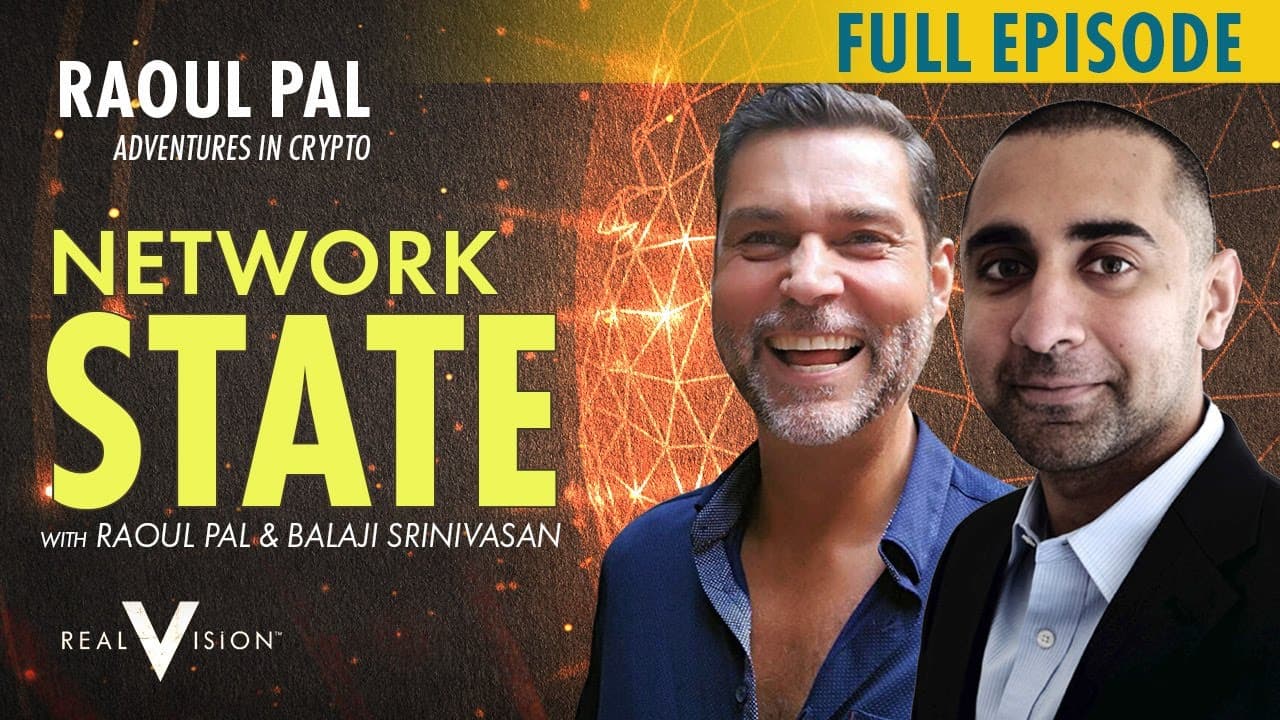
Raoul Pal & Balaji Srinivasan: Balaji's Network State
TL;DR
Balaji discusses the rise of network states and crypto's role in reshaping nation-states.
Transcript
we've got this construct that the state is less trusted right that's obvious everywhere it's polarizing society because people don't know where the answer lies but people don't want it partially enabling that polarization well that's things people don't want to partially trust they want to just either trust or not trust and yeah exactly that's that... Read More
Key Insights
- Balaji describes his journey from academia to becoming a key figure in the crypto world, highlighting his early investments in Bitcoin and his role at Coinbase.
- The current regulatory state, particularly in the U.S., is seen as a barrier to innovation, especially in the fields of biotechnology and finance.
- Cryptocurrency is presented as a parallel financial ecosystem that offers an alternative to traditional financial systems and regulations.
- The internet has facilitated the creation of digital communities that transcend traditional geographical boundaries, leading to new forms of social organization.
- Digital identity is crucial for the future, providing individuals with sovereignty over their personal data and enabling participation in decentralized networks.
- The concept of the network state is introduced as a new form of governance that leverages digital technologies to create communities aligned by shared values and missions.
- Balaji argues that the U.S. and China operate under ideologies that appear universalist but are actually particularist, serving specific power structures.
- The rise of network states is seen as inevitable due to technological advancements and the increasing dissatisfaction with traditional nation-state models.
Install to Summarize YouTube Videos and Get Transcripts
Explore YouTube Video Summarizer or Get YouTube Transcript Extractor
Questions & Answers
Q: What is Balaji's perspective on the current regulatory state?
Balaji views the current regulatory state, particularly in the U.S., as a significant barrier to innovation. He argues that regulations, especially in biotechnology and finance, are holding back potential advancements and economic growth. He cites the FDA and other regulatory bodies as examples of entities that prioritize optics over actual progress, stifling innovation through entrenched bureaucratic processes.
Q: How does cryptocurrency serve as a parallel financial ecosystem?
Cryptocurrency is seen as a parallel financial ecosystem that provides an alternative to traditional financial systems and regulations. Balaji argues that crypto offers a way to bypass the constraints of the existing regulatory framework, allowing for more innovation and financial freedom. It provides a new form of currency and financial infrastructure that operates independently of state control, enabling global transactions and the creation of decentralized communities.
Q: What role does digital identity play in the future according to Balaji?
Digital identity is crucial for the future as it provides individuals with sovereignty over their personal data, allowing them to participate in decentralized networks. Balaji emphasizes that a digital identity on the blockchain acts as a bearer instrument, giving users control and access to various digital communities. This concept is fundamental to the development of network states, where individuals can engage in communities that align with their values and missions.
Q: What are network states and why are they important?
Network states are a new form of governance that leverages digital technologies to create communities organized by shared values and missions. These communities operate independently of traditional nation-states and are bound by digital identities and decentralized currencies. Balaji argues that network states are important because they offer an alternative to the current nation-state model, which he sees as increasingly inadequate for addressing the needs and values of modern, connected societies.
Q: How does Balaji view the U.S. and China's ideological frameworks?
Balaji suggests that both the U.S. and China operate under ideologies that appear universalist but are actually particularist, serving specific power structures. He argues that the U.S.'s concept of democracy and China's communism are both tools used by their respective establishments to maintain control and influence. This perspective challenges the notion of these ideologies as universally applicable, highlighting their role in supporting specific national interests.
Q: What impact has the internet had on traditional geographical boundaries?
The internet has significantly impacted traditional geographical boundaries by facilitating the creation of digital communities that transcend physical locations. Balaji explains that this has led to the formation of new social organizations that are not constrained by geography, allowing people to connect and collaborate based on shared interests and values rather than proximity. This shift is paving the way for the emergence of network states and new forms of governance.
Q: Why does Balaji believe the rise of network states is inevitable?
Balaji believes the rise of network states is inevitable due to technological advancements and the increasing dissatisfaction with traditional nation-state models. As digital technologies continue to evolve, they enable the creation of communities that are aligned by shared missions and values, offering a more flexible and responsive form of governance. This trend is driven by the desire for more autonomy and the ability to shape one's community according to specific principles and goals.
Q: How does Balaji's background influence his views on crypto and network states?
Balaji's background in academia, technology, and investment has significantly influenced his views on crypto and network states. His early involvement in Bitcoin and his role at Coinbase provided him with a deep understanding of the potential of cryptocurrencies to disrupt traditional financial systems. His academic background in engineering and genomics informed his appreciation for innovation and the need for new governance models that can adapt to technological progress and societal changes.
Summary & Key Takeaways
-
Balaji Srinivasan discusses the evolution of his career from academia to becoming a prominent figure in the crypto industry, emphasizing his early involvement with Bitcoin and his role in shaping Coinbase. He highlights the regulatory barriers that stifle innovation, particularly in the U.S., and how cryptocurrencies offer an alternative financial ecosystem.
-
The conversation delves into the transformative impact of the internet in creating digital communities that transcend traditional geographical boundaries. Balaji introduces the concept of digital identity as a means for individuals to gain sovereignty over their data, which is essential for participating in decentralized networks and the emerging network states.
-
Balaji presents the idea of network states as a new form of governance enabled by digital technologies, where communities are organized by shared values and missions. He critiques the traditional nation-state model, suggesting that both the U.S. and China operate under ideologies that are particularist in nature, despite their universalist appearances.
Read in Other Languages (beta)
Share This Summary 📚
Summarize YouTube Videos and Get Video Transcripts with 1-Click
Try YouTube Summary with ChatGPT & Claude or YouTube Transcript Generator
Explore More Summaries from Real Vision 📚




Summarize YouTube Videos and Get Video Transcripts with 1-Click
Try YouTube Summary with ChatGPT & Claude or YouTube Transcript Generator