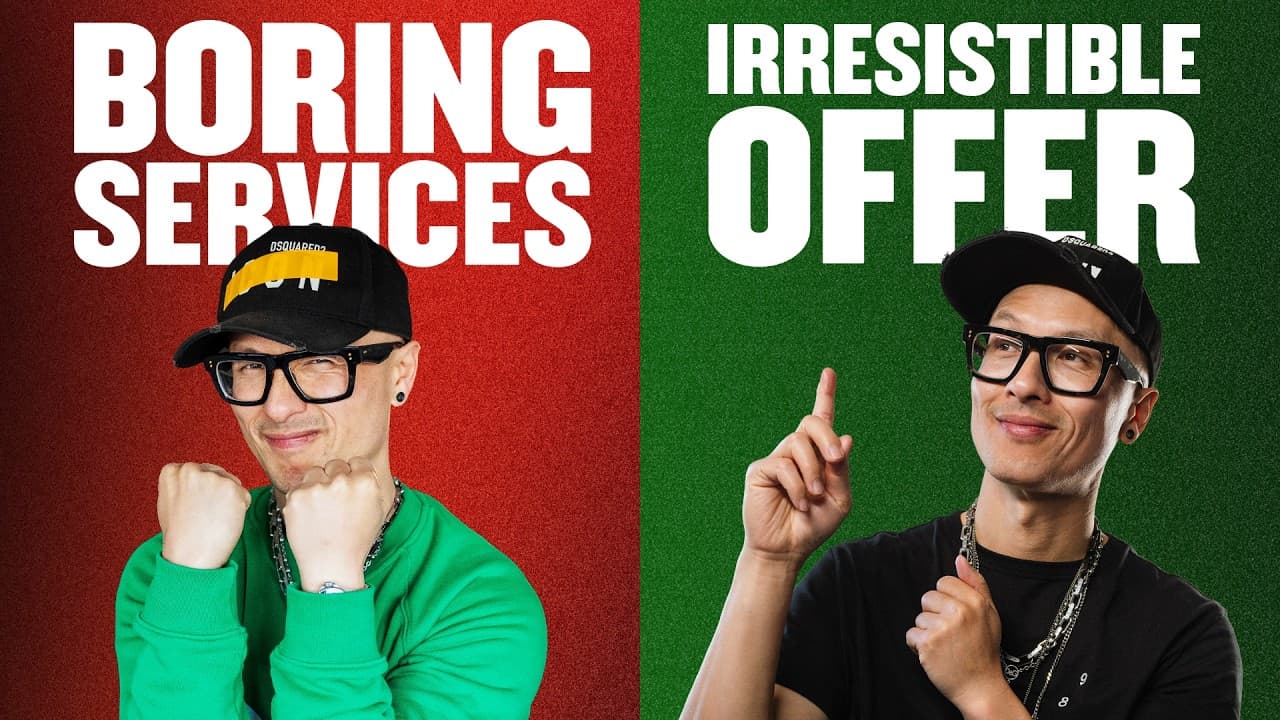
How to price and package services for premium buyers
TL;DR
The core idea is to use value based pricing to attract high paying clients by selling outcomes, not deliverables. Define the dream outcome, identify buyer fears and risk, and provide clear assurances and a faster, cleaner process. This reduces ghosting and upsells faster by offering a measurable path from discovery to delivery.
Transcript
Why do you all think you need to make something affordable? Who told you you need to do that? You want to charge less, but for some reason, you want to pay more? There's a problem with that because you'd be broke. There's a reason why I like to work with very successful people cuz they think like I think. So, you have to change your mindset, your o... Read More
Key Insights
- Pricing should reflect value and outcomes, not just deliverables.
- The dream outcome is what the client wants to achieve, not what you do.
- Identify and address buyer fears such as waste of time and mismatch to reduce risk.
- Clarify assurances like timelines, mood boards, and two design concepts to increase certainty.
- Discovery calls should be framed as collaborative and outcome focused rather than task oriented.
- A clear road map and a money back guarantee can significantly reduce buyer hesitation.
- Limit options to three concepts to avoid decision paralysis and speed up approval.
- Offer two timelines and a defined revision policy to accelerate delivery and billing.
- More videos from this channel:
- More from this channel: The Futur
Install to Summarize YouTube Videos and Get Transcripts
Explore YouTube Video Summarizer or Get YouTube Transcript Extractor
Questions & Answers
Q: What is the main pricing shift recommended for premium buyers
The main pricing shift is to move from charging for deliverables to selling outcomes. This means pricing based on the value the client receives, such as increased leads or better brand impact, rather than the specific design tasks performed. It requires understanding the client dream outcome and aligning the offer to deliver that result.
Q: How should you define the client’s dream outcome
Defining the dream outcome involves identifying what the client wants to achieve as a result of hiring you, such as leads or growth, and translating that into tangible, measurable results. This focuses the offer on value and helps justify a higher price by showing the end benefits beyond aesthetics.
Q: What fears should you identify and address for buyers
You should identify fears like the identity not matching, waste of time and money, and not getting the vision right. Address these by offering concrete safeguards such as timelines, milestones, and clear communication. Acknowledging fears helps reduce perceived risk and makes the offer more attractive.
Q: What assurances increase the certainty of outcomes
Assurances include a clear discovery and mood board process, two design concepts, a defined timeline, and a road map showing stages and approvals. Providing a structure that guides the project from start to finish reduces uncertainty, helps clients feel in control, and speeds up decision making.
Q: Why is a discovery call framed as collaborative important
Framing discovery as collaborative helps the client feel involved and heard, which increases trust and perceived value. It shifts the conversation from a vendor delivering tasks to a partnership focused on achieving outcomes, making the client more likely to commit to the process and pricing.
Q: How can you reduce time to result in the design process
Reduce time by offering three design concepts instead of four, restricting revision cycles, and establishing faster approval turns such as 24 hour response windows. A streamlined process cuts waiting time, prevents backlog, and accelerates the path to final delivery.
Q: What is the role of a road map in the sales process
A road map clarifies the upcoming steps, milestones, and checkpoints, giving the client a clear view of how the project will progress and when decisions are needed. It reduces ambiguity, improves confidence, and speeds up commitment by showing a transparent, outcome oriented plan.
Q: How does a risk reversal guarantee influence buyer decisions
A risk reversal guarantee, such as a money back option if mood boards do not align, removes the perceived risk of trying a new provider. It signals confidence in your process and makes the client more willing to proceed, knowing there is a safety net if expectations are not met.
Summary & Key Takeaways
-
This segment explains why charging low prices attracts low value clients and repels premium buyers, and it guides you to shift to outcomes based pricing.
-
It emphasizes defining the dream outcome for clients and addressing their fears with concrete assurances, timelines, and a structured process.
-
It shows how to speed up decisions by offering a clear road map, limited revisions, and a risk reversal guarantee to reduce buying friction.
Read in Other Languages (beta)
Share This Summary 📚
Summarize YouTube Videos and Get Video Transcripts with 1-Click
Try YouTube Summary with ChatGPT & Claude or YouTube Transcript Generator
Explore More Summaries from The Futur 📚




Summarize YouTube Videos and Get Video Transcripts with 1-Click
Try YouTube Summary with ChatGPT & Claude or YouTube Transcript Generator