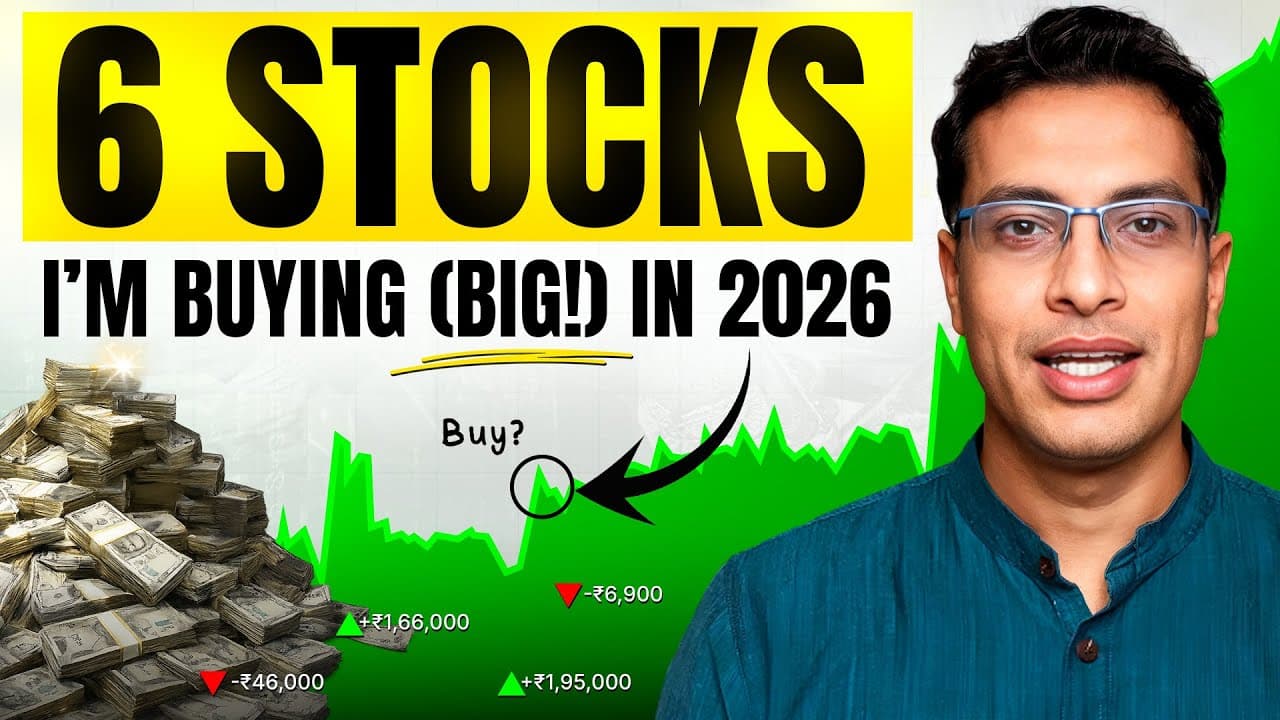
Which 6 Stocks Is Akshat Shrivastava Buying for 2026?
TL;DR
Six stocks are named for 2026: Amazon, IDFC First Bank, PVR, IEX, Melly and Netflix, presented as data analysis rather than recommendation. The Amazon thesis is that shifting capex from low-margin retail to high-margin AWS lifts return on invested capital, driving both EPS growth and PE expansion. IDFC First Bank's market cap moved from around 50,000 crore to 73,000-74,000 crore.
Transcript
Hi everyone. So I will not make you wait till the end of this video to reveal the stock names. Here are six stocks that I will cover on this video. Amazon, IDFC, First Bank, PVR, IEX, Melly and Netflix. Now I am bullish about these stocks in 2026. It is not as if that I'm building positions today on these stocks. Some positions I have built it last... Read More
Key Insights
- The six stocks named for 2026 are Amazon, IDFC First Bank, PVR, IEX, Melly and Netflix. The presentation is framed as fundamental, macro and business analysis offered through an educational lens, explicitly not as a stock recommendation, with viewers told to do their own due diligence.
- Amazon has been a laggard among the Magnificent Seven not just for one year but for five years. Identifying why a stock underperforms its peer group is described as the fundamental analysis question most investors skip while examining a hundred ratios that miss the point.
- Return on invested capital measures capital efficiency: if a company puts an additional $100 into building capacity and expects to make $115 from it, that is 15% ROIC. Amazon's ROIC shrank during the retail-heavy capex phase and is now rising again.
- Stocks rise for two mathematical reasons only: the PE of the business expanding, or an improvement in earnings per share. Expecting $100 to become $120 in a year without understanding which of those two engines drives it is described as the common investor mistake.
- Tesla is presented as a case where EPS has not been expanding, described as going really bad, yet the PE stays in a certain zone. The explanation offered is that Elon Musk's marketing signals huge business potential to investors, so the stock keeps commanding an excellent PE.
- Amazon's revenue has grown consistently while gross profit margins have trended upward. Two high-margin operating income streams are highlighted as the growth engines: AWS, which absorbs most current capex, and advertising revenue, which has grown consistently on the tracked chart.
- Technical and fundamental analysis are described as complementary. Following Amazon's price channel since the channel began in 2023 after the 2022 dip would have produced a 15-16% gain opportunity on technicals alone, and converging both methods builds a stronger buy or sell thesis.
- Covered calls sold 30% out of the money are used on the Amazon position to generate extra income alongside the long-term holding. This is described as a high-level finance topic to be covered separately, with an existing video linked for the basic definition.
- IDFC First Bank's market cap has moved from around 50,000 crore when it was first discussed to 73,000-74,000 crore, with all positions still held. Market cap is cited as the key metric tracked for this Indian banking stock.
Install to Summarize YouTube Videos and Get Transcripts
Explore YouTube Video Summarizer or Get YouTube Transcript Extractor
Questions & Answers
Q: What are the 6 stocks Akshat Shrivastava is buying in 2026?
The six stocks are Amazon, IDFC First Bank, PVR, IEX, Melly and Netflix. These are not all new positions opened at the time of the video. Some were built during the previous year or in the last quarter of 2025, and others are being tracked so that more can be accumulated when a more opportune entry appears. The video is explicitly framed as data analysis and research presented through an educational lens rather than as a stock recommendation, and both the video and the description state that this is not investment advice and viewers should do their own due diligence.
Q: Why has Amazon stock underperformed the other Magnificent Seven stocks?
Amazon has lagged the other Magnificent Seven companies not for one year but for five years. The reason given is the previous investment cycle, running roughly from 2018 to 2022, when Amazon's capital expenditure went primarily into the retail and e-commerce space. E-commerce carries a lower profit margin, so even though it was a big growth engine, the return on invested capital from that spending was low relative to the other Magnificent Seven stocks. Understanding this specific peer-group underperformance is described as the key fundamental question, one most investors miss while examining a hundred different ratios.
Q: What is ROIC and why does it matter for Amazon?
ROIC stands for return on invested capital, and it is a metric that indicates capital efficiency. The explanation given is simple: if a company invests an additional $100 in improving its business, for example by building a new factory, and expects that the added capacity will generate $115, that is a 15% ROIC. For Amazon, ROIC shrank during the retail-heavy capital expenditure phase, which is the core reason the stock was one of the worst performers among its peers in that cycle. ROIC is now rising, and the thesis is that as AWS grows, ROIC will keep improving.
Q: How does the AWS shift change the Amazon investment thesis?
The capital expenditure cycle that began around 2024 to 2025 directs most of Amazon's spending toward AWS, Amazon Web Services, which is a high profit margin business, unlike the low-margin retail spending of the previous cycle. Amazon is also building its own chips, Inferentia and Tranium, and increasing data center capacity, described as one of the core businesses it will run in the future. Because AWS carries higher margins, the argument is that Amazon's ROIC improves, profit margins improve, and that improvement flows through to earnings per share while also creating the conditions for a PE expansion.
Q: Why do stock prices go up according to this analysis?
Stocks grow for only two reasons: the price-to-earnings multiple of the business expands, or earnings per share improves. The common mistake described is investors putting in $100 and expecting $120 the next year without looking at the mathematics that produces that 20%. For Amazon specifically, the argument is that both engines can fire together: EPS is likely to go up as profit margins improve, and PE is likely to go up after a long period of derating. That combination is described as a double engine for stock price growth.
Q: What does the Tesla comparison illustrate about PE and EPS?
Tesla is offered as a case study of one engine working without the other. Tesla's EPS has not been expanding, described as going really bad, yet its PE stays within a certain zone. The explanation given is that excellent marketing by Elon Musk signals to investors that the potential of Tesla's business is huge and that the company will go out and dominate every industry, so Tesla continues to command an excellent PE. Amazon is presented as the exact opposite situation: EPS keeps expanding while the PE keeps getting derated, meaning it keeps softening.
Q: How can technical analysis be combined with fundamental analysis on a stock like Amazon?
The two are described as complementary rather than competing. On Amazon, a price channel is shown that has held since the channel started in 2023, after the 2022 dip, and most current positions were built within it. Buying at the lower part of that channel is described as a 15 to 16% gain opportunity on technicals alone, meaning someone following the charts could have captured it without studying the business. Converging technical and fundamental analysis is said to produce a very good thesis for deciding whether to be a net buyer or a net seller of a particular stock.
Q: What is a covered call and how is it used on the Amazon position?
Covered calls are being sold on the Amazon position at 30% out of the money as a way to generate extra income on top of holding the stock. The mechanics are described as a high-level finance topic to be covered in a separate video, with an existing video linked for viewers who want the basic definition of what a covered call means. The practice is already underway on the position, presented alongside a continued strong buy stance on Amazon in which more will be added on every dip.
Q: How has IDFC First Bank performed since it was first covered?
IDFC First Bank is the second stock discussed and the first Indian stock in the list. The metric emphasized is market capitalization. When the stock was first discussed in earlier videos, its market cap was around 50,000 crore, and it has since moved to roughly 73,000 to 74,000 crore. All positions in the stock are still held, and the bullish stance from those previous videos continues. Market cap is presented as the key thing that was repeatedly highlighted about this bank.
Q: Is Akshat Shrivastava buying all six stocks right now?
No, he says he is not currently building positions in all six stocks. Some positions were built last year or in the last quarter of 2025, while he is tracking other stocks for a more opportune time.
Q: How much has Akshat Shrivastava invested in Amazon stock?
He says he has invested more than $200,000 in Amazon stock in one of his portfolios. He also says the position is already up and making money.
Q: Are Amazon’s revenue and profit margins improving?
Yes, the analysis says Amazon’s total revenue has consistently grown while its profit margins have improved. Its gross profit margin is described as being mostly on a positive trajectory.
Summary & Key Takeaways
-
Six stocks are covered upfront rather than teased: Amazon, IDFC First Bank, PVR, IEX, Melly and Netflix. Positions were not all opened on the day of recording. Some were built in the previous year or in the last quarter of 2025, and others are simply being tracked so more can be added at a more opportune time.
-
Amazon is the central case study. It lagged the other Magnificent Seven stocks over five years because the 2018-2022 capex cycle went heavily into lower-margin e-commerce retail, pushing return on invested capital below peers. The 2024-2025 cycle shifts spending into AWS, chips such as Inferentia and Tranium, and data center capacity.
-
Stock prices are framed as moving for only two reasons: PE expansion or EPS improvement. Tesla is cited as a stock whose EPS is not expanding while its PE holds up, attributed to marketing. Amazon is the opposite, with EPS expanding while PE keeps getting derated, so both engines could fire together.
Read in Other Languages (beta)
Share This Summary 📚
Summarize YouTube Videos and Get Video Transcripts with 1-Click
Try YouTube Summary with ChatGPT & Claude or YouTube Transcript Generator
Explore More Summaries from Akshat Shrivastava 📚

Summarize YouTube Videos and Get Video Transcripts with 1-Click
Try YouTube Summary with ChatGPT & Claude or YouTube Transcript Generator