Products
Features
YouTube Video Summarizer
Summarize YouTube videos
Web & PDF Highlighter
Highlight web pages & PDFs
Chat with PDF
Ask any PDF questions with AI
Ask AI Clone
Chat with your highlights & memories
Audio Transcriber
Transcribe audio files to text
Glasp Reader
Read and highlight articles
Kindle Highlight Export
Export your Kindle highlights
Idea Hatch
Hatch ideas from your highlights
Integrations
Obsidian Plugin
Notion Integration
Pocket Integration
Instapaper Integration
Medium Integration
Readwise Integration
Snipd Integration
Hypothesis Integration
Apps & Extensions
Chrome Extension
Safari Extension
Edge Add-ons
Firefox Add-ons
iOS App
Android App
Discover
Discover
Ideas
Discover new ideas and insights
Articles
Curated articles and insights
Books
Book recommendations by great minds
Posts
Essays and notes from readers
Quotes
Inspiring quotes collection
Videos
Curated videos and summaries
Explore Glasp
Glasp Story
How we grew from 0 to 3 million users
Glasp Newsletter
Weekly insights and updates
Glasp Talk
Interview series with great minds
Glasp Blog
Latest news and articles
Glasp Use Cases
Learn how others use Glasp
Build & Support
Glasp API
Access Glasp's API for developers
MCP Connector
Connect Glasp to Claude & ChatGPT
Community
Glasp Reddit Community
Students
Student discount and benefits
FAQs
Frequently Asked Questions
AboutPricing
DashboardLog inSign up

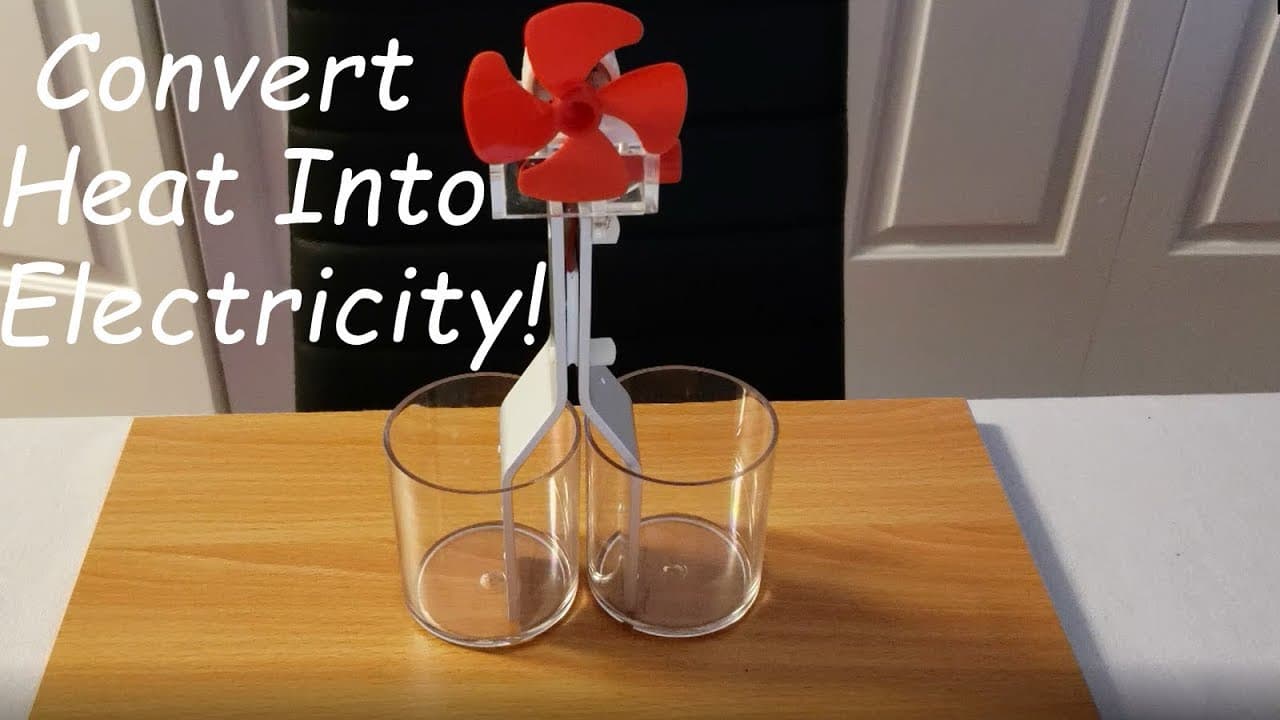
Thermodynamics - Converting Heat Energy Into Electricity Using a Thermoelectric Generator
November 28, 2019
by
The Organic Chemistry Tutor
YouTube video player
Thermodynamics - Converting Heat Energy Into Electricity Using a Thermoelectric Generator

TL;DR

Thermoelectric generators can convert heat into electricity with an efficiency of around 5-8%, generating useful work while losing the majority of thermal energy to the environment.

Transcript

so here we have a thermoelectric generator you can see it in the middle this device can convert heat into electricity one side has to be hot and the other side has to be cold so let me go ahead and demonstrate that for you so here we have the thermoelectric generator in its active state on the left side the cup contains hot water and on the right s... Read More

Key Insights

  • 🥵 Thermoelectric generators convert heat into electricity by utilizing the thermoelectric effect.
  • 🌸 The efficiency of these generators is typically around 5-8%, resulting in a significant loss of thermal energy.
  • 🥵 Reversing the operation of a thermoelectric generator allows it to function as a heat pump, transferring heat from one surface to another.

Install to Summarize YouTube Videos and Get Transcripts

Explore YouTube Video Summarizer or Get YouTube Transcript Extractor

Questions & Answers

Q: How does a thermoelectric generator convert heat into electricity?

A thermoelectric generator uses the flow of thermal energy from a hot reservoir to a cold reservoir to generate electricity through the thermoelectric effect.

Q: What is the typical efficiency of a thermoelectric generator?

The typical efficiency of a thermoelectric generator is around 5-8%, meaning only a small portion of thermal energy is converted into useful work.

Q: Can a thermoelectric generator create a temperature differential?

Yes, by applying an electric current to the device, a temperature differential can be created, with one side becoming cold and the other side becoming hot.

Q: What safety precautions are important when using a thermoelectric generator?

It is vital to limit the current flowing through the device to prevent overheating and potential fire hazards. Using a current limiting resistor is recommended for safety purposes.

Summary & Key Takeaways

  • Thermoelectric generators convert heat into electricity through the flow of thermal energy from a hot reservoir to a cold reservoir.

  • These devices typically have an efficiency of around 5%, with only a small portion of thermal energy being converted into electrical energy.

  • Reversing the operation of the generator allows it to function as a heat pump, transferring heat from one surface to another.


Read in Other Languages (beta)

English

Share This Summary 📚

Summarize YouTube Videos and Get Video Transcripts with 1-Click

Download browser extensions on:

Try YouTube Summary with ChatGPT & Claude or YouTube Transcript Generator

Explore More Summaries from The Organic Chemistry Tutor 📚
First Law of Thermodynamics, Basic Introduction, Physics Problems thumbnail
First Law of Thermodynamics, Basic Introduction, Physics Problems
The Organic Chemistry Tutor
How to Convert Alcohols into Alkyl Halides thumbnail
How to Convert Alcohols into Alkyl Halides
The Organic Chemistry Tutor
What Is Chemical Shift in NMR Spectroscopy? thumbnail
What Is Chemical Shift in NMR Spectroscopy?
The Organic Chemistry Tutor
Detour Proofs - Double Triangle Congruence thumbnail
Detour Proofs - Double Triangle Congruence
The Organic Chemistry Tutor
Gaussian Elimination With 4 Variables Using Elementary Row Operations With Matrices thumbnail
Gaussian Elimination With 4 Variables Using Elementary Row Operations With Matrices
The Organic Chemistry Tutor
Integral of tan^5(x) thumbnail
Integral of tan^5(x)
The Organic Chemistry Tutor

Summarize YouTube Videos and Get Video Transcripts with 1-Click

Download browser extensions on:

Try YouTube Summary with ChatGPT & Claude or YouTube Transcript Generator

Apps & Extensions

  • Chrome Extension
  • Safari Extension
  • Edge Add-ons
  • Firefox Add-ons
  • iOS App
  • Android App

Key Features

  • YouTube Video Summarizer
  • Web & PDF Summarizer
  • Web & PDF Highlighter
  • Chat with PDF
  • Ask AI Clone
  • Audio Transcriber
  • Glasp Reader
  • Kindle Highlight Export
  • Idea Hatch

Integrations

  • Obsidian Plugin
  • Notion Integration
  • Pocket Integration
  • Instapaper Integration
  • Medium Integration
  • Readwise Integration
  • Snipd Integration
  • Hypothesis Integration

More Features

  • APIs
  • MCP Connector
  • Blog & Post
  • Embed Links
  • Image Highlight
  • Personality Test
  • Quote Shots
  • Open Graph Checker

Company

  • About us
  • Our Story
  • Blog
  • Community
  • FAQs
  • Job Board
  • Newsletter
  • Pricing
Terms

•

Privacy

•

Guidelines

© 2026 Glasp Inc. All rights reserved.