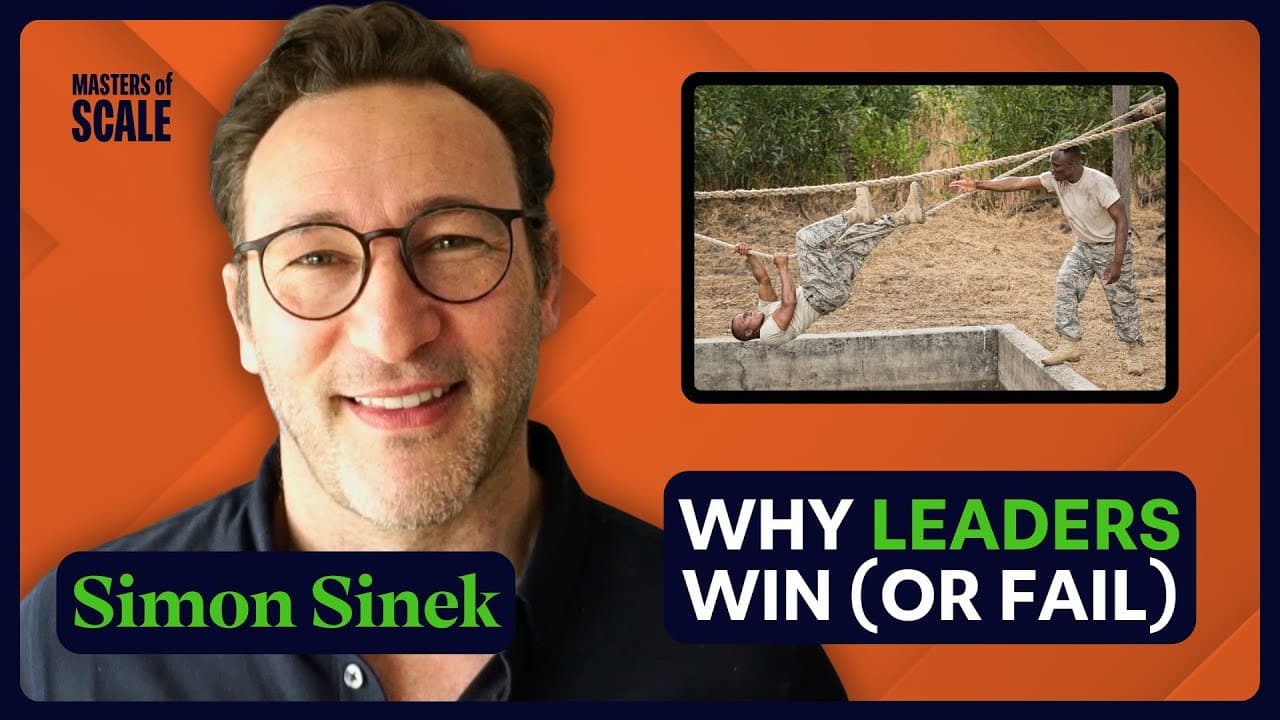
Simon Sinek: What the best leaders have in common (with Reid Hoffman)
TL;DR
Leadership isn't measured by success; true qualities ensure long-term success.
Transcript
We understand that sometimes good leaders suffer a mission failure and sometimes bad leaders enjoy mission success. So the success or failure that they have in the mission doesn't tell us if they're a good leader or not. But we know that if we select the people who have the qualities of good leadership that over time they will enjoy mission success... Read More
Key Insights
- Leadership success isn't solely determined by mission outcomes; true leadership qualities are crucial for long-term success.
- In Silicon Valley, the difference between missionaries and mercenaries affects company longevity and mission alignment.
- Performance-driven cultures often misalign incentives, focusing on outcomes rather than the necessary inputs for success.
- Missionaries prioritize their mission over short-term financial gains, often rejecting large venture capital for greater autonomy.
- Leadership qualities include willingness to listen, decisiveness, and the ability to integrate ideas from others.
- The Marine Corps evaluates leadership through characteristics rather than mission success, focusing on long-term leader development.
- Business environments often prioritize short-term gains, contrasting with the Marine Corps' focus on cultivating leadership qualities.
- Effective incentive structures balance financial rewards with mission alignment, fostering a culture of true leadership.
Install to Summarize YouTube Videos and Get Transcripts
Explore YouTube Video Summarizer or Get YouTube Transcript Extractor
Questions & Answers
Q: What is the main argument Simon Sinek presents about leadership?
Simon Sinek argues that leadership should not be measured solely by mission success or failure. Instead, true leadership is defined by the qualities and characteristics that lead to long-term success. He emphasizes the importance of qualities like decisiveness and willingness to listen, which contribute to enduring leadership.
Q: How does the discussion differentiate between missionaries and mercenaries?
The discussion differentiates missionaries as individuals who build enduring companies by prioritizing the mission over short-term financial gains. In contrast, mercenaries focus on immediate profits and outcomes, often at the expense of the company's long-term mission and values. This distinction affects the sustainability and integrity of organizations.
Q: What role do incentive structures play in leadership and company culture?
Incentive structures play a significant role in shaping leadership and company culture. The conversation highlights that performance-driven cultures often misalign incentives, focusing on outputs rather than inputs. Effective incentive structures should balance financial rewards with mission alignment to cultivate true leadership and long-term success.
Q: What insights does the Marine Corps' leadership evaluation provide?
The Marine Corps' leadership evaluation provides insights into measuring leadership based on characteristics rather than mission success. Their approach focuses on developing leaders with qualities like decisiveness and the ability to integrate ideas, contrasting with business practices that often prioritize short-term performance metrics over long-term leadership development.
Q: Why do missionaries often reject large venture capital investments?
Missionaries often reject large venture capital investments to maintain autonomy and mission integrity. They prioritize long-term mission success over short-term financial gains, choosing alternative funding methods like bootstrapping or smaller investments that align with their mission and values, ensuring that their vision remains untainted by external pressures.
Q: How does the conversation address the balance between mission and financial incentives?
The conversation addresses the balance between mission and financial incentives by highlighting the importance of aligning incentives with the mission. It suggests that focusing solely on financial rewards can undermine the mission, whereas balancing these incentives fosters a culture of true leadership and ensures long-term organizational success.
Q: What are some characteristics of good leaders according to the discussion?
According to the discussion, good leaders possess characteristics such as decisiveness, willingness to listen to others, and the ability to integrate diverse ideas. These qualities contribute to long-term success and are more indicative of true leadership than mere mission outcomes, emphasizing the importance of personal attributes in leadership roles.
Q: How does the discussion relate to the current state of Silicon Valley?
The discussion relates to the current state of Silicon Valley by contrasting the earlier days, characterized by missionaries, with the present, which sees more mercenaries. This shift is attributed to venture capital models prioritizing short-term returns, often conflicting with the mission, highlighting the need for a balance between financial incentives and mission alignment.
Summary & Key Takeaways
-
In a conversation between Simon Sinek and Reid Hoffman, the discussion highlights the importance of leadership qualities over mere mission success. They explore how true leaders are not defined solely by outcomes but by their ability to inspire and maintain mission alignment.
-
The dialogue contrasts missionaries, who build enduring companies, with mercenaries, who prioritize short-term gains. Sinek emphasizes that true leaders focus on the mission, often rejecting large investments to maintain autonomy and integrity.
-
The Marine Corps' leadership evaluation method is discussed, showcasing a system that prioritizes leadership characteristics over mission success. This approach contrasts with typical business practices that often focus on short-term performance metrics.
Read in Other Languages (beta)
Share This Summary 📚
Summarize YouTube Videos and Get Video Transcripts with 1-Click
Try YouTube Summary with ChatGPT & Claude or YouTube Transcript Generator