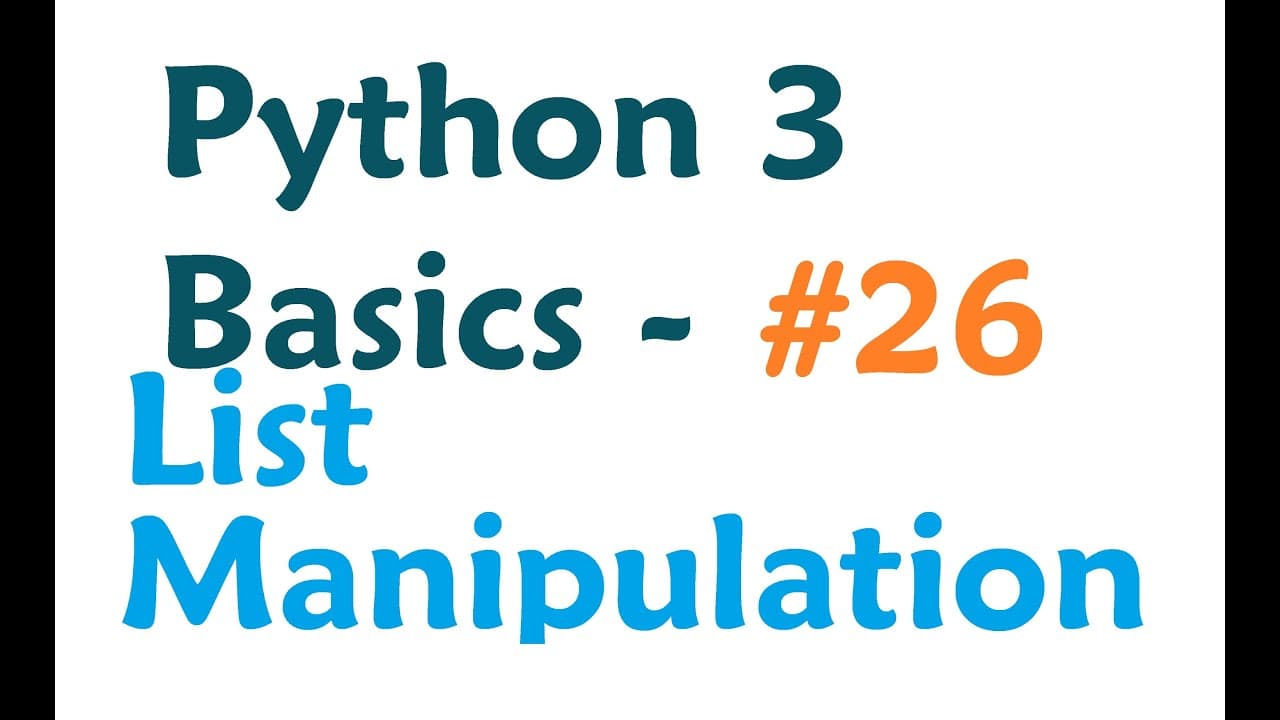
How to Manipulate Lists in Python 3
TL;DR
To manipulate lists in Python, you can add elements using the append or insert methods, remove elements with remove, and find their positions using the index function. You can also count occurrences of an element with count, slice the list, and sort it with the sort method, which automatically sorts numerically or alphabetically based on data type.
Transcript
what's going on everybody welcome to another Python 3 Basics video in this video what we're going to be talking about is list manipulation within python so the last video we talked about tupal versus lists and we said that lists are mutable which means we can manipulate them change them and all sorts of fun stuff and there's a lot of builtin things... Read More
Key Insights
- 👂 Lists in Python are mutable and can be changed and manipulated.
- 👂 Elements of different data types can be added to a list.
- 🪜 The append function adds elements to the end of a list, and the insert function allows adding elements at specific positions.
- 🫰 The remove function removes specific elements from a list, and the index function returns the index value of a specific element.
- 👻 Slicing enables extracting a portion of a list, and negative indexing allows accessing elements from the end.
- 🔄 The count function can be used to count the occurrences of a specific element in a list.
- 👂 Lists can be sorted using the sort function, which handles sorting numerically or alphabetically based on the data type in the list.
Install to Summarize YouTube Videos and Get Transcripts
Explore YouTube Video Summarizer or Get YouTube Transcript Extractor
Questions & Answers
Q: What is list manipulation in Python?
List manipulation refers to the ability to add, remove, reference, and modify elements in a list data structure in Python.
Q: Can elements of different data types be added to a list?
Yes, a Python list can contain elements of any data type, including numbers, strings, and even other lists.
Q: How can an element be inserted at a specific position in a list?
The insert function is used to add an element at a specific index position in a list. The first argument specifies the index, and the second argument specifies the value to be inserted.
Q: How can elements be removed from a list?
The remove function is used to remove the first occurrence of a specific element from a list. Alternatively, you can specify the index value of the element to be removed using the del keyword.
Q: How can a specific element in a list be referenced?
Elements in a list can be referenced using their index value. The index starts from 0 for the first element, and negative indexing can be used to access elements from the end of the list.
Q: How can a slice of a list be obtained?
Slicing allows you to extract a portion of a list by specifying the starting and ending index values. The slice will include elements from the starting index up to, but not including, the ending index.
Q: How can the index value of a specific element be found?
The index function returns the index value of the first occurrence of a specific element in a list. This can be useful when working with multiple lists that correspond to each other.
Q: How can the occurrences of a specific element be counted in a list?
The count function is used to determine the number of occurrences of a specific element in a list. It returns an integer indicating the count.
Summary & Key Takeaways
-
Lists in Python are mutable, meaning they can be changed and manipulated.
-
Append can be used to add elements to the end of a list.
-
Insert allows for adding elements at specific positions in the list.
-
The remove function can be used to remove specific elements from a list.
-
The index function returns the index value of a specific element in a list.
-
The count function can be used to count the occurrences of a specific element in a list.
-
Lists can be sorted using the sort function, which sorts numerically or alphabetically based on the type of data in the list.
Read in Other Languages (beta)
Share This Summary 📚
Summarize YouTube Videos and Get Video Transcripts with 1-Click
Try YouTube Summary with ChatGPT & Claude or YouTube Transcript Generator
Explore More Summaries from sentdex 📚
Summarize YouTube Videos and Get Video Transcripts with 1-Click
Try YouTube Summary with ChatGPT & Claude or YouTube Transcript Generator