How Can Energy Supply Keep Pace With AI Growth?
TL;DR
Electricity availability, rather than its price, is the immediate constraint on expanding AI data centers. Faster grid connections, locating compute near abundant generation, and deploying solar, batteries, natural gas, fission, or future fusion could ease that bottleneck, while sodium-ion batteries may eventually reduce battery costs by a factor of 10.
Transcript
In the US, [music] if you put in a request for a hundreds of megawatts of power to build the data center today, good luck getting that power before 2031. That's the situation that we have today. So, new technologies like sodium ion batteries could drop the cost of batteries by a factor of 10. We already have [music] the very first solar plus batter... Read More
Key Insights
- Electricity availability is the main energy constraint on AI because large data centers can generate far more value from power than the electricity costs. AI developers may therefore accept electricity at twice the usual price when it can be supplied immediately instead of years later.
- A gigawatt-scale data center is described as a $50 billion project, with approximately $35 billion allocated to chips. This cost distribution shows why optimizing electricity prices is less urgent than securing enough power to operate expensive computing hardware without prolonged delays.
- The grid connection queue has expanded from roughly 15 months 20 years ago to nearly 45 months today. This delay affects new generation projects seeking to connect solar, wind, natural gas, or other power sources to customers through existing transmission and distribution infrastructure.
- Grid construction has slowed partly because reduced electricity-demand growth changed how utilities operate. Utilities became more focused on customer service and regulatory requirements, while permitting for land controlled by counties, states, and the federal government created additional barriers to building poles and wires.
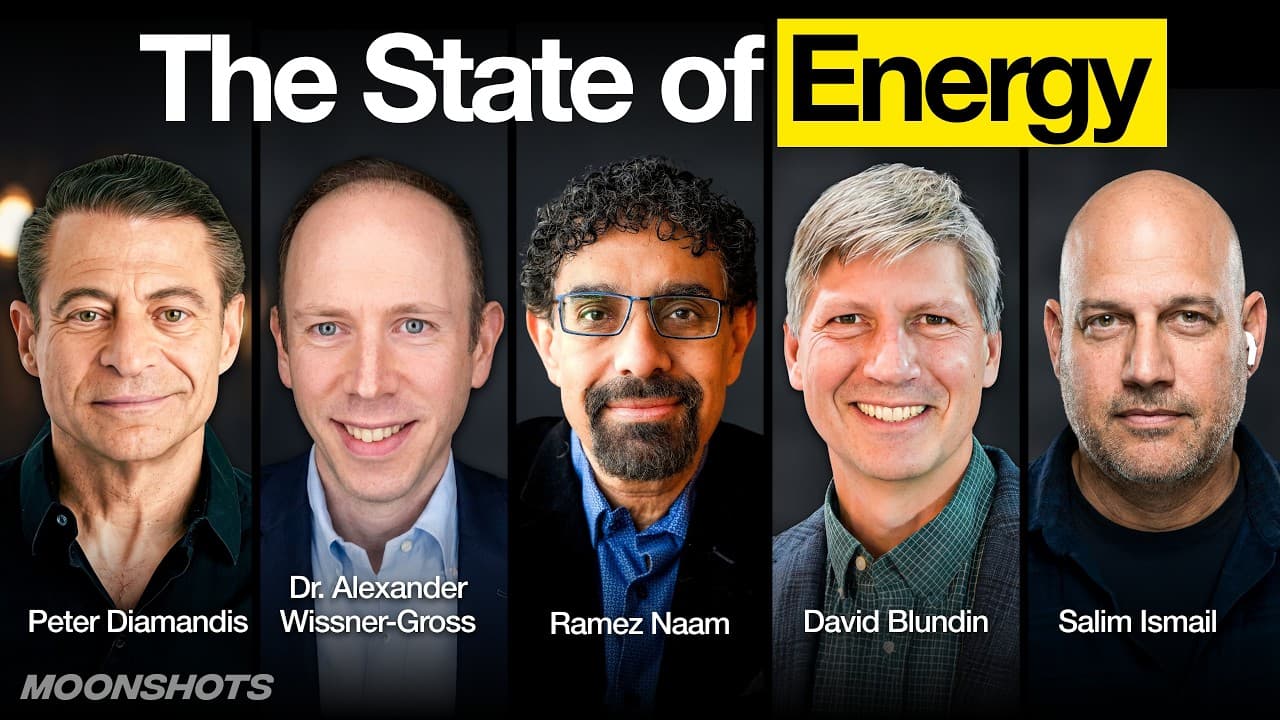
- AI progress has historically shown a roughly log-linear relationship between training-data scale and model precision, according to Naam. Larger gains therefore require rapidly increasing compute, although continuing algorithmic improvements can bend the curve and reduce how severe the diminishing returns become.
- Solar, wind, batteries, and natural gas can still be built comparatively quickly, but delivering their output through the grid remains difficult. The discussion therefore emphasizes speed to power and behind-the-meter generation as practical responses to delayed grid expansion and interconnection.
- Sodium-ion batteries could eventually reduce battery costs by a factor of 10, while battery prices are already falling. The discussion also notes that the first combined solar-and-battery power plants are operating at affordable costs, supporting a broader case for increasingly economical clean electricity.
- Space-based and ocean-based data centers are presented as speculative responses to constrained terrestrial power. A space system producing 10 gigawatts annually is estimated to require five or six Starship launches every day, making that approach prohibitive for 15 to 20 years without full exponential progress.
Install to Summarize YouTube Videos and Get Transcripts
Explore YouTube Video Summarizer or Get YouTube Transcript Extractor
Questions & Answers
Q: Why is electricity a bottleneck for AI data centers?
Electricity is a bottleneck because the grid cannot provide large new connections as quickly as AI developers want to build computing capacity. A request for hundreds of megawatts in the United States may not receive power before 2031. Since chips dominate project costs and AI can produce substantial revenue from electricity, timely access matters more than securing the lowest possible rate.
Q: How much does power contribute to AI data center costs?
Power is described as inexpensive compared with the computing equipment inside an AI data center. A gigawatt-scale facility may require $50 billion in total capital, with $35 billion spent on chips. Its five-year electricity expense is comparatively small beside that investment, which explains why an AI company could accept power at twice the usual cost if it were available immediately.
Q: Why are grid interconnection delays getting longer?
Grid interconnection delays have risen because utilities and permitting systems are no longer organized for rapid expansion. The generation queue reportedly grew from about 15 months 20 years ago to nearly 45 months. Slower demand growth changed utility priorities, while approvals involving county, state, and federal land further delay the poles and wires required to connect new projects.
Q: Can new power generation be built faster than the grid?
Solar, wind, batteries, and natural gas generation can still be developed relatively quickly, but transmission and distribution infrastructure are harder to expand. The core problem is therefore not limited to producing electricity. New projects must also obtain permission and physical connections to deliver power, and the growing interconnection queue can leave otherwise viable generation waiting for years.
Q: How could sodium-ion batteries change energy costs?
Sodium-ion batteries could eventually reduce battery costs by a factor of 10, according to the discussion. That possibility accompanies an existing decline in battery prices and the emergence of affordable combined solar-and-battery power plants. If the projected reduction occurs, storage could support more low-cost electricity, although the transcript presents the tenfold decline as a future possibility rather than a completed result.
Q: How does increasing compute affect AI performance?
AI performance is described as having a roughly log-linear relationship with compute and training-data scale, meaning progressively larger resources are needed for continued gains. Naam says algorithmic improvements repeatedly make this relationship more efficient, citing recent model advances as examples. These improvements bend the curve, but he still expects steeply diminishing returns rather than an end to rising compute and electricity requirements.
Q: Could moving data centers solve the power shortage?
Moving data centers closer to abundant energy is presented as one response to slow grid expansion. This approach shifts compute toward available generation instead of waiting for utilities to deliver hundreds of megawatts at a preferred location. The broader discussion considers behind-the-meter power and large solar projects, while also exploring more speculative ocean-based and space-based data-center concepts.
Q: Are space-based data centers practical in the near term?
Space-based data centers face an enormous launch requirement under the scenario discussed. Supplying 10 gigawatts per year is estimated to require five or six Starship launches every day. Without fully sustained exponential progress, the concept appears prohibitive for 15 to 20 years. It is therefore framed as a moonshot rather than an immediate answer to current grid connection delays.
Summary & Key Takeaways
-
AI expansion is constrained by access to electricity because the grid cannot connect large new loads quickly enough. A gigawatt-scale data center may cost $50 billion, including $35 billion for chips, so electricity remains relatively inexpensive beside computing hardware. For AI companies, obtaining power promptly can matter more than its price.
-
Grid infrastructure is the central near-term obstacle. The generation interconnection queue has lengthened from about 15 months 20 years ago to nearly 45 months. Slower demand growth changed utility priorities, while permitting across state, county, and federal land creates further delays for the poles and wires needed to deliver new electricity.
-
The proposed energy response combines practical technologies and longer-term experiments. Solar, wind, batteries, and natural gas can still be deployed relatively quickly, while fission and fusion have different timelines. Sodium-ion batteries could eventually reduce battery costs tenfold. Other possibilities include moving data centers toward abundant energy, into space, or onto wave-powered ocean platforms.
Read in Other Languages (beta)
Share This Summary 📚
Summarize YouTube Videos and Get Video Transcripts with 1-Click
Try YouTube Summary with ChatGPT & Claude or YouTube Transcript Generator
Explore More Summaries from Peter H. Diamandis 📚




Summarize YouTube Videos and Get Video Transcripts with 1-Click
Try YouTube Summary with ChatGPT & Claude or YouTube Transcript Generator