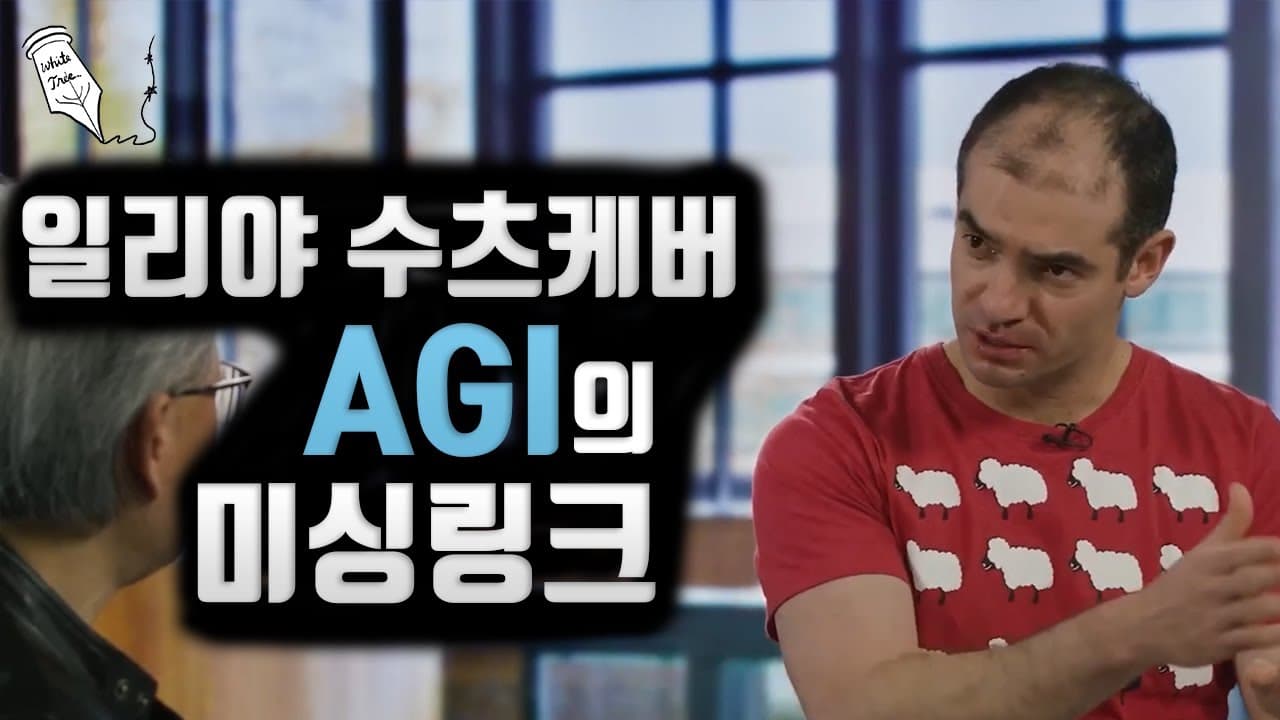
How did Ilia Sutskever spark the deep learning revolution?
TL;DR
Deep learning seemed promising because large, deep networks can represent complex solutions when trained on big data with sufficient compute. The breakthrough came from training on GPUs, realizing supervised learning at scale, and pursuing the idea that unsupervised learning could be driven by compression. These threads led to AlexNet, ImageNet, and eventually a path toward AI that accelerates with data and hardware.
Transcript
Ilia unbelievable today is the day after gpt4 it's great to have you here I'm delighted to have you I've known you a long time the journey and just my mental hit my my mental memory of your of the times that I've known you and the seminal work that you have done starting in Universal University of Toronto the co-invention of alexnet with Alex and J... Read More
Key Insights
- Deep learning became credible when networks were large enough to fit big data and compute, making the right questions tractable.
- Scale and data drove progress in neural nets, with supervised learning appearing as a practical path to traction before unsupervised approaches.
- GPUs provided the practical horsepower that allowed training of large convolutional networks at unprecedented speeds.
- The ImageNet data set served as a proving ground showing that deep nets could surpass traditional methods on difficult tasks.
- Unsupervised learning was an unsolved challenge in 2016, and compression was proposed as a route to learn from unlabeled data.
- The idea that learning in neural networks could parallel brain-like computation offered a compelling path for scalable AI.
- OpenAI pursued two enduring ideas from inception, including unsupervised learning through compression and the potential of large-scale models.
- The collaboration between Ilia Sutskever and Jeff Hinton helped crystallize the belief that data scale, compute, and supervised learning would drive AI breakthroughs.
Install to Summarize YouTube Videos and Get Transcripts
Explore YouTube Video Summarizer or Get YouTube Transcript Extractor
Questions & Answers
Q: What first convinced you that supervised learning would deliver real traction for neural networks?
The argument was that if a neural network is deep and large, it can be configured to solve a hard task, provided enough data and compute. This meant that larger models with more data could potentially outperform traditional methods. Optimization breakthroughs and recognizing supervised learning as a practical path to leverage data helped cement this view, especially as more powerful GPUs became available to train bigger networks.
Q: How did the idea of compression relate to unsupervised learning in your thinking?
Compression served as a conceptual bridge to unsupervised learning. The idea was that by compressing information, a model captures the essential structure of data, enabling it to learn representations without labeled targets. This perspective suggested that reducing redundancy could yield powerful, generalizable features suitable for downstream tasks, addressing a central challenge in unsupervised learning at the time.
Q: Why were GPUs crucial for the success of AlexNet and similar models?
GPUs provided the parallel processing power needed to train large convolutional networks efficiently. They allowed us to run many computations simultaneously, which dramatically reduced training time and made experiential experimentation with larger architectures feasible. This hardware shift turned the theoretical potential of deep learning into a practical, scalable approach.
Q: What data choice helped demonstrate the potential of deep learning in vision tasks?
ImageNet served as the benchmark that made the potential of deep learning clear. Training a large convolutional network on this dataset showed unprecedented performance improvements, signaling a discontinuity in computer vision and helping to redefine what could be achieved with data-driven models.
Q: What were the two big initial ideas at the start of OpenAI, and which endured?
One idea was unsupervised learning through compression, aiming to enable unsupervised progress by efficiently encoding data. The other idea focused on leveraging the potential of large-scale models and data to push the boundaries of what AI could do. Both ideas endured, shaping approaches and research directions that contributed to later breakthroughs like GPT.
Q: How did the early environment of AI research influence your approach at OpenAI?
In the early days, there were far fewer researchers, and progress depended on bold, foundational ideas rather than incremental advances. The scarcity of researchers meant that clear, high-potential lines of work—such as learning from data at scale and leveraging GPUs—were essential. This context pushed us to pursue ambitious, long-horizon goals.
Q: What role did collaboration with Jeff Hinton play in your work on AlexNet?
Collaborating with Jeff Hinton provided essential guidance on neural networks and learning, helping to identify the viability of deep architectures for vision tasks. Hinton’s interest in neural networks and parallel computing, combined with his mentorship, helped steer the project toward a breakthrough and set the stage for the broader exploration of deep learning.
Q: What lesson from the AlexNet era still informs your view on AI progress today?
The key lesson is that scale matters: large models trained on substantial data with adequate compute can yield breakthroughs that redefine a field. The combination of data, compute, and effective model design unlocks capabilities that were previously out of reach, underscoring the importance of continued investment in scalable AI research.
Summary & Key Takeaways
-
Ilia Sutskever traces the early intuition that learning is the key to progress in AI and that large, deep networks paired with data and compute unlocks powerful solutions.
-
GPUs played a pivotal role in enabling fast training of large convolutional networks, transforming feasibility into practice and accelerating the AI boom.
-
The conversation covers the shift from traditional methods to supervised and unsupervised learning, the importance of data scales like ImageNet, and the initial OpenAI ideas that shaped subsequent AI progress.
Read in Other Languages (beta)
Share This Summary 📚
Summarize YouTube Videos and Get Video Transcripts with 1-Click
Try YouTube Summary with ChatGPT & Claude or YouTube Transcript Generator
Explore More Summaries from 백색나무 📚

Summarize YouTube Videos and Get Video Transcripts with 1-Click
Try YouTube Summary with ChatGPT & Claude or YouTube Transcript Generator