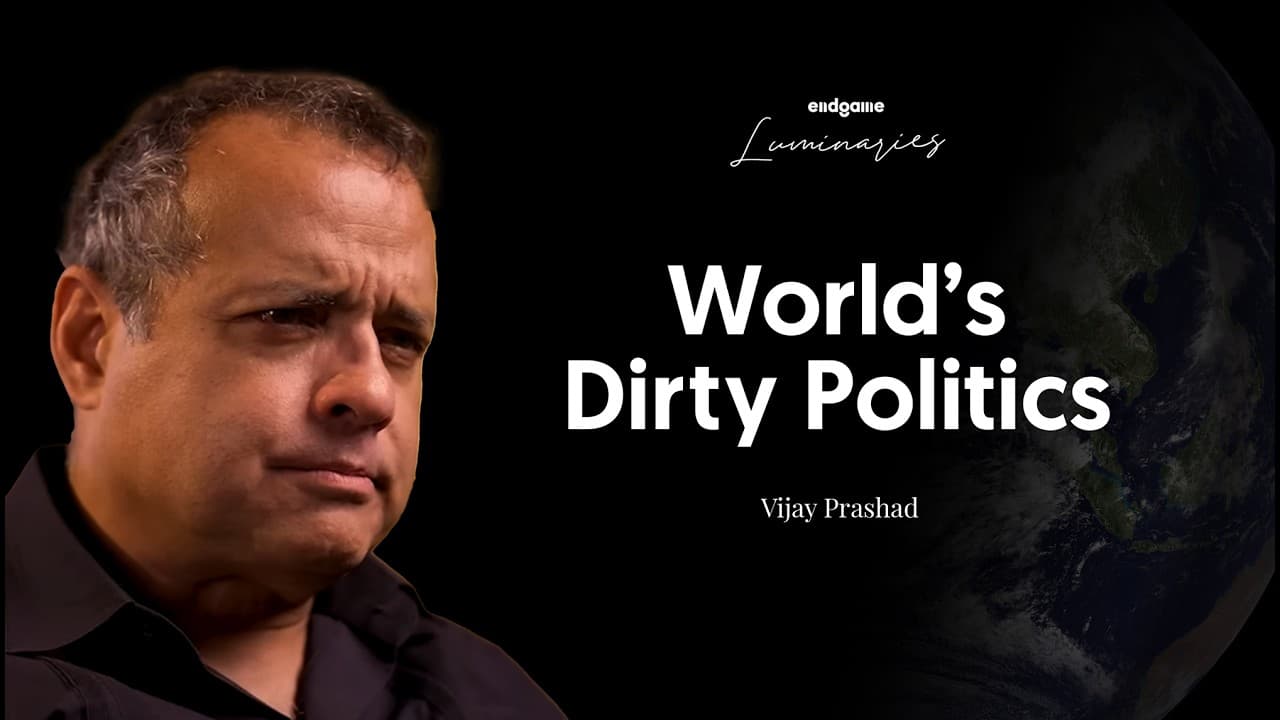
Why Does Vijay Prashad Say America’s Finger-Wagging Puts the Global South in Danger? | Endgame #176 (Luminaries)
TL;DR
Vijay Prashad argues that America’s finger-wagging endangers equal international relations because it reflects a colonial mentality that treats countries such as Indonesia as inferior. Drawing on his politically charged upbringing in Kolkata, he connects democracy to how people think, intellectual life to passionate engagement, and knowledge to action. Read on for his views on inequality, history, war zones, and political responsibility.
Transcript
There's nothing special about the United States. What makes the US think that it's better than Indonesia, for instance. Why should the Indonesian president have to defer to the US president? He is the executive director of the Tricontinental Institute for Social Research. ... As a historian and a journalist, and he has all these things: a write... Read More
Key Insights
- Vijay Prashad criticizes the US for its perceived superiority complex and colonial mentality, arguing that it undermines genuine democracy and equality on the global stage.
- The conversation highlights the ongoing struggles in the Middle East, particularly the Israeli-Palestinian conflict, emphasizing the need for a resolution that respects Palestinian rights.
- Prashad discusses the double standards in international politics, comparing the global reactions to conflicts in Ukraine and Palestine, and highlighting the West's selective moral outrage.
- The discussion touches on the challenges of multipolarity, with the US struggling to adapt to a world where it is no longer the sole superpower, and the Global South seeking a more equitable global order.
- Prashad advocates for the Global South to focus on intellectual development and self-reliance, criticizing the reliance on Western institutions like McKinsey and the IMF for guidance.
- Africa's potential as a future economic giant is explored, with emphasis on its vast resources and growing population, but also the challenges posed by historical exploitation and current geopolitical tensions.
- The conversation underscores the importance of resource sovereignty and local industry development, questioning why basic goods are often imported rather than produced locally in the Global South.
- Prashad calls for a new intellectual and political movement in the Global South to address structural issues, drawing inspiration from past efforts like the South Commission.
- "There's nothing special about the United States." (0:00)
- "Democracy doesn't mature when you get the most expensive voting system." (0:29)
- "Democracy is in the head, it's not in the machine." (0:29)
- "You love lecturing us because you have a colonial mentality." (0:37)
- "You should be deeply moved by things in the world." (1:11)
Install to Summarize YouTube Videos and Get Transcripts
Explore YouTube Video Summarizer or Get YouTube Transcript Extractor
Questions & Answers
Q: Why does Vijay Prashad criticize the United States?
Prashad says there is nothing special about the United States that makes it better than Indonesia. He argues that American lecturing reflects a colonial mentality and questions why Indonesia’s president should defer to the US president.
Q: What does Vijay Prashad say genuine democracy requires?
Prashad says democracy does not mature simply through the most expensive voting system. In his words, democracy is in the head, not in the machine.
Q: How did growing up in Kolkata shape Vijay Prashad?
Prashad grew up surrounded by visible colonial history, great inequality, and intense political debate. He says these conditions made it difficult for people in Bengal during the early 1970s to remain uninterested in politics.
Q: How does Vijay Prashad describe Asia’s relationship with the past?
Prashad says the ancient world remains directly present in Asia, creating links to a thousand years of history or more. He explains that societies have not completely broken from either their best traditions or their worst ones, including India’s caste system.
Q: What political environment surrounded Vijay Prashad’s childhood?
Prashad says almost everyone around him was involved in politics in some way. His family included communists, centrists, and supporters of right-wing parties, so he grew up in a household filled with debate and discussion.
Q: What did Vijay Prashad learn from his parents?
His father had no formal college education but was eager to read and learn, even buying an encyclopedia for his son to read aloud. His mother was deeply connected to suffering in the world and took him out to become involved in things.
Q: Why does Vijay Prashad reject dispassionate intellectualism?
Prashad calls it terrible advice to tell young people that intellectuals should be dispassionate. He says people should be deeply moved by the world and that knowing or being right means little without action.
Q: What does Vijay Prashad say people misunderstand about war zones?
Prashad says people notice death but often miss the banality and overwhelming noise of a war zone. He also emphasizes the dust, debris, and quantity of toxic material that become ordinary there.
Summary & Key Takeaways
-
Vijay Prashad criticizes the US for its perceived superiority and colonial mentality, urging for a more equitable global order where countries like Indonesia are treated as equals. He emphasizes that genuine democracy is about empowering people, not just having advanced voting systems.
-
The discussion highlights the ongoing Israeli-Palestinian conflict, with Prashad expressing concern over the lack of progress towards a two-state solution and the international community's double standards when comparing Ukraine and Palestine.
-
Prashad sees potential in Africa as a future economic powerhouse due to its resources and population growth. However, he stresses the need for the continent to overcome historical exploitation and current geopolitical challenges, advocating for resource sovereignty and local industry development.
Read in Other Languages (beta)
Share This Summary 📚
Summarize YouTube Videos and Get Video Transcripts with 1-Click
Try YouTube Summary with ChatGPT & Claude or YouTube Transcript Generator
Explore More Summaries from Gita Wirjawan 📚

Summarize YouTube Videos and Get Video Transcripts with 1-Click
Try YouTube Summary with ChatGPT & Claude or YouTube Transcript Generator