Why Is the AI Data Center Stock Boom Unwinding?
TL;DR
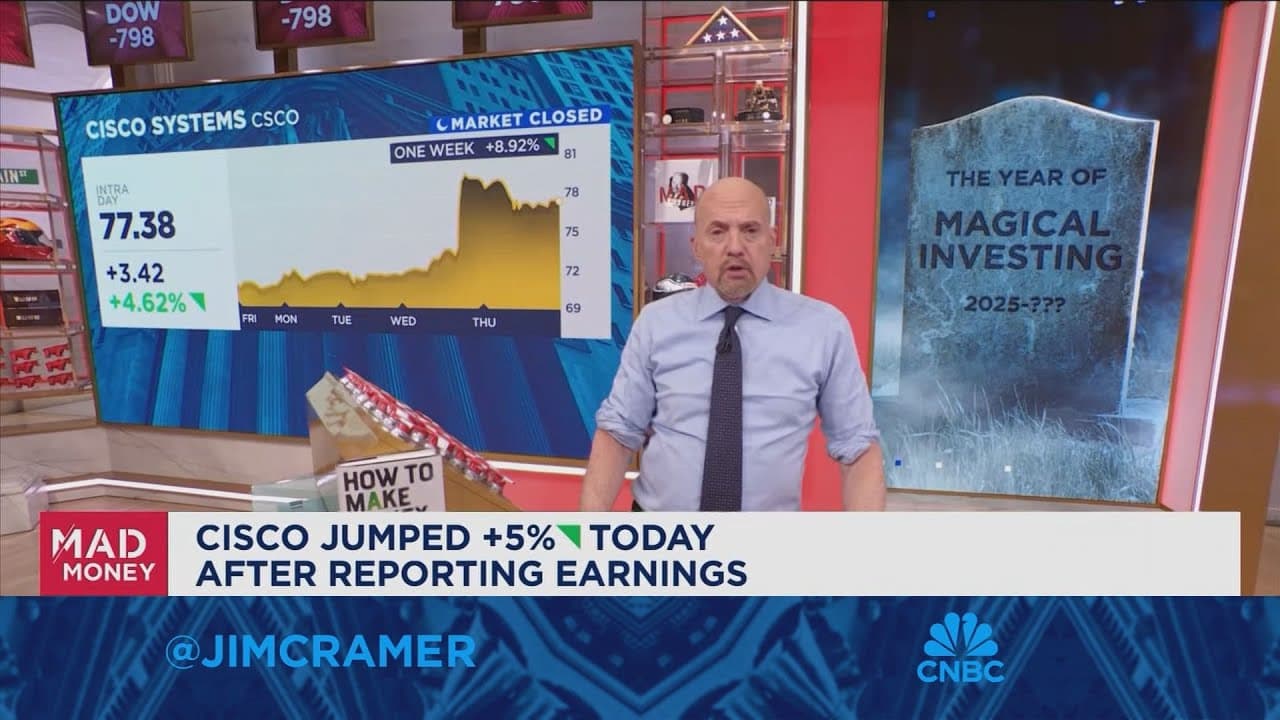
Speculative AI and data center stocks are entering a shakeout as insider selling, secondary offerings, heavy borrowing, persistent losses, and uncertain business models weaken investor confidence. Profitable, well-capitalized AI companies may remain attractive, but diversification and caution are warranted until OpenAI secures sufficient capital and speculative quantum, nuclear, crypto, and alternative-power businesses produce tangible results.
Transcript
Hey I'm Cramer. Welcome to Mad Money. Welcome to Cramerica. Other people want to make money I'm just trying to save your world. My job is not just entertain. It's to teach you to deal with days like today. So call me at one 800 743 CNBC. You can tweet me JimCramer. Somebody has to pay the bad guy. Might as well be me. In the last two months regular... Read More
Key Insights
- The Year of Magical Investing is over because speculative AI and data center stocks are showing multiple signs of financial strain, including insider selling, secondary offerings, borrowing, limited revenue, and continuing losses. Cramer believes these conditions indicate that the earlier mania has begun to unwind.
- Profitable AI companies are distinct from speculative peripheral businesses because established operators can support investment with strong balance sheets and cash flow. Cramer does not want to abandon truly profitable AI companies, and his charitable trust continues to own well-capitalized data center stocks.
- The comparison with 2000 is based on recurring financing behavior. During the dot-com era, money-losing companies repeatedly sold shares or convertible bonds while insiders sold their holdings, and Cramer sees similar activity among alternative-power, quantum-computing, crypto, and AI-related businesses.
- OpenAI is a central financial risk because it is spending heavily and making hundreds of billions of dollars in promises despite rapid growth, 800 million users, and a $20 billion exit run rate. Cramer believes its current resources remain insufficient for its commitments.
- Cisco sees important differences from the 1990s because current AI investment is largely coming from massive, profitable companies with strong balance sheets and cash flow. CEO Chuck Robbins also said the transition is moving faster and that participating companies view the investment as existential.
- BitPay Technologies Group illustrates the financing concerns because it priced $400 million of 4% convertible senior notes and more than 10.6 million Class A ordinary shares for certain noteholders. The financing knocked the stock down 20%, according to Cramer.
- A speculative-market shakeout can become self-reinforcing because investors grow reluctant to fund companies that lose money. Those businesses may then struggle to pay their bills, which resembles the process that weakened the broader technology market in 2000, although Cramer does not predict an identical collapse.
- Diversification reduces the damage from a concentrated technology sell-off because a portfolio containing different types of growth stocks does not depend on one basket. Cramer acknowledged that diversification may limit gains during a continuing rally, but argued that it can support a faster recovery afterward.
Install to Summarize YouTube Videos and Get Transcripts
Explore YouTube Video Summarizer or Get YouTube Transcript Extractor
Questions & Answers
Q: Why does Jim Cramer think the AI stock boom is ending?
Cramer believes the speculative AI and data center boom is ending because he sees insider selling, secondary offerings, increased borrowing, operations without revenue, and companies that continue losing money. The sharp decline in technology and data center shares reinforced his concern that the mania is unwinding and that investors are moving money toward the sidelines or away from technology.
Q: How is the current AI sell-off similar to the dot-com era?
The similarity lies in how speculative companies finance themselves and how investors respond. Cramer recalls that money-losing dot-com businesses repeatedly raised money by selling stock or convertible bonds while insiders sold shares. He now sees comparable behavior in quantum computing, alternative power, crypto, and peripheral AI companies, alongside a rotation from technology into healthcare stocks.
Q: Why does Cramer distinguish profitable AI companies from speculative stocks?
Cramer distinguishes them because profitable AI companies have the financial capacity to fund investment without relying entirely on repeated market financing. He remains willing to own truly profitable businesses and says his charitable trust holds well-capitalized data center stocks. His concern focuses on companies with weak business models, little revenue, continuing losses, insider selling, and repeated securities offerings.
Q: Why does Cramer view OpenAI as a risk to AI investing?
Cramer views OpenAI as a risk because it is spending heavily and making hundreds of billions of dollars in promises while lacking the cash resources of the largest hyperscalers. He acknowledges its rapid growth, 800 million users, and $20 billion exit run rate, but says these figures remain far below what it needs to support its commitments.
Q: What could revive speculative AI and data center stocks?
Cramer says the stocks could receive a major second wind if OpenAI obtains the capital it needs. He also wants real operating results from speculative quantum, nuclear, bitcoin-related, and alternative-power companies. Until OpenAI raises substantial funds and peripheral businesses demonstrate tangible performance, he does not expect the Year of Magical Investing to restart soon.
Q: What warning does the BitPay financing provide investors?
BitPay Technologies Group provides an example of a money-losing company raising more capital through securities. It priced $400 million of 4% convertible senior notes and more than 10.6 million Class A ordinary shares for certain holders of existing notes. Cramer says the financing knocked the stock down 20%, resembling financing patterns he observed in 2000.
Q: How should investors manage risk during an AI stock shakeout?
Cramer favors a diversified portfolio of growth stocks so that investors do not place all their money in one technology basket. He says this approach may produce smaller gains if the market keeps rising, but losses should hurt less and the portfolio can recover faster. He also recommends stepping back from businesses showing financial and governance warning signs.
Q: What did Cisco say about comparisons between AI investing and the 1990s?
Cisco CEO Chuck Robbins said the current transition is moving faster than the earlier technology shift. He also emphasized that many companies funding AI investment are massive, profitable businesses with strong balance sheets and cash flow, and that they view the spending as existential. Robbins added that fewer companies are making bets without business models, though winners and losers will emerge.
Summary & Key Takeaways
-
Cramer declared the Year of Magical Investing over after becoming increasingly cautious about speculative AI and data center stocks. He identified insider selling, secondary offerings, borrowing, businesses without revenue, and persistent losses as warning signs, while distinguishing these companies from profitable AI businesses with strong balance sheets and cash flow.
-
The sell-off reminded Cramer of 2000, when institutional money fled technology stocks and moved into food and drug companies. He sees a similar rotation toward healthcare, but does not expect an exact replay because large hyperscalers and the Magnificent Seven possess substantial financial resources to continue investing in AI infrastructure.
-
OpenAI represents a major uncertainty because its rapid growth is accompanied by enormous spending and commitments. Cramer argued that speculative markets are unlikely to recover until OpenAI raises substantial capital and quantum, nuclear, bitcoin, and alternative-power companies demonstrate real results. He recommended diversification to reduce losses and accelerate recovery after declines.
Read in Other Languages (beta)
Share This Summary 📚
Summarize YouTube Videos and Get Video Transcripts with 1-Click
Try YouTube Summary with ChatGPT & Claude or YouTube Transcript Generator
Explore More Summaries from CNBC Television 📚



Summarize YouTube Videos and Get Video Transcripts with 1-Click
Try YouTube Summary with ChatGPT & Claude or YouTube Transcript Generator