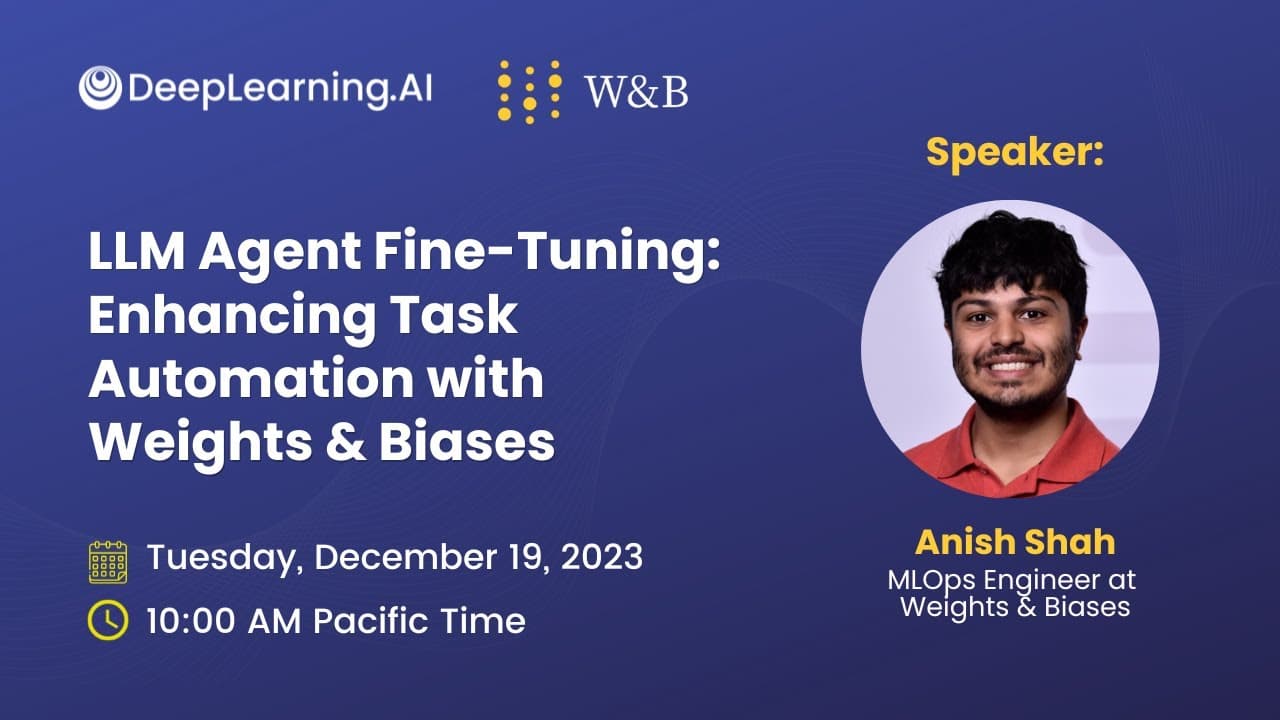
LLM Agent Fine-Tuning: Enhancing Task Automation with Weights & Biases
TL;DR
Fine-tuning LLM agents improves task automation by adapting their behavior to specific tasks or data sources, while evaluation and debugging help identify hallucinations and knowledge gaps. The workflow combines user feedback, smaller evaluation sets, LLM-as-a-judge metrics such as faithfulness and relevancy, human expert review, and Weights & Biases logging and traces. Read on to see how these components support more reliable agent applications.
Transcript
hey everyone my name is Diana Chan Morgan and I run all things Community here at Deep learning . a today is our last webinar of the year we've had so much fun doing so many different workshops doing with all of our different course Partners as well as other exciting ml Community Partners as well today we have a very exciting workshop and event to f... Read More
Key Insights
- 👻 Fine-tuning LLM agents allows for customization and improvement of their behavior for specific tasks or data sources.
- 🤔 Techniques like Master Laura and prompt tuning help optimize the training process and enhance the thought process of LLM agents.
- 🖐️ Evaluating the performance of LLM agents is crucial, and tools like the LM evaluation harness and human feedback play a significant role in this process.
- 🥠 Prompt engineering and hyperparameter tuning are important considerations when fine-tuning LLM agents.
- 😌 The future of LLM agents lies in multi-agent environments and more advanced techniques like reflection and tree of thought.
- 🏋️ Centralized platforms like weights and biases simplify the process of managing and evaluating fine-tuned LLM agents.
Install to Summarize YouTube Videos and Get Transcripts
Explore YouTube Video Summarizer or Get YouTube Transcript Extractor
Questions & Answers
Q: How does LLM agent fine-tuning improve task automation?
Fine-tuning adapts an LLM agent’s behavior to specific tasks or data sources, helping it perform more effectively within an application or automation workflow. The session also connects fine-tuning with prompt engineering, evaluation, logging, and debugging through Weights & Biases.
Q: Why is user feedback essential for LLM agent applications?
RAG pipelines use dynamic context, while large language models produce non-deterministic outputs. Collecting users’ questions, upvotes, and downvotes helps reveal how the application behaves after release and provides data for evaluation.
Q: How can user feedback be turned into an LLM evaluation set?
The questions users ask and their upvotes and downvotes can be condensed into a smaller, workable evaluation set. Selected questions from that set can then be used to score how well the model performs.
Q: What does LLM-as-a-judge evaluate?
LLM-as-a-judge uses language models to score other language models. The transcript highlights faithfulness, meaning answer accuracy given a document, and relevancy, meaning how useful a document was when producing an answer.
Q: Why is human-in-the-loop evaluation necessary for LLM agents?
A human expert can determine whether an answer is correct and useful for the intended users. Experts can also check for hallucinations and verify details such as whether included hyperlinks actually work.
Q: What problems can LLM evaluation uncover?
Evaluation can expose gaps in the model’s knowledge base and identify hallucinations. It can also show when a model invents answers or hyperlinks even after receiving the correct context.
Q: Why are standard benchmarks used to evaluate large language models?
Developers generally do not have access to the complete pre-training corpus or know exactly how users will interact with a chatbot before release. Standard benchmark collections, including the LM Evaluation Harness and OpenAI evaluations, provide a consistent way to check model performance.
Q: How do Weights & Biases logs and traces help debug LLM agents?
The session presents comprehensive logging and traces in Weights & Biases as tools for managing and evaluating LLM agent workflows. Traces can be used to pinpoint issues, supporting hands-on evaluation and debugging of agent behavior.
Summary & Key Takeaways
-
Fine-tuning large language models (LLM) is a way to improve their performance and adapt them to specific tasks or data sources.
-
Techniques like Master Laura, low rank adaptation metrics, and prompt tuning are used to enhance the behavior and thought process of LLM agents.
-
Evaluating the performance of LLM agents is crucial, and tools like the LM evaluation harness and human feedback play a key role in this process.
Read in Other Languages (beta)
Share This Summary 📚
Summarize YouTube Videos and Get Video Transcripts with 1-Click
Try YouTube Summary with ChatGPT & Claude or YouTube Transcript Generator
Explore More Summaries from DeepLearningAI 📚
Summarize YouTube Videos and Get Video Transcripts with 1-Click
Try YouTube Summary with ChatGPT & Claude or YouTube Transcript Generator