How Skill Shapes Functional Movement Variability & Exploration Tendencies in Kickboxing
TL;DR
Skill level affects creativity and functionality in kickboxing movements.
Transcript
hi everyone this is Rob Gray from ASU in the perception action podcast back with another article review in this episode I want to look at a really interesting paper that looked at the relationship between kind of skill level expertise um exploration of the movement solution space and creativity and it's going to use the task of a kickboxing and it'... Read More
Key Insights
- The study explores the relationship between skill level and creativity in kickboxing, focusing on how individual constraints and intrinsic dynamics influence movement solutions.
- Intrinsic dynamics, or coordination tendencies, can either facilitate or hinder creativity, depending on how they interact with external constraints during skill acquisition.
- Experts demonstrate greater functionality in their movements, delivering higher force, but novices and experts show similar levels of originality in exploring new movement solutions.
- Creativity in movement is a product of exploration and adapting to constraints, rather than a spontaneous insight or 'aha' moment.
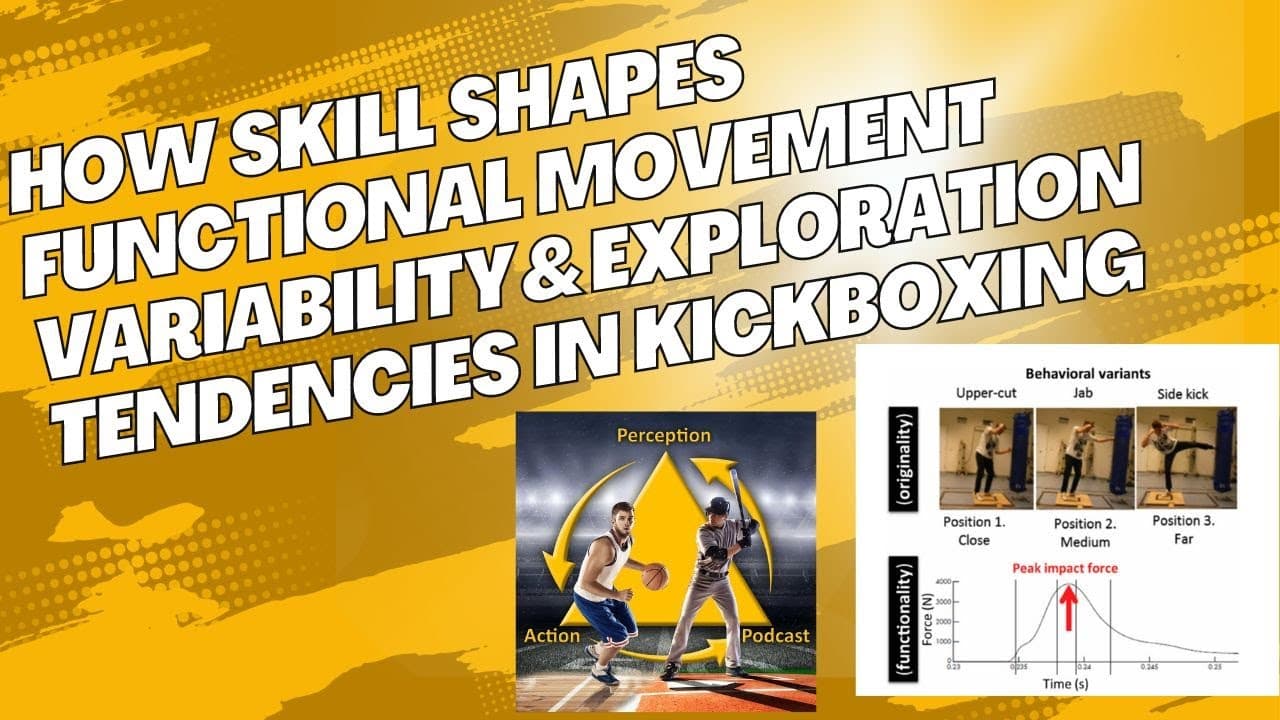
- The study involved manipulating the distance between participants and a punching bag to observe the variability and creativity in kickboxing actions.
- Both novice and expert kickboxers are capable of exploring movement solutions, suggesting that extensive training is not necessary for originality.
- Entropy, a measure of unpredictability, is used to assess the breadth of exploration, with higher entropy indicating more diverse movement solutions.
- The findings suggest that encouraging exploration and variation in training can lead to more creative and functional movement solutions in athletes.
Install to Summarize YouTube Videos and Get Transcripts
Explore YouTube Video Summarizer or Get YouTube Transcript Extractor
Questions & Answers
Q: What is the main focus of the study discussed in the content?
The main focus of the study is to explore the relationship between skill level and creativity in kickboxing. It examines how individual constraints and intrinsic dynamics influence the ability to explore and develop new movement solutions. By manipulating environmental constraints, the study assesses the impact of skill on functional movement variability and the emergence of creative actions.
Q: How do intrinsic dynamics affect creativity according to the study?
Intrinsic dynamics, or coordination tendencies, can either facilitate or hinder creativity in movement. These dynamics are shaped by individual experiences and constraints, influencing how new movements are learned. The study suggests that while intrinsic dynamics can provide stability, they may also limit exploration unless constraints are manipulated to promote adaptability and problem-solving, leading to creative solutions.
Q: What methodology was used in the study to assess creativity in kickboxing?
The study used a task involving manipulation of the distance between participants and a punching bag to assess creativity and movement variability. Participants, both novice and expert kickboxers, were instructed to strike the bag using various techniques, with the distance adjusted relative to their leg length. The researchers analyzed the originality, functionality, and fluency of the movements to determine creativity and adaptability.
Q: What were the key findings regarding experts and novices in the study?
The study found that experts demonstrated greater functionality, delivering higher force in their movements, while both experts and novices showed similar levels of originality in exploring new movement solutions. This indicates that extensive training is not necessary for originality, as both groups were equally proficient at exploring the movement space and developing creative actions when coached to do so.
Q: How does the study define creativity in movement?
Creativity in movement is defined as the ability to produce actions that are both original and functional. Originality is determined by the rarity of the action among participants, while functionality is measured by the force and effectiveness of the movement. The study emphasizes that creativity is a byproduct of exploration and adapting to constraints, rather than a sudden insight or inspiration.
Q: What role does entropy play in the study's analysis?
Entropy is used as a measure of unpredictability in the study's analysis, indicating the breadth of exploration in movement solutions. Higher entropy suggests that a participant's actions are less predictable and more varied, reflecting a greater degree of exploration. The study found that participants with higher entropy demonstrated more fluency and originality in their movements, highlighting the importance of exploring diverse solutions.
Q: What practical implications does the study suggest for training athletes?
The study suggests that training athletes should involve encouraging exploration and variation, even at early stages. By varying constraints such as distance, angles, and opponents, athletes can develop more creative and functional movement solutions. This approach challenges traditional training methods that focus on tight constraints and repetition, advocating for a more flexible and exploratory training environment to enhance creativity and adaptability.
Q: How does the study challenge traditional views on skill development and creativity?
The study challenges traditional views that extensive training and a strong foundation are necessary for creativity in movement. It shows that both novices and experts can be equally original when exploring movement solutions, suggesting that creativity is not built on internal models or knowledge but rather emerges from adapting to manipulated constraints. This highlights the natural human capacity for exploration and variation, advocating for training methods that promote these qualities.
Summary & Key Takeaways
-
The study investigates how skill level influences creativity and functionality in kickboxing, focusing on the interaction between individual constraints and movement solutions. By manipulating the distance to a punching bag, researchers observed how participants explored different actions. The results suggest that both novices and experts can be equally original in their movements.
-
Experts demonstrated greater functionality by delivering higher force in their actions, but both novice and expert participants showed similar levels of originality. The study highlights that creativity in movement is less about spontaneous insights and more about exploring and adapting to constraints, emphasizing the role of exploration in developing creative solutions.
-
Entropy was used to measure exploration, with higher entropy indicating more diverse movement solutions. The study found that encouraging variation in training, such as altering distances and angles, can enhance creativity and functionality in athletes, challenging the notion that extensive training is required for originality in movement.
Read in Other Languages (beta)
Share This Summary 📚
Summarize YouTube Videos and Get Video Transcripts with 1-Click
Try YouTube Summary with ChatGPT & Claude or YouTube Transcript Generator
Explore More Summaries from Rob Gray 📚
Summarize YouTube Videos and Get Video Transcripts with 1-Click
Try YouTube Summary with ChatGPT & Claude or YouTube Transcript Generator