How to Talk About Age in English: Key Phrases and Tips
TL;DR
To talk about age in English, use 'I am' followed by your age, and the proper question is 'How old are you?' Avoid asking adults their age unless it’s their birthday. Common terms for age groups include 'newborn,' 'toddler,' 'teenager,' 'middle-aged,' and 'elderly,' while generalized phrases like 'in their 30s' can be used when the exact age is unknown.
Transcript
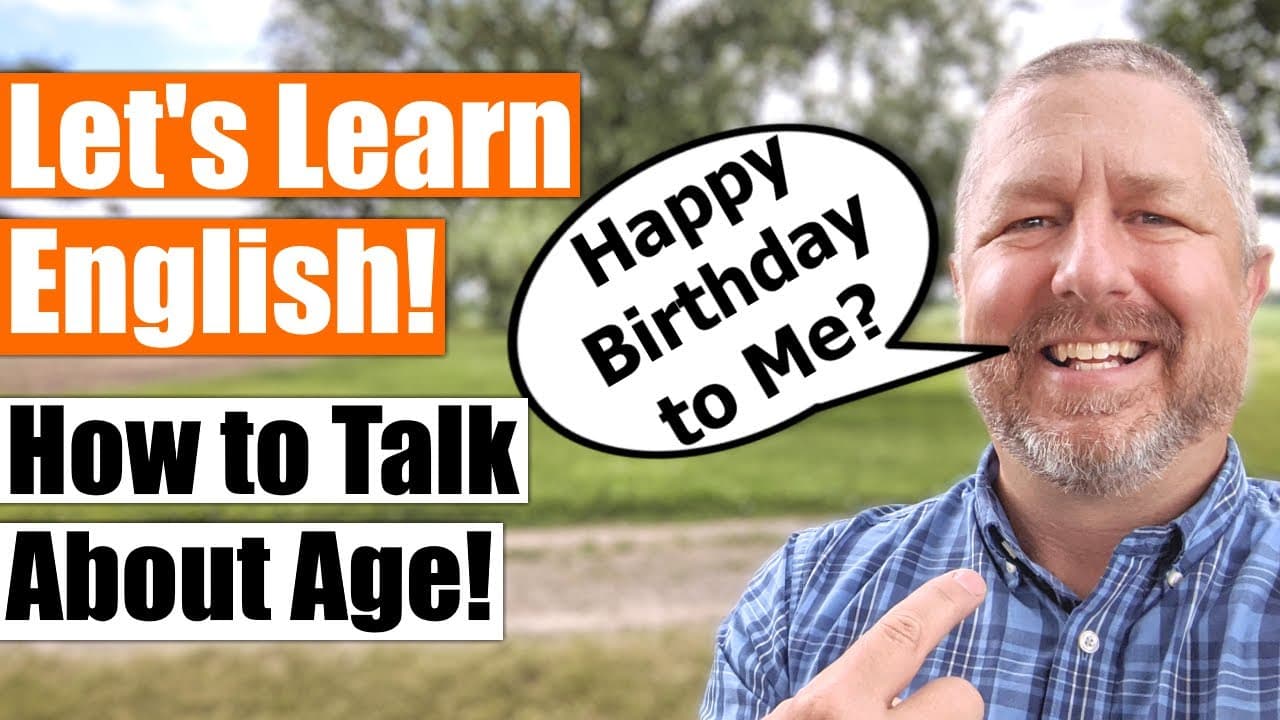
Hi, Bob the Canadian here. Welcome to this English lesson about age and how to talk about age in English. Soon, it will be my birthday. I usually don't give the exact date, and I usually don't say my exact age, but let's just say that later this summer, I will have a birthday and I will still be in my late 40s. But because my birthday is coming up,... Read More
Key Insights
- 🤕 In English, you say "I am" followed by your age to talk about your age or ask someone else's age.
- 😷 Asking adults about their age is generally considered a private question, except on their birthday.
- 👶 The terms used to describe different age groups include "newborn," "baby," "toddler," "child," "tween," "teenager," "young adult," "adult," "middle-aged," "senior," and "elderly."
- 💝 Generalized terms like "in their 20s," "early/mid/late 30s," and "late 40s" can be used when you don't know someone's exact age.
- 💆 Advanced phrases for talking about age include "getting on in years," "over the hill," "midlife crisis," and "turning grey."
- 🧑🤝🧑 Terms like "young people" and "youth" refer to younger individuals, while "old people" refers to seniors or elderly.
- 😑 Phrases like "kids these days" and "when I was a kid" are used to express sentiments about younger generations.
Install to Summarize YouTube Videos and Get Transcripts
Explore YouTube Video Summarizer or Get YouTube Transcript Extractor
Questions & Answers
Q: How do you say and ask someone’s age in English?
Say “I am 25,” “I am 25 years old,” or “I’m 25.” To ask, say “How old are you?” rather than “How many years do you have?”
Q: Is it appropriate to ask an adult how old they are?
An adult’s age is generally considered private and personal, so people rarely ask about it. The lesson says a birthday is the main occasion when asking “How old are you today?” or “How old are you turning today?” is acceptable.
Q: How do you talk about the age you will reach on your birthday?
Use “I am going to be” followed by the age, as in “On my birthday, I’m going to be 25.” You can also say, “On my birthday, I’m going to turn 25.”
Q: What is the difference between a newborn, a baby, and a toddler?
A newborn has just been born and is usually only a month or two old, though the term may cover the first few months. A baby is the broader term used afterward, while a toddler is a very young child who is learning to walk or has recently learned.
Q: What do “child,” “kid,” and “tween” mean?
Someone from about age three or four to around 10 may be called a child or kid. A tween is someone between childhood and the teenage years, typically age 10, 11, or 12.
Q: What ages are considered teenagers and young adults?
Anyone from age 13 through 19 is called a teenager. From age 20 to about 30, a person would generally be called a young adult.
Q: What ages are described as adult or middle-aged?
The lesson describes someone from about age 30 to 45 as an adult. Someone from 45 to 60, or perhaps 65, may be described as middle-aged.
Q: When is someone called a senior or elderly?
People may be called seniors from around age 60 or 65, although in some places the term starts at 55. Someone close to retirement or already retired may also be called a senior, while “elderly” may describe someone over 70 or 75.
Summary & Key Takeaways
-
The lesson starts with the basics of how to say your age in English and how to ask someone about their age.
-
It emphasizes that asking about someone's age is usually a private question for adults, except on their birthday.
-
The lesson then covers the terms used to describe different age groups, from newborns to elderly individuals.
Read in Other Languages (beta)
Share This Summary 📚
Summarize YouTube Videos and Get Video Transcripts with 1-Click
Try YouTube Summary with ChatGPT & Claude or YouTube Transcript Generator
Explore More Summaries from Learn English with Bob the Canadian 📚
Summarize YouTube Videos and Get Video Transcripts with 1-Click
Try YouTube Summary with ChatGPT & Claude or YouTube Transcript Generator