Loop Quantum Gravity Explained
TL;DR
Explores loop quantum gravity as an alternative to string theory.
Transcript
It’s time we talked about loop quantum gravity. What exactly is it? What are the loops? And can it really defeat string theory in our quest for a Theory of Everything? The holy grail of physics is to connect our understanding of the tiny scales of atoms and subatomic particles with that of the vast scales of planets, galaxies, and the entire univer... Read More
Key Insights
- Loop quantum gravity aims to reconcile quantum mechanics and general relativity, offering an alternative to string theory without relying on strings or extra dimensions.
- The concept of background independence is crucial in loop quantum gravity, where spacetime is dynamic and not fixed, unlike in traditional quantum mechanics.
- Loop quantum gravity uses Ashketar variables and spin connections to rewrite general relativity, allowing the quantization of spacetime through loops.
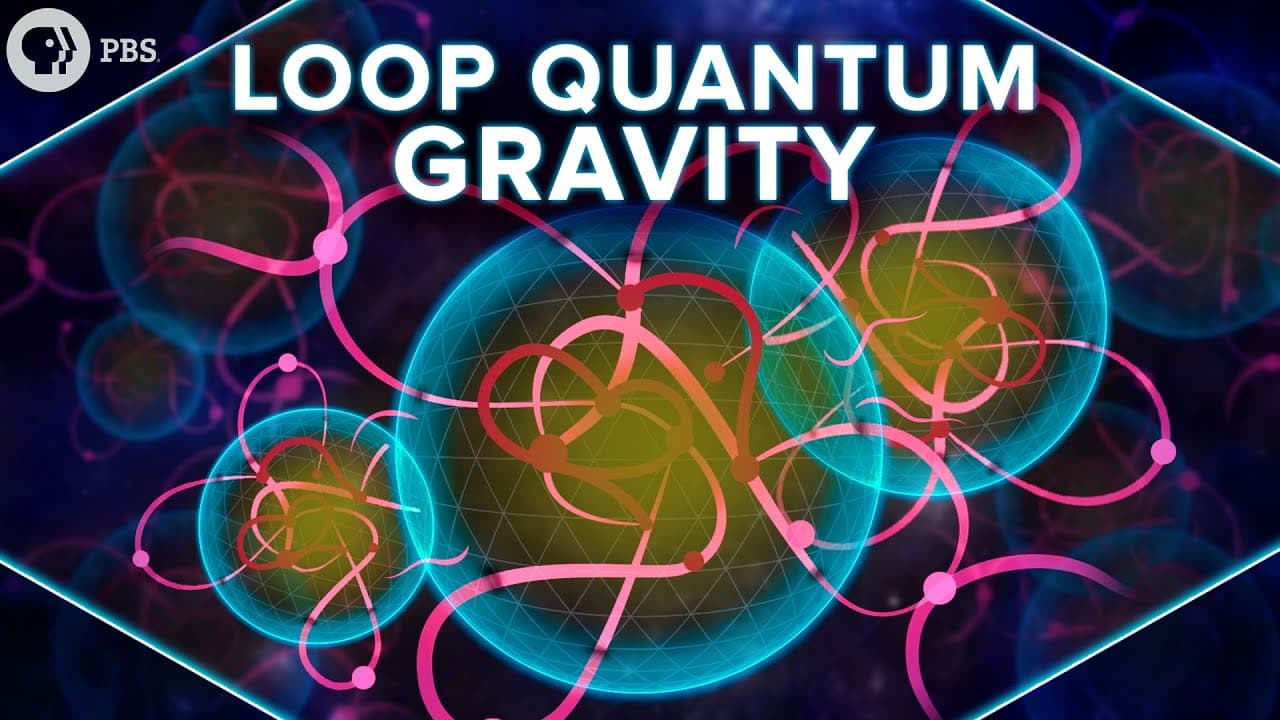
- The theory predicts a pixelated structure of space at the Planck scale, with quantized volume elements and area facets forming a spin-network.
- Loop quantum gravity has had some success in predicting phenomena like black hole entropy and Hawking radiation, aligning with existing equations.
- Challenges remain, such as extending background independence to 4-D spacetime and resolving the problem of time, which are still debated in the scientific community.
- Experimental tests for loop quantum gravity include observing the speed variation of light photons, though results have been inconclusive so far.
- The theory provides a unique mathematical framework, but like string theory, it currently lacks experimental validation, keeping it in the realm of theoretical physics.
Install to Summarize YouTube Videos and Get Transcripts
Explore YouTube Video Summarizer or Get YouTube Transcript Extractor
Questions & Answers
Q: What is the main goal of loop quantum gravity?
The main goal of loop quantum gravity is to unify quantum mechanics and general relativity into a single framework. It seeks to provide a theory of quantum gravity that reconciles the physics of the very small, such as atoms and subatomic particles, with the physics of the very large, including planets, galaxies, and the universe as a whole, without relying on the assumptions of string theory.
Q: How does loop quantum gravity differ from string theory?
Loop quantum gravity differs from string theory in that it does not require the existence of strings or extra dimensions. Instead, it focuses on quantizing spacetime itself through loops and emphasizes background independence, where spacetime is dynamic and not a fixed backdrop. This approach avoids some of the conceptual complexities and assumptions inherent in string theory, such as the need for supersymmetry.
Q: What are Ashketar variables and their significance in loop quantum gravity?
Ashketar variables are a set of mathematical constructs used in loop quantum gravity to reformulate general relativity. They involve spin connections, which are vector-like entities that represent quantum angular momentum. These variables allow for the quantization of spacetime, enabling the creation of a network of loops that define the fabric of space. This reformulation is crucial for achieving background independence and quantizing gravity.
Q: What challenges does loop quantum gravity face?
Loop quantum gravity faces several challenges, including extending background independence to 4-D spacetime and resolving the problem of time, where time is treated differently in quantum mechanics compared to general relativity. Additionally, the theory needs to demonstrate that it can reproduce the equations of general relativity at large scales, known as the classical limit. These issues are subjects of ongoing debate and research within the scientific community.
Q: What experimental evidence is there for loop quantum gravity?
Currently, loop quantum gravity lacks direct experimental evidence. Some proposed experiments involve observing potential variations in the speed of light photons due to the graininess of spacetime predicted by the theory. For instance, differences in the arrival times of light from distant gamma-ray bursts were examined, but the results were inconclusive. More experimental validation is needed to support the theory's predictions.
Q: How does loop quantum gravity address the problem of time?
Loop quantum gravity attempts to address the problem of time by focusing on background independence, where time is not treated as a separate entity but as part of the dynamic spacetime fabric. However, the theory has not fully resolved the issue, as time in quantum mechanics is still treated differently than in general relativity. The problem of time remains a significant challenge for developing a complete theory of quantum gravity.
Q: What is the significance of background independence in loop quantum gravity?
Background independence is a key feature of loop quantum gravity, signifying that spacetime itself is not a fixed backdrop but a dynamic entity influenced by mass and energy. This contrasts with traditional quantum mechanics, where a fixed coordinate system is often assumed. Achieving background independence is crucial for reconciling quantum mechanics with general relativity and developing a consistent theory of quantum gravity.
Q: What are the potential implications of loop quantum gravity for our understanding of the universe?
If validated, loop quantum gravity could fundamentally change our understanding of the universe by providing a unified framework for quantum mechanics and general relativity. It could offer insights into the nature of spacetime at the smallest scales, potentially revealing a pixelated structure and influencing our comprehension of phenomena like black holes and the early universe. The theory's success could lead to new breakthroughs in theoretical and experimental physics.
Summary & Key Takeaways
-
Loop quantum gravity offers a potential path to unifying quantum mechanics and general relativity by avoiding the complexities of string theory. It emphasizes background independence, where spacetime is not a fixed stage but a dynamic entity influenced by mass and energy.
-
The theory uses mathematical constructs like Ashketar variables and spin connections to quantize spacetime, forming a network of loops that define the fabric of space. This approach results in a pixelated structure at the smallest scales.
-
While loop quantum gravity has made strides in theoretical predictions, such as black hole entropy, it faces challenges in experimental validation and resolving fundamental issues like the problem of time. Its viability as a theory of everything remains a topic of active research and debate.
Read in Other Languages (beta)
Share This Summary 📚
Summarize YouTube Videos and Get Video Transcripts with 1-Click
Try YouTube Summary with ChatGPT & Claude or YouTube Transcript Generator
Explore More Summaries from PBS Space Time 📚


Summarize YouTube Videos and Get Video Transcripts with 1-Click
Try YouTube Summary with ChatGPT & Claude or YouTube Transcript Generator