How Are Frontier AI Labs Reshaping Technology?
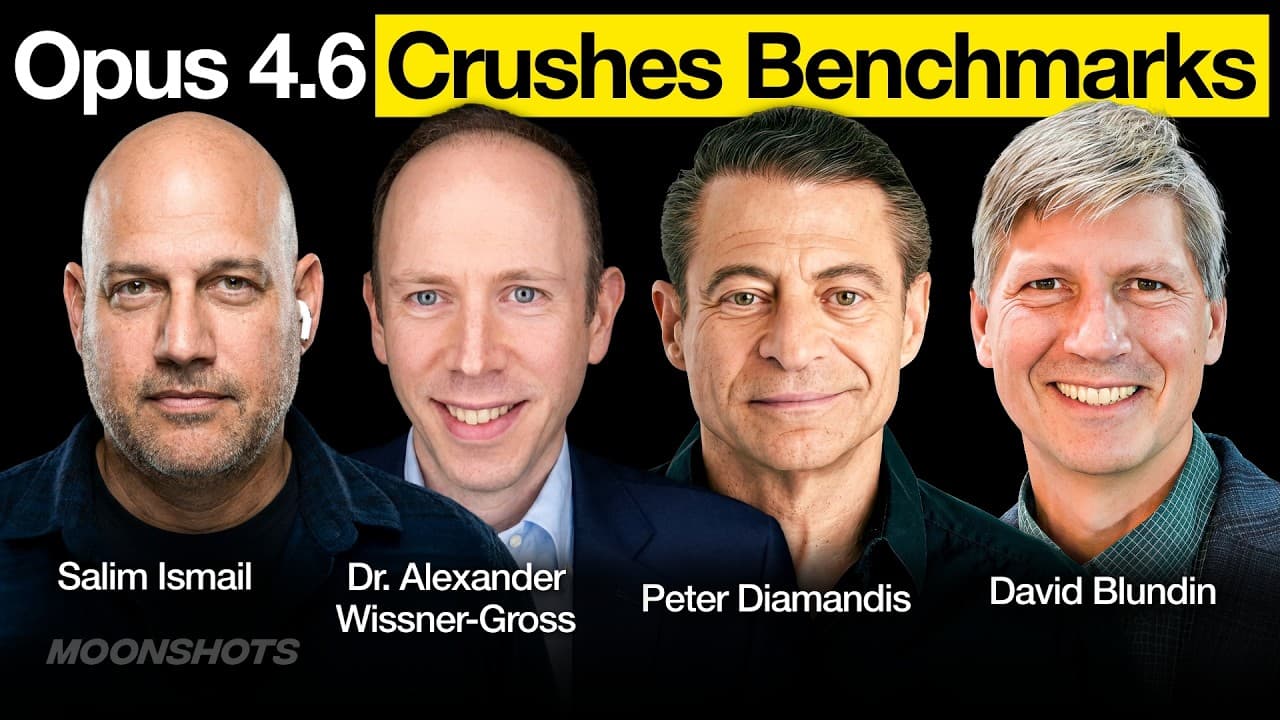
TL;DR
Claude Opus 4.6 is presented as a major advance in coding, reasoning, research, long-context processing, and multi-agent collaboration. The discussion argues that verifiable tasks such as compiler construction are especially suitable for AI agents, while organizations must improve data access and security practices as AI capabilities, infrastructure spending, privacy risks, and workforce disruption accelerate.
Transcript
Enthropic drops Claude Opus 4.6. It's the new king of the hill on coding, reasoning, and research. There are so many [music] aspects in which this is a feel the AGI moment by every measure. It's a beast. Opus 4.6 just dropped, and it's absolutely wild. This thing handles 1 million tokens now. That's like reading 750,000 [music] words in one go. Thi... Read More
Key Insights
- Claude Opus 4.6 is described as the leading model for coding, reasoning, and research in the discussion, with a context capacity of one million tokens, roughly represented by the hosts as 750,000 words processed in a single session.
- Agent-team mode enables multiple Opus 4.6 instances to collaborate as a relatively democratic swarm. The reported demonstration produced a Rust-based C compiler supporting multiple processor architectures from scratch, using $20,000 in API calls rather than a conventional multi-year development process.
- The compiler project is especially measurable because its output either functions or fails, can be compared with existing compilers, and was reportedly used to compile a Linux kernel. Clear evaluation criteria make tightly constrained projects strong targets for large allocations of AI compute.
- Recursive self-improvement is characterized by the hosts as AI rewriting parts of the technical stack beneath itself. They interpret the creation of a functional compiler as evidence that recursively improving systems have moved beyond laboratory demonstrations and into production settings.
- Organizational AI performance depends on access to relevant operational knowledge. One host describes launching about 20 documents for company-wide data gathering, arguing that businesses seeking lower costs or greater market share must first make their internal information available to AI systems.
- Security leadership is facing an inflection point because established practices may no longer address emerging agent-driven risks. After meeting about 150 chief security officers, one host observed that changing defensive mechanisms introduces risk, but continuing unchanged also leaves organizations exposed.
- Privacy is contested rather than assumed in the discussion. The hosts cite claimed capabilities such as reading lips from 100 meters away and deriving extensive information from sequenced skin cells, then disagree about whether meaningful privacy can remain possible today or after a singularity.
- Frontier AI competition extends beyond model benchmarks into advertising, market share, infrastructure, energy, and deployment. The listed topics include GPT-5.3-Codex, Anthropic advertisements criticizing ChatGPT advertising strategy, $650 billion in projected 2026 technology spending, space data centers, and robotaxi services.
Install to Summarize YouTube Videos and Get Transcripts
Explore YouTube Video Summarizer or Get YouTube Transcript Extractor
Questions & Answers
Q: What makes Claude Opus 4.6 significant for AI development?
Claude Opus 4.6 is presented as a major advance in coding, reasoning, and research, with a one-million-token context window that the hosts compare with reading roughly 750,000 words at once. Its importance is illustrated through capabilities rather than benchmarks alone, especially its agent-team mode and the reported construction of a functional, cross-architecture C compiler written in Rust.
Q: How did Opus 4.6 agents build a C compiler?
The reported project used Opus 4.6 in a native agent-team mode, allowing multiple agents to collaborate in a relatively flat, democratic swarm. These agents created a C compiler from scratch in Rust that worked across multiple processor architectures. The project reportedly cost $20,000 in API calls, and its output was subsequently used to compile a Linux kernel successfully.
Q: Why are constrained tasks suitable for AI agents?
Constrained tasks provide clear evidence of whether an AI system has succeeded. A compiler is a strong example because generated code either works or does not, can be benchmarked against existing compilers, and can be tested by compiling other software. The hosts argue that projects with firm evaluations and provable outputs can support large amounts of autonomous AI compute more reliably.
Q: What does recursive self-improvement mean in this discussion?
Recursive self-improvement refers to an AI system helping rewrite the technical infrastructure that supports software and, indirectly, AI itself. The hosts treat the creation of a working C compiler, followed by its successful compilation of a Linux kernel, as evidence that models can contribute to rebuilding underlying technology stacks. They characterize such systems as already entering production use.
Q: How should companies prepare their data for AI systems?
Companies should gather and organize operational knowledge so AI systems can understand what is happening across the business. One host describes launching about 20 documents for data collection across companies. The stated principle is that AI cannot effectively reduce costs or expand market share without relevant knowledge, making accessible, well-structured information a prerequisite for useful corporate deployment.
Q: Why must corporate security practices change as AI advances?
Existing security practices may be inadequate when both defensive and malicious agents can operate continuously. One host reports seeing shock among about 150 chief security officers because their organizations lacked mechanisms to react. Although changing established systems introduces risk, the discussion argues that continuing previous practices also creates predictable exposure, potentially leading to ongoing black-hat and white-hat agent conflict.
Q: What privacy risks from advanced AI are discussed?
The conversation challenges assumptions of absolute privacy by citing claimed capabilities such as reading lips from 100 meters away and obtaining skin cells through physical contact, sequencing them, and deriving extensive personal information. The participants disagree on the outlook: one believes privacy can remain possible today and after a singularity, while another doubts that meaningful privacy can be preserved.
Q: What broader trends are shaping competition among AI labs?
The discussion frames laboratory competition as extending beyond model quality into public adoption, advertising, infrastructure, energy, and commercial deployment. Its listed topics include GPT-5.3-Codex, ChatGPT market-share decline between 2025 and 2026, Anthropic advertisements criticizing ChatGPT advertising strategy, $650 billion in projected 2026 technology spending, space-based data centers, worldwide energy developments, and robotaxi launches.
Summary & Key Takeaways
-
The hosts characterize Claude Opus 4.6 as a leading model for coding, reasoning, and research, with a one-million-token context window. They focus less on benchmark rankings and more on its agent-team mode, which reportedly enabled collaborating agents to build a working Rust-based C compiler across multiple processor architectures for $20,000.
-
The compiler project illustrates why constrained, measurable assignments are strong candidates for AI automation. Compiler outputs can be tested, benchmarked against existing tools, and used to compile a Linux kernel. The hosts interpret this result as evidence that AI can compress projects historically requiring many person-years while lowering the cost of intelligence.
-
The wider conversation connects frontier models with organizational security, data availability, privacy, infrastructure, energy, robotics, and employment. It covers GPT-5.3-Codex, declining ChatGPT market share, advertising disputes, projected technology spending, space-based data centers, energy developments, robotaxi expansion, and debates over whether privacy can survive increasingly capable AI systems.
Read in Other Languages (beta)
Share This Summary 📚
Summarize YouTube Videos and Get Video Transcripts with 1-Click
Try YouTube Summary with ChatGPT & Claude or YouTube Transcript Generator
Explore More Summaries from Peter H. Diamandis 📚






Summarize YouTube Videos and Get Video Transcripts with 1-Click
Try YouTube Summary with ChatGPT & Claude or YouTube Transcript Generator