[Eng Sub] HBM Memory Module: Samsung, SK Hynix
TL;DR
HBM offers superior performance over GDDR for GPUs at higher costs.
Transcript
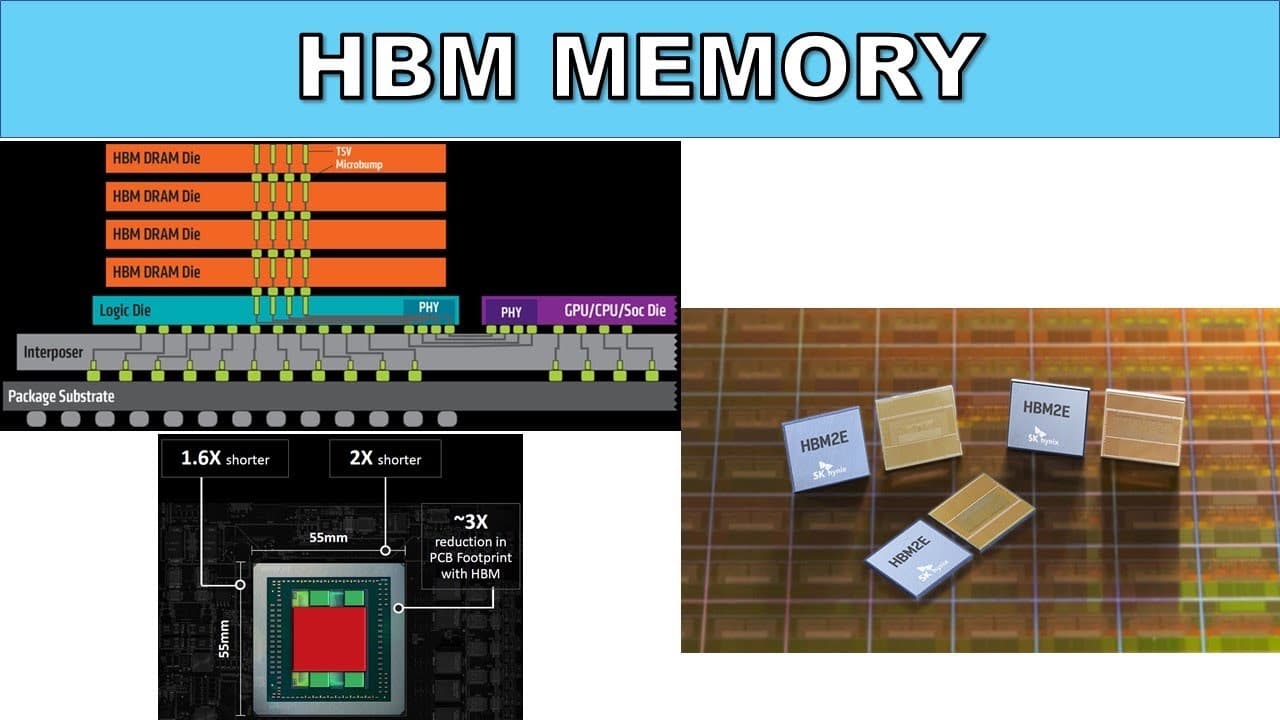
Today let’s talk about HBM. In previous episode, we talked about 2.5D and there was HBM in that 2.5D. HBM stands for High Bandwith Memory. It is a kind of DRAM and looks like this. For more detail structure, it has multiple vertically stacked DRAM dies with TSV on top and also has logic die at the bottom which also has TSV. Even though it is a ki... Read More
Key Insights
- HBM, or High Bandwidth Memory, is a type of DRAM that features vertically stacked DRAM dies and a logic die at the bottom, differentiating it from conventional DRAM.
- The integration of HBM with GPUs, using a silicon interposer, results in a smaller form factor of 55x55mm compared to GDDR's 110x90mm, leading to better performance and faster data processing.
- HBM offers significant advantages over GDDR, including higher memory density, bandwidth, capacity, lower power consumption, and reduced latency, making it ideal for high-performance applications.
- The primary disadvantage of HBM is its cost, driven by the use of TSV and silicon interposer, which makes it more expensive than GDDR.
- HBM assembly is carried out by memory suppliers like Samsung and SK Hynix, while the packaging process is performed by OSAT companies such as ASE, Amkor, and JCET.
- There are two HBM assembly processes: TCCUF, which uses thermocompression bonding with capillary underfill, and TCNCF, which uses thermocompression bonding with a non-conductive film.
- Samsung and SK Hynix are leading players in the HBM market, with Samsung introducing HBM2E memory with 8 stacked DRAM dies and over 56,000 TSVs in 2019.
- In 2020, both Samsung and SK Hynix began mass production of HBM2E, with Samsung also developing the industry's first 12 stacked DRAM dies for 24GB capacity.
Install to Summarize YouTube Videos and Get Transcripts
Explore YouTube Video Summarizer or Get YouTube Transcript Extractor
Questions & Answers
Q: What differentiates HBM from conventional DRAM?
HBM differs from conventional DRAM in its structure, featuring vertically stacked DRAM dies and a logic die at the bottom. This configuration, along with through-silicon vias (TSVs), allows HBM to achieve higher memory density, bandwidth, and capacity, as well as lower power consumption and latency compared to traditional DRAM.
Q: Why is HBM preferred over GDDR for GPUs?
HBM is preferred over GDDR for GPUs due to its smaller form factor, higher memory density, and superior performance. The integration of HBM with GPUs using a silicon interposer allows for faster data processing and reduced latency. These features make HBM ideal for high-performance applications, despite its higher cost compared to GDDR.
Q: What are the main disadvantages of using HBM?
The main disadvantage of using HBM is its high cost, which arises from the use of advanced technologies such as TSVs and silicon interposers. These components increase the manufacturing complexity and expense, making HBM more costly than GDDR. This cost factor limits the widespread adoption of HBM despite its performance benefits.
Q: Who are the major players in the HBM market?
The major players in the HBM market are Samsung and SK Hynix. Samsung has been a pioneer in HBM technology, introducing HBM2E memory with significant advancements in DRAM stacking and TSV integration. SK Hynix also plays a crucial role, having started mass production of HBM2E, contributing to the advancement and availability of HBM technology.
Q: What are the two assembly processes for HBM?
The two assembly processes for HBM are TCCUF and TCNCF. TCCUF stands for Thermocompression with Capillary Underfill, which involves thermocompression bonding and the use of capillary underfill. TCNCF stands for Thermocompression with Non-Conductive Film, which uses thermocompression bonding with a non-conductive film. Both processes are crucial for the reliable assembly of HBM modules.
Q: What advancements did Samsung make in HBM technology?
Samsung made significant advancements in HBM technology by introducing HBM2E memory with 8 stacked DRAM dies and over 56,000 TSVs. Additionally, Samsung developed the industry's first 12 stacked DRAM dies for 24GB capacity, showcasing their leadership in enhancing HBM's performance and capacity for high-performance computing applications.
Q: How is HBM integrated with GPUs?
HBM is integrated with GPUs using a silicon interposer, which allows the HBM module and GPU to be housed within the same package. This integration results in a compact form factor, improving data processing speeds and reducing latency. The close proximity of HBM to the GPU enhances performance, making it suitable for demanding applications.
Q: What role do OSAT companies play in HBM production?
OSAT companies, such as ASE, Amkor, and JCET, are responsible for the packaging process of HBM modules. While memory suppliers like Samsung and SK Hynix handle the assembly of HBM, OSAT companies provide the necessary expertise and facilities for packaging, ensuring that the final product meets the required standards for high-performance applications.
Summary & Key Takeaways
-
High Bandwidth Memory (HBM) is an advanced DRAM type used primarily in GPUs due to its superior performance characteristics compared to GDDR. It features vertically stacked DRAM dies and a logic die, providing higher memory density, bandwidth, and capacity, while consuming less power and offering lower latency.
-
The integration of HBM with GPUs using a silicon interposer results in a compact form factor, enhancing data processing speeds. However, the advanced technology, including TSV and silicon interposer, makes HBM more expensive than GDDR, limiting its widespread adoption despite its advantages.
-
Samsung and SK Hynix are major players in the HBM market, with Samsung pioneering HBM2E memory production and introducing 12 stacked DRAM dies for enhanced capacity. The assembly and packaging of HBM involve specialized processes, with contributions from both memory suppliers and OSAT companies.
Read in Other Languages (beta)
Share This Summary 📚
Summarize YouTube Videos and Get Video Transcripts with 1-Click
Try YouTube Summary with ChatGPT & Claude or YouTube Transcript Generator
Explore More Summaries from Semicon Talk 📚
![[Eng Sub] Cu Wire Bonding thumbnail](/_next/image?url=https%3A%2F%2Fi.ytimg.com%2Fvi%2F8XaobXIQueM%2Fhqdefault.jpg&w=750&q=75)
![[Eng Sub] 5G Smartphone: Samsung Galaxy, Apple iPhone, Qualcomm thumbnail](/_next/image?url=https%3A%2F%2Fi.ytimg.com%2Fvi%2F6yGn0cJ18Kw%2Fhqdefault.jpg&w=750&q=75)
![[Eng Sub] TSMC SOIC thumbnail](/_next/image?url=https%3A%2F%2Fi.ytimg.com%2Fvi%2F3pXrcWs8BqQ%2Fhqdefault.jpg&w=750&q=75)
![[Eng Sub] 2.5D Package Technology: GPU+HBM, AMD, nVIDIA, TSMC thumbnail](/_next/image?url=https%3A%2F%2Fi.ytimg.com%2Fvi%2FEuBRa3NWMPs%2Fhqdefault.jpg&w=750&q=75)
![[Eng Sub] PoP(Package on Package): Qualcomm, Apple, Samsung - MCeP, InFO, iPoP thumbnail](/_next/image?url=https%3A%2F%2Fi.ytimg.com%2Fvi%2FFU62n4S9VEk%2Fhqdefault.jpg&w=750&q=75)

Summarize YouTube Videos and Get Video Transcripts with 1-Click
Try YouTube Summary with ChatGPT & Claude or YouTube Transcript Generator