Gemini 3.0 vs ChatGPT: Is Google's New AI Worth Switching?
TL;DR
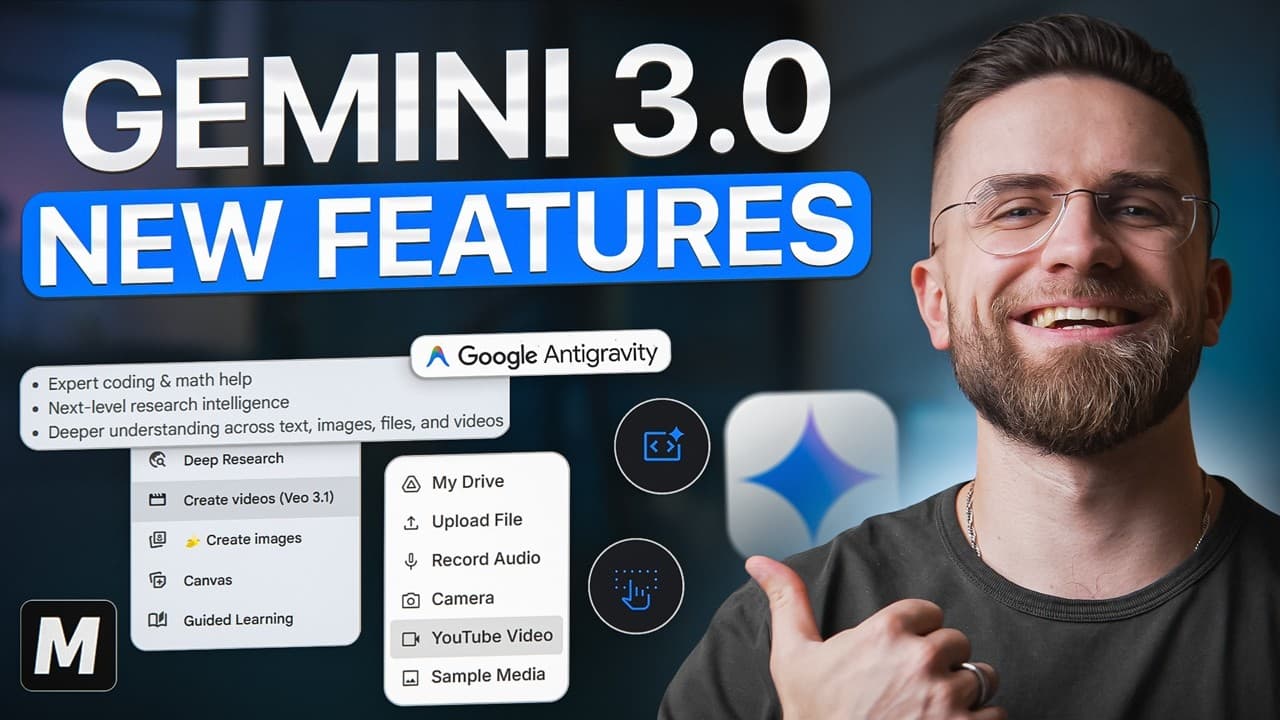
Gemini 3.0 is Google's most advanced multimodal AI, scoring 91.9% on GPQA and topping the LMArena leaderboard at over 1,500 ELO. Its standout feature is frame-by-frame YouTube video analysis with a 1 million token context window, letting you query exactly what appears on screen at any timestamp. It also powers a new AI-first IDE called Antigravity and generative search interfaces.
Transcript
Google just dropped Gemini 3.0 and the AI world is losing its mind again. GBT5, Claw 4, they just got benched. I'm talking benchmarks that crush the competition. Video understanding that actually works frame by frame and a brand new AI first IDE called anti-gravity that's already making developers rethink their entire workflow. This isn't another i... Read More
Key Insights
- Gemini 3 is Google's latest multimodal AI, natively understanding text, images, audio, and video in one system, built for deep reasoning and agentic behavior that performs multi-step tasks across tools rather than just answering chat questions.
- Gemini 3 comes in three variants: the standard model for fast everyday tasks, Gemini 3 Pro (the flagship handling up to 1 million input tokens), and Gemini 3 Deep Think, optimized for slower but harder multi-step reasoning.
- Gemini 3 scored 41% on the Humanities Last Exam, a graduate-level test spanning literature, philosophy, and history, a threshold no other model has come close to passing according to the video.
- Gemini 3 hit 91.9% on GPQA, the graduate-level physics, chemistry, and biology benchmark, which the video says is higher than most PhD students score on these multi-step scientific reasoning questions.
- Gemini 3 Deep Think scored 31.1% on ARC-AGI-2, a test of abstract reasoning, versus roughly 5% for Gemini 2.5 Pro and low-to-mid teens for competing OpenAI and Anthropic models, per Google's published results.
- Gemini 3 became the first model to top the LMArena leaderboard with over 1,500 ELO, 50 points above Gemini 2.5 Pro, on a crowdsourced benchmark where real users compare models head-to-head.
- Gemini 3 analyzes YouTube videos frame by frame, understanding on-screen visuals, so uploading a 13-minute video let the presenter ask what appeared at 7 minutes 32 seconds and get a precise visual description.
- Antigravity is Google's new AI-first IDE built on a fork of VS Code and powered by Gemini 3's coding, capable of long-horizon tasks like building a landing page with pricing tiers, a contact form, and mobile-responsive design end to end.
Install to Summarize YouTube Videos and Get Transcripts
Explore YouTube Video Summarizer or Get YouTube Transcript Extractor
Questions & Answers
Q: What is Gemini 3.0 and what can it do?
Gemini 3 is Google's latest and most advanced multimodal AI model, designed for deep reasoning. It natively understands text, images, audio, and video all in one system. Beyond answering questions, it has agentic behavior, meaning it can perform tasks across multiple tools, such as organizing your inbox, booking travel from email details, or generating custom code and deploying it live. It builds on Gemini 2's reasoning with stronger multimodal understanding.
Q: What are the three variants of Gemini 3?
There are three main variants. The standard Gemini 3 model is fast, efficient, and great for everyday tasks. Gemini 3 Pro is the flagship, crushing benchmarks and handling ultra-long context windows up to 1 million input tokens. Gemini 3 Deep Think is optimized for complex reasoning tasks requiring multi-step problem solving; it's slower but worth the wait for hard coding, research, or planning problems.
Q: How did Gemini 3 perform on the ARC-AGI-2 benchmark?
Gemini 3 Deep Think scored 31.1% on ARC-AGI-2 according to Google's published results. This test measures abstract reasoning and general intelligence, closer to how humans think than pattern matching. For context, Gemini 2.5 Pro was around 5%, and competing models from OpenAI and Anthropic are mostly in the low to mid-teens. The video describes this as a capability jump into a new tier of AI reasoning, not a marginal improvement.
Q: How does Gemini 3 analyze YouTube videos frame by frame?
Gemini 3 can analyze YouTube videos frame by frame, looking at the visuals rather than just the transcript or audio, and answering questions about specific moments. It supports up to 1 million input tokens, so you can feed it an entire feature-length film or multi-hour lecture. The creator uploaded a 13-minute video to Google AI Studio, asked what was on screen at 7 minutes 32 seconds, and got a precise description of slides, props, and even his outfit.
Q: What benchmark scores did Gemini 3 achieve?
Gemini 3 scored 41% on the Humanities Last Exam, a graduate-level test that no other model has come close to passing, and 91.9% on GPQA, the graduate-level physics, chemistry, and biology benchmark, which is higher than most PhD students score. On ARC-AGI-2, Deep Think scored 31.1%. It also became the first model to top the LMArena leaderboard with over 1,500 ELO, 50 points above Gemini 2.5 Pro.
Q: What is Google's Antigravity IDE?
Antigravity is Google's new AI-first IDE that competes with Cursor and Windsurf. It's built on a fork of VS Code, so the interface feels familiar, but it's powered by Gemini 3's coding capabilities. It handles long-horizon tasks, working systematically through complex multi-step goals. In a test, it built a landing page with three pricing tiers, a contact form, and mobile-responsive design, wrote the HTML, CSS, and JavaScript, set up the folder structure, deployed a local preview, and took a screenshot.
Q: What is AI Mode in Google Search and generative interfaces?
On day one of the Gemini 3 launch, Google rolled out AI Mode in search with generative interfaces. Instead of just links, Gemini dynamically generates a custom user interface tailored to your query. There are two types: visual layout mode, which gives a polished structured design, and dynamic view mode, where Gemini codes a custom UI in real time so you can filter data, compare specs, or explore options live. A search for AI automation tools produced an interactive comparison table.
Q: Why does frame-by-frame video analysis matter for creators and educators?
For content creators, it's a game-changer: you can instantly generate chapter markers, pull thumbnails and stills, create video summaries, clean up transcripts with visual context, or spot editing mistakes without scrubbing through footage. For educators and researchers, you can upload a lecture or documentary and query it like a database, asking for every moment a concept is explained visually or which experiments are demonstrated between specific minutes. Developers can build intelligent video search and automated highlight reels.
Summary & Key Takeaways
-
Gemini 3 is Google's most advanced multimodal AI, pushing past Gemini 2 with stronger reasoning, better multimodal understanding, and sophisticated agentic behavior. It ships in three variants: a fast standard model, the flagship Pro handling up to 1 million input tokens, and Deep Think for complex multi-step problem solving.
-
On benchmarks, Gemini 3 scored 41% on the Humanities Last Exam, 91.9% on GPQA, and 31.1% on ARC-AGI-2 with Deep Think, versus about 5% for Gemini 2.5 Pro. It also became the first model to top LMArena with over 1,500 ELO, 50 points above its predecessor.
-
The standout feature is frame-by-frame video understanding, letting users query on-screen content at specific timestamps across hours of footage. Google also launched AI Mode search with generative interfaces that build custom UIs on the fly, and Antigravity, an AI-first IDE built on VS Code that handles long-horizon coding tasks.
Read in Other Languages (beta)
Share This Summary 📚
Summarize YouTube Videos and Get Video Transcripts with 1-Click
Try YouTube Summary with ChatGPT & Claude or YouTube Transcript Generator
Explore More Summaries from AI Master 📚





Summarize YouTube Videos and Get Video Transcripts with 1-Click
Try YouTube Summary with ChatGPT & Claude or YouTube Transcript Generator