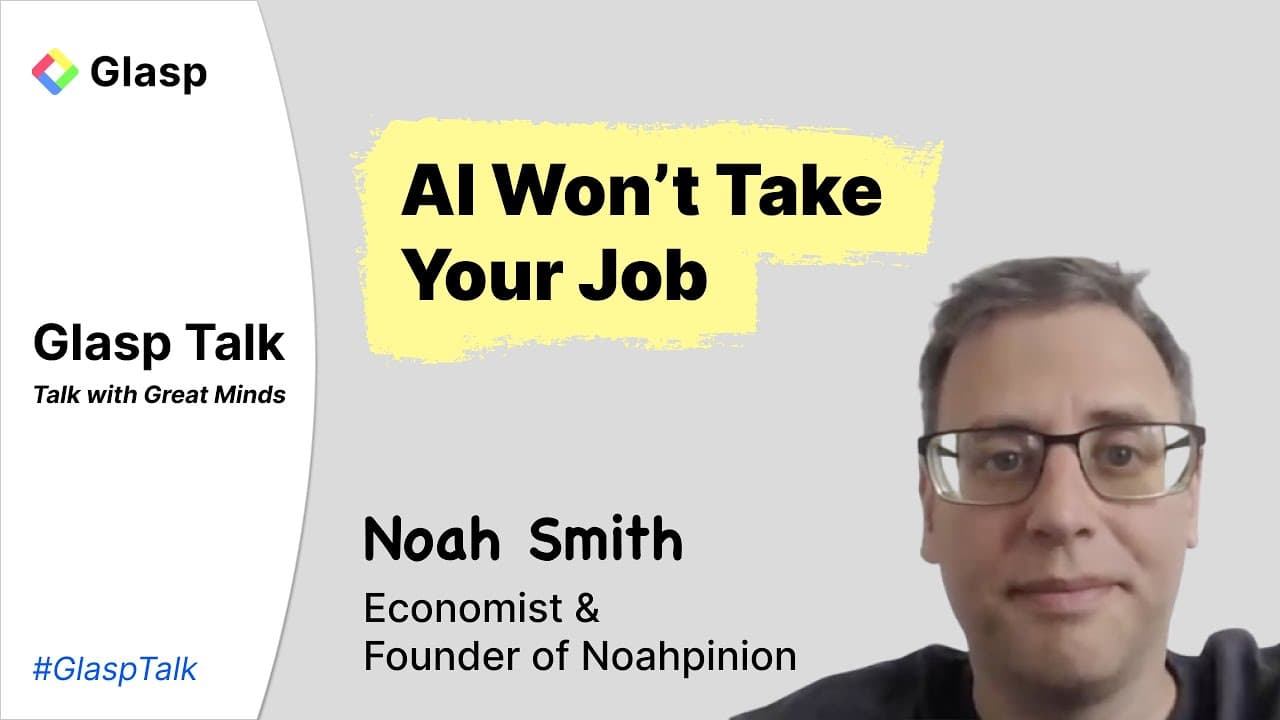
Why AI Won't Replace Jobs Soon: Insights from Noah Smith
TL;DR
AI is unlikely to replace jobs in the near future, as evidenced by past predictions about job loss in sectors like trucking and radiology that have not materialized. Regulations for AI should be adaptable and evolve with technological changes rather than being based on fear-driven projections.
Transcript
Hi everyone, welcome back to another episode of Glasp Talk. Today we are very excited to have Noah Smith with us. So Noah is a renowned economist, writer and commentator known for his sharp insights into economics, technology, geopolitics and culture. and he is the Founder and Writer of Noahpinion, a widely read newsletter with nearly 400,000 subsc... Read More
Key Insights
- Noah Smith switched from physics to economics due to personal challenges and a desire for change, eventually leading him to Japan for three years.
- Smith's interest in Japan stemmed from cultural influences, specifically underground movies and street fashion, rather than mainstream anime.
- He transitioned from academia to writing full-time, initially blogging as a hobby before being approached by Bloomberg to write professionally.
- Smith argues that AI's impact on job displacement is overstated, citing examples like truck drivers and radiologists who still have strong job markets.
- He uses AI tools like GPT-3 for proofreading and research but finds AI-generated text lacks the quality needed for his writing.
- Smith advocates for adaptive AI regulations that evolve with technology, instead of rigid rules based on speculative future scenarios.
- He sees greenfield investments as a missing piece in Japan's economy, suggesting it could boost GDP by 25% if strategically implemented.
- Smith encourages Japanese founders to build large organizations that contribute to society, rather than focusing solely on personal wealth.
Install to Summarize YouTube Videos and Get Transcripts
Explore YouTube Video Summarizer or Get YouTube Transcript Extractor
Questions & Answers
Q: What led Noah Smith to switch from physics to economics?
Noah Smith switched from physics to economics after experiencing personal challenges, including depression following his mother's death. He sought a change in life direction, which led him to live in Japan for three years, where he contemplated his career path and eventually chose economics for its broader societal impact.
Q: Why did Noah Smith become interested in Japan?
Noah Smith's interest in Japan was sparked by cultural influences, particularly underground movies and street fashion, rather than mainstream anime. He was fascinated by the unique cultural elements and decided to study Japanese, which eventually led to his three-year stay in Osaka, Japan.
Q: How did Noah Smith transition from academia to full-time writing?
Noah Smith began blogging as a hobby during graduate school, which caught the attention of Bloomberg. They offered him a writing position, allowing him to turn his passion into a profession. Smith continued to write both for Bloomberg and his blog, eventually moving to Substack to reach a wider audience.
Q: What is Noah Smith's view on AI's impact on jobs?
Noah Smith believes that the narrative of AI replacing jobs is overstated. He cites examples like truck drivers and radiologists, who still have strong job markets despite predictions of automation. Smith argues that historical predictions have often been incorrect and emphasizes the complexity of technological impacts on employment.
Q: How does Noah Smith use AI tools in his work?
Noah Smith uses AI tools like GPT-3 primarily for proofreading and conducting background research. While he finds these tools helpful for catching errors and identifying research papers, he does not use AI to generate text, as he believes the quality does not yet meet the standards required for his writing.
Q: What are Smith's thoughts on AI regulation?
Smith advocates for adaptive AI regulations that can evolve with technological advancements. He cautions against creating rigid rules based on speculative future scenarios, as these may stifle innovation. Instead, he suggests monitoring AI's real-world impact and adjusting regulations accordingly to ensure safety and progress.
Q: What is Smith's proposal for Japan's economic growth?
Smith proposes that Japan embrace greenfield investments to boost its economy. He believes that attracting foreign companies to set up operations in Japan could significantly increase the country's GDP by up to 25%. Smith emphasizes the importance of positioning Japan as a hub for manufacturing and technology exports.
Q: What advice does Noah Smith have for Japanese founders?
Noah Smith advises Japanese founders to focus on building large organizations that contribute to societal well-being, rather than merely accumulating personal wealth. He encourages them to dream big and aim to create impactful businesses that can drive economic growth and innovation, similar to the vision of historical figures like Matsushita Konosuke.
Summary & Key Takeaways
-
Noah Smith, an economist and writer, discusses his career transition from physics to economics, influenced by personal challenges and a cultural interest in Japan. He lived in Japan for three years, where he immersed himself in its underground culture.
-
Smith addresses the misconception that AI will imminently replace jobs, citing historical inaccuracies in such predictions. He emphasizes the need for adaptable regulations that can evolve with technological advancements.
-
He advocates for Japan to embrace greenfield investments to enhance its economy, suggesting that this could significantly increase its GDP. Smith also encourages Japanese founders to focus on building impactful organizations rather than just accumulating wealth.
Read in Other Languages (beta)
Share This Summary 📚
Summarize YouTube Videos and Get Video Transcripts with 1-Click
Try YouTube Summary with ChatGPT & Claude or YouTube Transcript Generator
Explore More Summaries from Glasp 📚

Summarize YouTube Videos and Get Video Transcripts with 1-Click
Try YouTube Summary with ChatGPT & Claude or YouTube Transcript Generator