How to Design Scalable Frontend Architectures
TL;DR
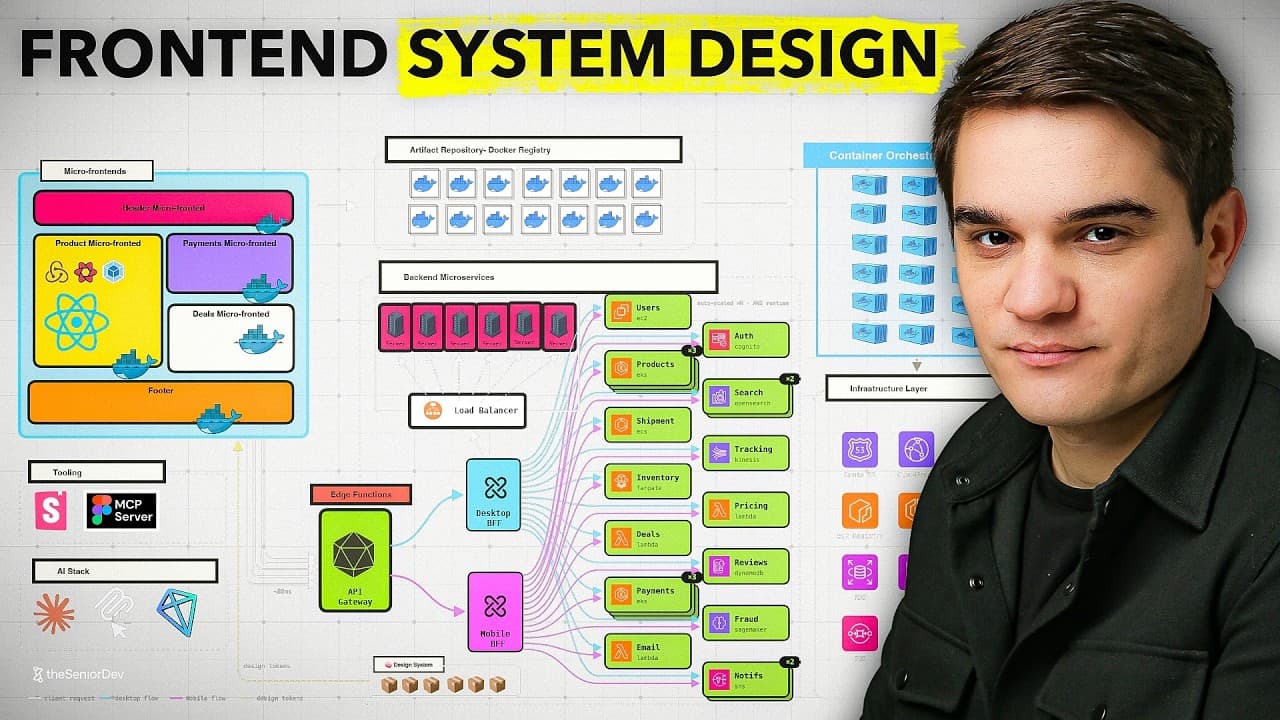
Scalable frontend architecture divides a monolith into independently deployable micro-frontends, pairs them with domain-aligned microservices, and assigns each vertical slice to a small feature team. A shared shell handles concerns such as authentication, routing, language, and global state, while platform teams maintain common infrastructure and design systems. Smaller boundaries also reduce bug impact, coding-agent context, and verification effort.
Transcript
As AI is getting better at writing front-end code, your only choice to stay relevant and competitive as a front-end engineer is to level up your system design and architecture skills. The problem is that most system design content is way too focused on the back-end while completely ignoring the front-end. So today I'm going to break down every fron... Read More
Key Insights
- Frontend system design is increasingly important because AI can accelerate code implementation, while engineers remain responsible for architecture, verification, and production reliability. The central challenge becomes designing systems that minimize verification time and architectural drift while preserving development velocity.
- A frontend monolith is a single client application containing many features in one place. It becomes harder to scale when a large team shares the same codebase, coordinates every release, and risks system-wide effects from mistakes such as changing a global CSS rule.
- Micro-frontends are independent frontend applications assembled into one user experience. They allow focused teams to develop and deploy product areas separately, reducing coordination overhead and preventing one team’s release process from becoming a bottleneck for another team.
- A micro-frontend shell is responsible for shared application capabilities such as authentication, routing, language, and global state. It loads the individual frontend applications and passes relevant shared state into them while allowing those applications to remain independently deployable.
- A microservice is an independently deployable backend with its own API, business logic layer, persistence layer, and usually a database. Teams communicate with other services through APIs, enabling backend ownership to be divided into smaller and more independent units.
- Vertical slicing is the alignment of a micro-frontend with one or more microservices from the same product domain. A feature team can own this full stack slice, extend it independently, and work against other teams’ published APIs instead of coordinating every internal implementation detail.
- Micro-frontends and microservices reduce verification effort by creating smaller, localized code changes with a narrower production blast radius. Coding agents receive less context, pull requests cover a smaller surface area, and engineers can evaluate quality with less unrelated code involved.
- An API gateway is a shared entry point into backend systems that centralizes repetitive edge functions. Capabilities mentioned include caching, HTTPS, authentication, content negotiation, and security rate limiting, which otherwise create repeated work whenever a micro-frontend connects to another backend service.
Install to Summarize YouTube Videos and Get Transcripts
Explore YouTube Video Summarizer or Get YouTube Transcript Extractor
Questions & Answers
Q: How do micro-frontends improve frontend scalability?
Micro-frontends improve scalability by splitting a frontend monolith into independent applications that focused teams can develop and deploy separately. This reduces the communication overhead created when many engineers push changes into one client and coordinate shared releases. It also limits the reach of mistakes, such as global CSS changes, and allows each product area to move without waiting for unrelated teams.
Q: What does a micro-frontend shell manage?
A micro-frontend shell combines the independent frontend applications into one product experience. It manages global functionality such as authentication, routing, language, and shared state, including whether a user is logged in. The shell loads the individual applications and passes appropriate global state into them, while each application remains independently deployable and may be hosted through its own domain.
Q: What is vertical slicing in frontend system design?
Vertical slicing means assigning one team ownership of a complete product feature across the frontend and backend. A slice can contain a micro-frontend plus one or more microservices in the same domain. Because the team controls the whole slice, it can extend and release the feature independently while communicating with other teams through defined APIs instead of relying on constant coordination.
Q: Why do large frontend monoliths become difficult to maintain?
Large frontend monoliths become difficult to maintain because many engineers modify the same client, creating substantial coordination and communication overhead. A single mistake can affect the entire system, and shared resources such as global CSS can cause unexpected consequences across unrelated features. Releases also become bottlenecks because teams must coordinate changes within the same application and codebase.
Q: How does AI coding change frontend architecture priorities?
AI coding reduces implementation time but increases the importance of verification. An AI-savvy frontend engineer therefore designs systems that are easy to check, resist architectural drift, and maintain development velocity. Smaller architectural boundaries help because coding agents need less context, code changes remain localized, and engineers can review a narrower surface area before deploying changes to production.
Q: Why are smaller feature teams aligned with modular architecture?
Smaller feature teams need architectural boundaries that let them work and deliver independently. Conway’s law, as presented in the transcript, says software architecture resembles the organization that creates it. Dividing a system into micro-frontends, microservices, and vertical slices therefore supports smaller teams, while a platform team can separately own shared infrastructure, frontend tooling, shells, or design systems.
Q: How do microservices support micro-frontend teams?
Microservices divide a backend monolith into small, independently deployable backends. Each service exposes an API and can include business logic, persistence, and a database. A micro-frontend can communicate with one or several services in its domain, giving a feature team control over a vertical slice while allowing other teams to depend on stable APIs rather than shared internal code.
Q: Why use an API gateway with micro-frontends and microservices?
An API gateway provides a common entry point to backend systems and reduces repeated implementation of API edge functions. The transcript identifies caching, HTTPS, authentication, content negotiation, and security rate limiting as recurring needs. Centralizing these responsibilities means a client does not have to reimplement the same capabilities every time another microservice is connected to a micro-frontend.
Summary & Key Takeaways
-
Frontend monoliths become difficult to scale when many engineers modify the same client, coordinate releases, and share global resources such as CSS. Micro-frontends address this organizational bottleneck by dividing the client into independent applications that can be developed and deployed separately, allowing smaller teams to own focused areas of the product.
-
A micro-frontend shell combines independently hosted applications and manages shared concerns such as authentication, routing, language, and global state. Each micro-frontend can communicate with one or more microservices in its domain, forming a vertical slice that a full-stack feature team can extend and release without blocking other teams.
-
AI coding shifts engineering effort from implementation toward verification. Smaller micro-frontends and microservices limit the blast radius of production bugs, produce localized code changes, reduce the context required by coding agents, and make quality checks easier. API gateways further reduce repeated client and service work by centralizing common API edge functions.
Read in Other Languages (beta)
Share This Summary 📚
Summarize YouTube Videos and Get Video Transcripts with 1-Click
Try YouTube Summary with ChatGPT & Claude or YouTube Transcript Generator
Explore More Summaries from theSeniorDev 📚






Summarize YouTube Videos and Get Video Transcripts with 1-Click
Try YouTube Summary with ChatGPT & Claude or YouTube Transcript Generator