How to Make Hard Work Produce Better Results
TL;DR
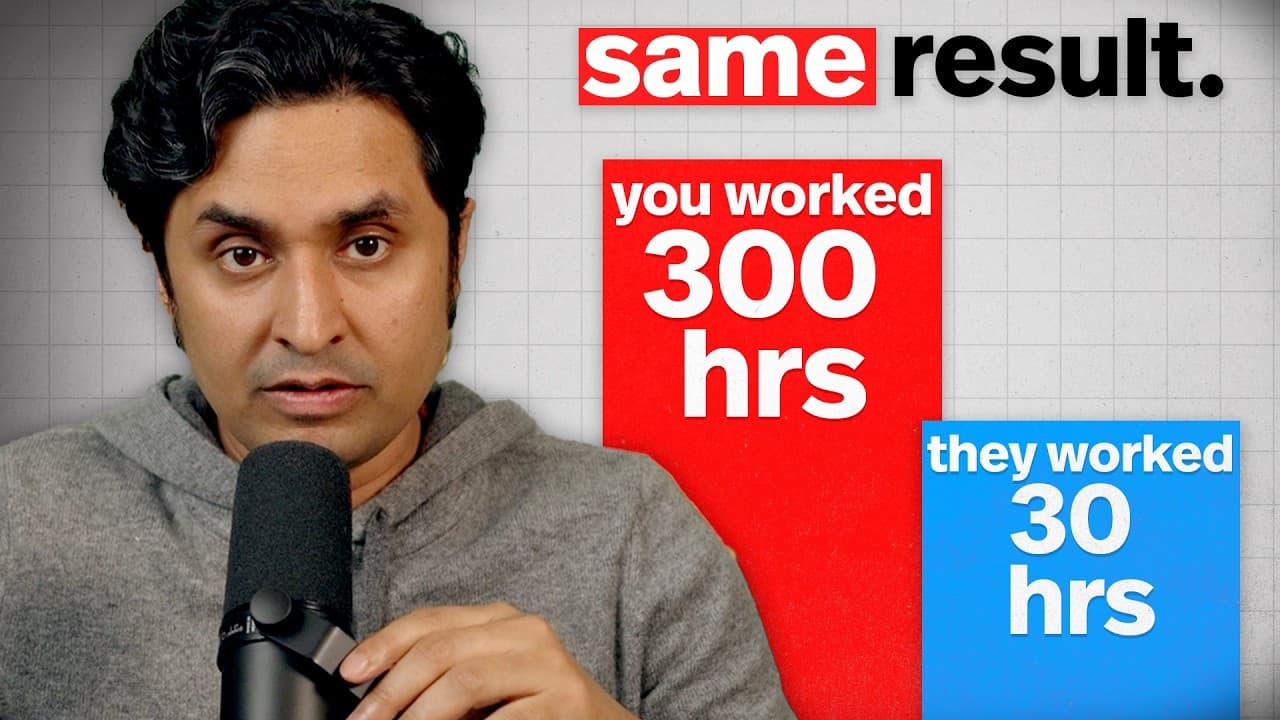
Working harder is not enough when effort is aimed at a misunderstood problem. Pay attention to friction, identify the source of resistance, and adjust your approach before investing more energy. A small increase in understanding can improve results dramatically, while repeatedly forcing an ineffective strategy can produce exhaustion, self-blame, burnout, and the desire to stop trying altogether.
Transcript
I'm back because I failed again. Dr. K, please give me some closure if you can. Earlier times, I can't handle things. Maybe I should try harder. I can do this. Other must have worked hard too. Even if I can't do anything or handle anything, I must keep doing. I would eventually learn how to deal with stuff. I should try harder. Everything will be f... Read More
Key Insights
- Hard work is an incomplete solution because additional effort only helps when it is directed toward an approach that can address the actual problem. If the problem has been misunderstood, increasing hours, discipline, intensity, or willpower can consume energy without producing meaningful improvement.
- Effort costs differ substantially between people because conditions such as depression and ADHD can make ordinary activities unusually demanding. A person may appear capable of participating in class or completing a task while paying a much higher internal cost than someone performing the same behavior.
- Visible success does not reliably reveal how hard someone works because people with fewer resources may expend enormous effort across several poorly compensated jobs. The transcript contrasts prestigious, demanding professions with patients holding three part-time jobs because individual employers would not provide full-time hours and benefits.
- Burnout is a predictable result of repeatedly forcing an ineffective strategy. When sustained effort produces little improvement, people may swing from demanding constant productivity of themselves to wishing they could withdraw, become dependent, do nothing, or escape their responsibilities entirely.
- The board game box analogy shows that alignment can matter more than force. A tilted lid will resist even intense pressure, but a slight reorientation allows it to close effortlessly. Similarly, identifying and adjusting the source of resistance can drastically increase the yield from personal energy.
- Understanding can improve performance more efficiently than repetition. Ranked multiplayer games show that learning a mechanic, positioning rule, or decision principle may produce more progress than simply playing additional matches, as demonstrated by players who remain at low ranks despite thousands of hours.
- Friction is information that should be examined rather than automatically overpowered. Feelings of resistance, recurring failures, and unsustainable stress may signal that the current method is not working. Ignoring those signals preserves the same strategy while increasing exhaustion and self-criticism.
- Accurate diagnosis must come before intensified treatment because greater intervention cannot reliably fix a problem that has been misunderstood. The psychiatric example shows that increasing medication doses or trying additional medications may fail when the original diagnosis does not identify the patient’s actual condition.
Install to Summarize YouTube Videos and Get Transcripts
Explore YouTube Video Summarizer or Get YouTube Transcript Extractor
Questions & Answers
Q: Why does working harder sometimes fail to improve results?
Working harder sometimes fails because effort is being applied to a misunderstood problem or ineffective strategy. More hours can improve outcomes when the method is appropriate, but they cannot guarantee progress. If recurring friction indicates misalignment, repeatedly increasing discipline, intensity, or willpower may only consume more energy. Better results require identifying the resistance, understanding its source, and adjusting where effort is directed.
Q: How can someone make hard work more productive?
Hard work becomes more productive when understanding comes before increased intensity. Examine what repeatedly creates friction, determine whether the goal or method is misaligned, and make a targeted adjustment. The transcript compares this process to straightening a tilted board game lid: force cannot close it while it is misaligned, but a small reorientation allows the same task to be completed with little effort.
Q: What does the board game box analogy mean?
The board game box represents a problem that cannot be solved through force alone. When its lid is slightly tilted, pushing harder does not make it close. Once the lid is reoriented, it fits with almost no effort. The analogy suggests that persistent resistance may call for a change in direction, understanding, or technique before more energy is invested in the task.
Q: How do depression and ADHD affect the cost of effort?
Depression and ADHD can raise the effort required for activities that may look easy from the outside. With depression, getting out of bed or cleaning a room can demand substantial energy. With ADHD, a student may converse and participate effectively in class, yet maintaining that engagement can cost far more effort than it costs a neurotypical person performing the same visible behavior.
Q: Why is effort not a fair measure of success?
Effort is not a fair measure of success because people face different internal costs and external constraints. Someone with depression or ADHD may need more energy for ordinary tasks, while someone holding three part-time jobs may work intensely without receiving the benefits associated with full-time employment. Outcomes therefore reflect more than willingness, hours, discipline, or the amount of strain a person endures.
Q: How can excessive effort lead to burnout and withdrawal?
Excessive effort leads to burnout when a person repeatedly forces a strategy that does not resolve the underlying problem. Energy accumulates as exhaustion rather than progress, which can create a pendulum between relentless self-pressure and a desire to do nothing. The wish to withdraw, depend on others, or escape responsibility may reflect a damaged relationship with effort rather than simple unwillingness to work.
Q: What can ranked multiplayer games teach about improvement?
Ranked multiplayer games demonstrate that understanding a small number of important mechanics can matter more than accumulating matches. Learning positioning, last hitting, creep pulling, or when to leave the enemy side of the map can improve decisions and ranking. Players may spend thousands of hours in a game and remain stuck because repeated play does not automatically correct missing knowledge or ineffective habits.
Q: What should someone do when repeated effort is not working?
When repeated effort is not working, the first response should be investigation rather than automatic escalation. Notice the signals produced by stress, resistance, recurring failure, and exhaustion. Ask whether the problem has been defined correctly and whether the current method addresses it. A small shift based on better understanding may produce a greater return than adding more hours, pressure, motivation, or self-control.
Summary & Key Takeaways
-
Hard work is correlated with outcomes such as better grades or higher earnings, but effort alone does not determine success. Depression, ADHD, financial constraints, and other circumstances can make ordinary tasks unusually costly. Judging progress only by hours worked ignores how much energy different people must spend to perform comparable actions.
-
Repeatedly forcing an ineffective approach can create burnout and a destructive swing between overwork and total withdrawal. The board game box analogy illustrates the alternative: pushing harder cannot close a misaligned lid, while a small adjustment makes it fit easily. Life problems may similarly require reorientation before additional effort becomes useful.
-
Better understanding increases the return on effort. Friction should be treated as information about resistance, incorrect assumptions, or a misunderstood problem. Like learning a crucial mechanic in a ranked game, one insight can improve performance more than thousands of repeated attempts. Productive energy must be guided by accurate diagnosis and deliberate adjustment.
Read in Other Languages (beta)
Share This Summary 📚
Summarize YouTube Videos and Get Video Transcripts with 1-Click
Try YouTube Summary with ChatGPT & Claude or YouTube Transcript Generator
Explore More Summaries from HealthyGamerGG 📚



Summarize YouTube Videos and Get Video Transcripts with 1-Click
Try YouTube Summary with ChatGPT & Claude or YouTube Transcript Generator