How to Adapt and Succeed in the AI Economy
TL;DR
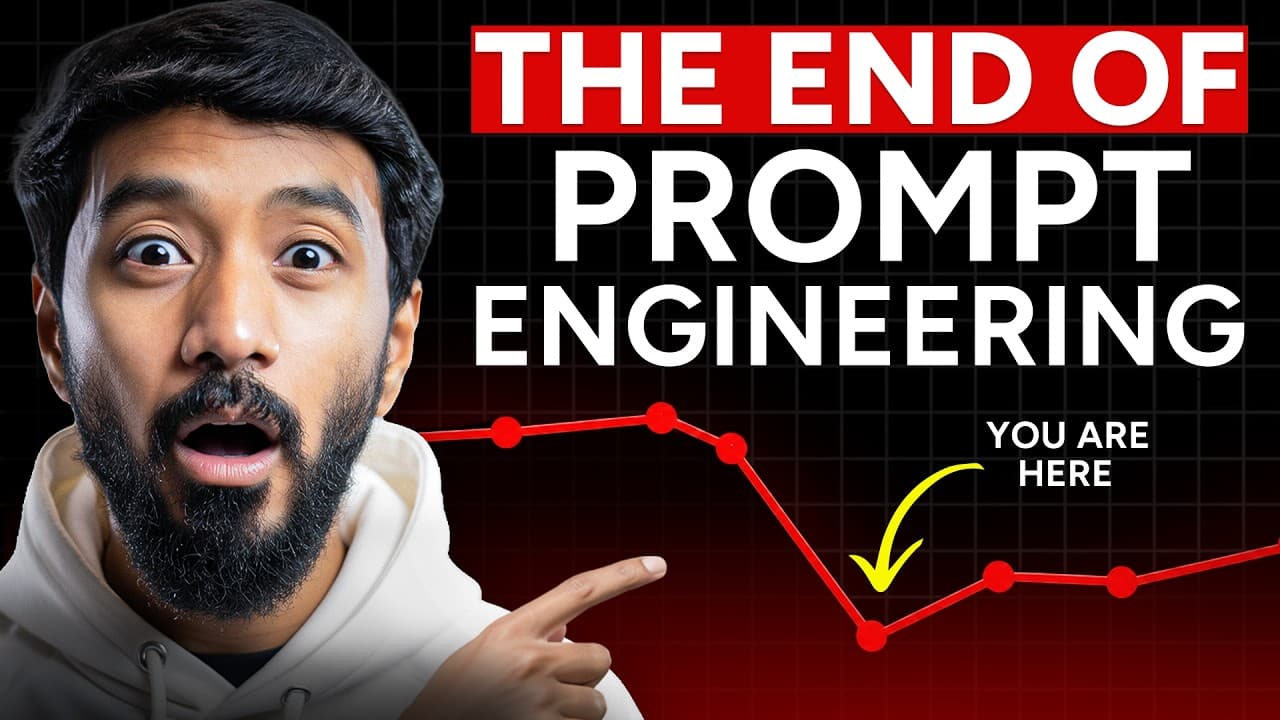
Adapting to AI is crucial for career success. The video outlines a five-stage framework: Acknowledge, Dabble, Amplify, Problem Solve, and Tie Together. Each stage builds on the previous, from recognizing AI's impact on jobs to orchestrating AI systems for efficiency. Mastery of these stages can significantly increase income and job relevance in an AI-driven world.
Transcript
There's a five-letter word that's going to decide your paycheck for the next decade. It's not agents. It's not coding. It's adapt. And it's a framework that will take any person from being an AI resistor to an AI pro. I'll explain. Last Monday, a friend of mine, a guy who runs a 200 person company, walked into his own Monday meeting and couldn't un... Read More
Key Insights
- Adaptation is crucial for staying relevant in the AI-driven job market.
- AI spans multiple domains: text, data, images, video, voice, code, and automation.
- The 'Acknowledge' stage involves accepting AI's impact on your job and identity.
- Dabbling involves exploring numerous AI tools to understand possibilities.
- Amplifying focuses on mastering 3-5 tools that solve real problems.
- Problem-solving involves integrating multiple tools to address complex issues.
- The 'Tie Together' stage orchestrates AI systems to automate tasks efficiently.
- Understanding AI jargon like system prompts, RAG, MCP, and fine-tuning is essential.
Install to Summarize YouTube Videos and Get Transcripts
Explore YouTube Video Summarizer or Get YouTube Transcript Extractor
Questions & Answers
Q: How to adapt to AI in the workplace?
Adapting to AI involves a five-stage framework: Acknowledge AI's impact on your job, Dabble by exploring numerous AI tools, Amplify by mastering a select few tools, Problem Solve by integrating tools to address complex issues, and Tie Together by orchestrating AI systems for efficiency. This approach ensures relevance and success in an AI-driven job market.
Q: What is the 'Acknowledge' stage in AI adaptation?
The 'Acknowledge' stage requires individuals to accept the reality that AI is transforming job roles and industries. It involves understanding that AI can automate a significant portion of tasks and that the key to staying relevant is to learn and adapt to these changes rather than resisting them.
Q: What does 'Dabble' mean in the context of AI?
'Dabble' involves exploring a wide range of AI tools to build an understanding of their capabilities and potential applications. It is about experimenting with different tools to create a mental map of what AI can achieve, without yet focusing on mastering any particular tool.
Q: How does 'Amplify' differ from 'Dabble' in AI adaptation?
While 'Dabble' involves exploring many AI tools, 'Amplify' focuses on selecting and mastering 3-5 tools that directly address current work challenges. This stage is about deepening expertise in chosen tools to maximize their utility and integrate them into daily workflows effectively.
Q: What is the significance of the 'Problem Solve' stage?
The 'Problem Solve' stage is crucial as it involves integrating multiple AI tools to address complex issues. It shifts the focus from individual tools to creating workflows that solve real-world problems, thereby unlocking significant value and financial opportunities in the AI economy.
Q: How do AI jargon terms like RAG and MCP apply in real-world scenarios?
RAG (Retrieval Augmented Generation) and MCP (Model Context Protocol) are essential AI concepts. RAG involves AI using specific data sources to generate accurate responses, while MCP allows AI to interact with applications like calendars. Understanding these terms enhances effectiveness in AI-driven tasks.
Q: What does it mean to 'Tie Together' AI systems?
To 'Tie Together' AI systems means to orchestrate multiple AI tools to work seamlessly in the background, automating tasks without manual intervention. This stage represents the pinnacle of AI adaptation, where systems are designed to handle complex workflows autonomously, significantly increasing productivity.
Q: Why do 94% of people quit between 'Dabble' and 'Amplify' stages?
Many quit between 'Dabble' and 'Amplify' because they mistake activity for progress. They explore numerous tools but fail to focus on mastering a select few that solve real problems. This lack of depth prevents them from realizing the full potential and value of AI in their work.
Summary & Key Takeaways
-
Adapting to AI is essential for future job security and success. The video presents a five-stage framework: Acknowledge, Dabble, Amplify, Problem Solve, and Tie Together. Each stage builds on the previous one, guiding viewers from recognizing AI's impact on their jobs to orchestrating AI systems for greater efficiency.
-
The 'Acknowledge' stage requires accepting AI's influence on job roles. 'Dabble' involves exploring a wide range of AI tools to understand their potential. 'Amplify' focuses on mastering a select few tools that address current work challenges, while 'Problem Solve' integrates tools to solve complex problems.
-
The final stage, 'Tie Together,' involves orchestrating AI systems to automate tasks, freeing up time and resources. Understanding AI terminology like system prompts, RAG, MCP, and fine-tuning is crucial. Mastery of these stages can significantly increase income and job relevance in an AI-driven world.
Read in Other Languages (beta)
Share This Summary 📚
Summarize YouTube Videos and Get Video Transcripts with 1-Click
Try YouTube Summary with ChatGPT & Claude or YouTube Transcript Generator
Explore More Summaries from Vaibhav Sisinty 📚






Summarize YouTube Videos and Get Video Transcripts with 1-Click
Try YouTube Summary with ChatGPT & Claude or YouTube Transcript Generator