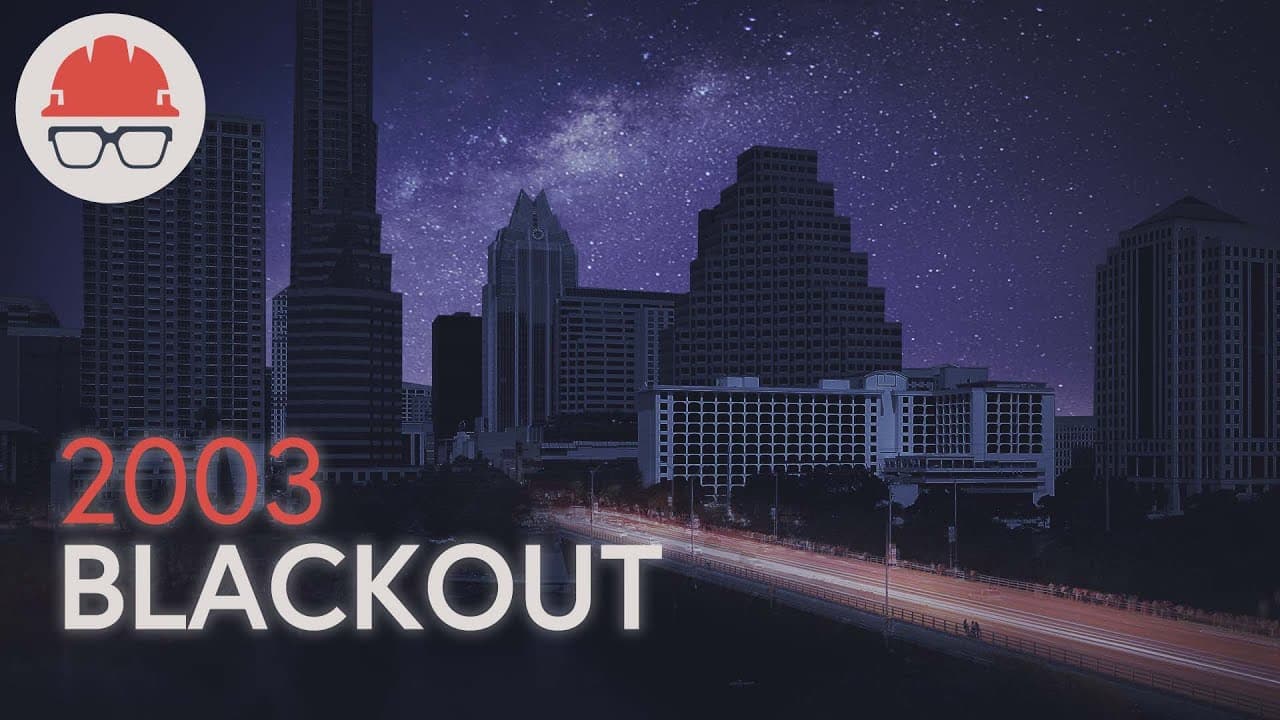
What Really Happened During the 2003 Blackout?
TL;DR
The 2003 blackout affected 50 million due to grid failures.
Transcript
On August 14, 2003, a cascading failure of the power grid plunged more than 50 million people into darkness in the northeast US and Canada. It was the most significant power outage ever in North America, with an economic impact north of ten billion dollars. Calamities like this don’t happen in a bubble, and there were many human factors, politi... Read More
Key Insights
- The 2003 blackout was the largest in North American history, affecting over 50 million people and causing significant economic losses.
- Human, political, and organizational factors contributed to the blackout, alongside technical issues within the power grid.
- The power grid's reliability depends on real-time balance of supply and demand, with little room for bulk electricity storage.
- MISO's state estimator failure left operators blind to grid vulnerabilities, contributing to the cascading blackout.
- FirstEnergy's control room experienced critical computer failures, preventing operators from receiving necessary alarms.
- Transmission lines sagged into trees due to high demand and heat, causing short circuits and triggering the blackout.
- Zone 3 relays, less discriminating in fault detection, caused many lines to trip during the cascade.
- The blackout led to significant changes in grid management practices and infrastructure improvements to prevent future occurrences.
Install to Summarize YouTube Videos and Get Transcripts
Explore YouTube Video Summarizer or Get YouTube Transcript Extractor
Questions & Answers
Q: What caused the 2003 blackout?
The 2003 blackout was caused by a combination of technical failures, including state estimator issues, computer failures in control rooms, and transmission lines sagging into trees. These factors, combined with human and organizational errors, led to a cascading failure of the power grid.
Q: How did the blackout affect the power grid?
The blackout caused a massive power outage across the northeastern US and parts of Canada, affecting over 50 million people. It highlighted vulnerabilities in the power grid's management and infrastructure, prompting significant changes to improve reliability and prevent future incidents.
Q: What role did MISO play in the blackout?
MISO, the Midwest Independent System Operator, experienced a failure in its state estimator tool, which left operators blind to grid vulnerabilities. This failure contributed to the cascading blackout as operators could not anticipate or mitigate the grid's weaknesses.
Q: Why did transmission lines sag during the blackout?
Transmission lines sagged due to high demand and heat, which caused them to expand and come into contact with trees. This resulted in short circuits and triggered the cascading failure of the power grid, contributing to the widespread blackout.
Q: What were the economic impacts of the blackout?
The blackout had significant economic impacts, with estimates exceeding ten billion dollars in losses. The power outage disrupted businesses, transportation, and essential services, highlighting the critical importance of a reliable power grid for economic stability.
Q: How did the blackout influence grid management practices?
The blackout prompted significant changes in grid management practices, including improved state estimation tools, better communication systems in control rooms, and enhanced infrastructure to prevent similar incidents. These changes aimed to increase the reliability and resilience of the power grid.
Q: What recommendations were made following the blackout?
A bilateral report made 46 recommendations to improve grid operations and infrastructure, many of which have been implemented. These recommendations focused on enhancing reliability, improving communication and coordination among grid operators, and upgrading infrastructure to prevent future blackouts.
Q: How does the 2003 blackout compare to recent power outages?
While the 2003 blackout was one of the largest in history, recent outages, such as the Texas outage related to extreme weather, highlight ongoing challenges in grid management. These events emphasize the need for continued improvements in infrastructure and management practices to adapt to changing conditions.
Summary & Key Takeaways
-
The 2003 blackout was a major power outage that affected over 50 million people in the northeastern US and Canada. It was caused by a combination of technical failures, human errors, and organizational issues, leading to a cascading failure of the power grid.
-
Key events leading to the blackout included failures in state estimation tools, computer system issues in control rooms, and transmission lines sagging into trees due to high demand and heat. These factors left the grid vulnerable to cascading outages.
-
The blackout highlighted the complexity and interconnectedness of the power grid, prompting significant changes in grid management practices and infrastructure improvements to enhance reliability and prevent similar incidents in the future.
Read in Other Languages (beta)
Share This Summary 📚
Summarize YouTube Videos and Get Video Transcripts with 1-Click
Try YouTube Summary with ChatGPT & Claude or YouTube Transcript Generator
Explore More Summaries from Practical Engineering 📚





Summarize YouTube Videos and Get Video Transcripts with 1-Click
Try YouTube Summary with ChatGPT & Claude or YouTube Transcript Generator