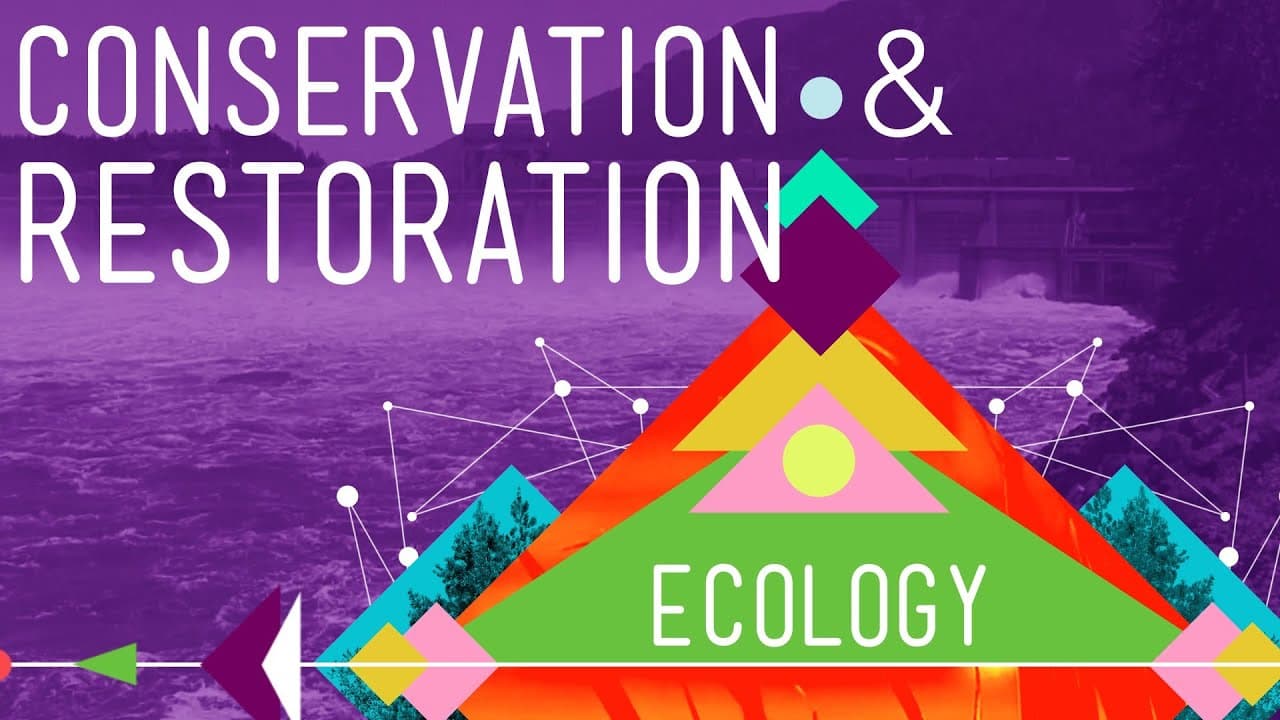
How Do Conservation and Restoration Ecology Work?
TL;DR
Conservation biology and restoration ecology focus on preserving biodiversity and repairing damaged ecosystems. These fields employ strategies like small-population conservation and declining population conservation to protect species. Restoration ecology involves structural restoration, bioremediation, and biological augmentation to rehabilitate ecosystems. Protecting ecosystems from human damage is often more effective than trying to restore them.
Transcript
For the past 12 weeks, we've been investigating our living planet together, and learning how it works on many levels; how populations of organisms interact, how communities thrive and ecosystems change, and how humans are wrecking the nice, perfectly functioning systems Earth has been using for hundreds of thousands of years. And now it's graduatio... Read More
Key Insights
- Conservation biology is focused on measuring biodiversity and protecting ecosystems.
- Restoration ecology aims to restore damaged ecosystems to their natural state.
- Biodiversity includes species diversity, genetic diversity, and ecosystem diversity.
- Small-population conservation boosts numbers and genetic diversity of small populations.
- Declining population conservation addresses causes of population decline.
- Structural restoration removes human impacts and rebuilds natural structures.
- Bioremediation uses organisms to remove toxins from ecosystems.
- Biological augmentation adds organisms to restore missing ecosystem elements.
Install to Summarize YouTube Videos and Get Transcripts
Explore YouTube Video Summarizer or Get YouTube Transcript Extractor
Questions & Answers
Q: How does conservation biology protect ecosystems?
Conservation biology protects ecosystems by measuring biodiversity and identifying ways to preserve species and habitats. It focuses on maintaining genetic diversity and ecosystem diversity, ensuring species can adapt to changes like disease and climate. Conservation strategies include small-population conservation to boost numbers and genetic diversity, and declining population conservation to address causes of population decline.
Q: What is restoration ecology?
Restoration ecology is the science of rehabilitating damaged ecosystems to their natural state. It involves practical solutions like structural restoration, which removes human impacts and rebuilds natural structures, and bioremediation, which uses organisms to remove toxins. Biological augmentation is another method, adding organisms to restore missing elements in ecosystems, such as nitrogen-fixing plants.
Q: What is the role of biodiversity in ecosystem restoration?
Biodiversity is crucial in ecosystem restoration as it includes species diversity, genetic diversity, and ecosystem diversity. High biodiversity increases resilience and adaptability, allowing ecosystems to recover from disturbances. Restoration efforts aim to enhance biodiversity by protecting species, maintaining genetic variation, and recreating diverse habitats to support ecological functions and interactions.
Q: What is small-population conservation?
Small-population conservation focuses on identifying and supporting species with small populations to prevent extinction. It aims to increase population size and genetic diversity, addressing issues like inbreeding and genetic drift. By calculating the minimum viable population, ecologists determine the smallest population size needed for long-term survival, guiding conservation efforts to boost numbers and genetic health.
Q: How does declining population conservation work?
Declining population conservation addresses species whose numbers are decreasing, regardless of initial population size. It involves determining if a population is declining, understanding its historical size and requirements, and identifying causes of decline. Conservationists then develop strategies to mitigate these causes, such as habitat restoration, pollution reduction, or legal protection, to stabilize and recover the population.
Q: What is structural restoration in ecology?
Structural restoration in ecology involves removing human impacts and rebuilding natural structures to restore ecosystems. This may include removing dams, cleaning up pollution, and reconstructing habitats like river channels and vegetation. The goal is to recreate the physical environment needed for ecosystems to function properly, supporting species recovery and ecological processes.
Q: What are bioremediation and biological augmentation?
Bioremediation uses organisms like bacteria and plants to remove toxins from ecosystems, such as bacteria that degrade oil spills or plants that extract heavy metals from soil. Biological augmentation involves adding organisms to restore missing ecosystem elements, like nitrogen-fixing plants to replenish soil nutrients. Both methods aim to enhance ecosystem health and resilience through natural processes.
Q: Why is it often easier to protect ecosystems than to restore them?
Protecting ecosystems is often easier than restoring them because it prevents damage and maintains natural processes, avoiding the complex and uncertain task of restoration. Restoration efforts can be challenging, requiring detailed knowledge of ecosystem functions and risks of unintended consequences, such as introducing invasive species. By focusing on conservation, we reduce the need for restoration and preserve ecological integrity.
Summary & Key Takeaways
-
Conservation biology and restoration ecology work to protect and restore ecosystems by focusing on biodiversity, which includes species, genetic, and ecosystem diversity. Small-population conservation and declining population conservation are strategies used to preserve species. Restoration involves structural restoration, bioremediation, and biological augmentation.
-
Efforts to restore ecosystems include removing harmful human impacts and using organisms to clean up pollutants. Structural restoration, bioremediation, and biological augmentation are key methods. Conservation biology measures biodiversity and identifies ways to protect ecosystems, while restoration ecology applies practical solutions to repair them.
-
Protecting ecosystems is often easier than restoring them after damage. Conservation biology and restoration ecology provide frameworks for understanding and mitigating human impacts on the environment. Strategies include preserving small populations, addressing population declines, and employing restoration techniques to rehabilitate ecosystems.
Read in Other Languages (beta)
Share This Summary 📚
Summarize YouTube Videos and Get Video Transcripts with 1-Click
Try YouTube Summary with ChatGPT & Claude or YouTube Transcript Generator
Explore More Summaries from CrashCourse 📚

Summarize YouTube Videos and Get Video Transcripts with 1-Click
Try YouTube Summary with ChatGPT & Claude or YouTube Transcript Generator