How Does GPT-5 Enhance AI Research Capabilities?
TL;DR
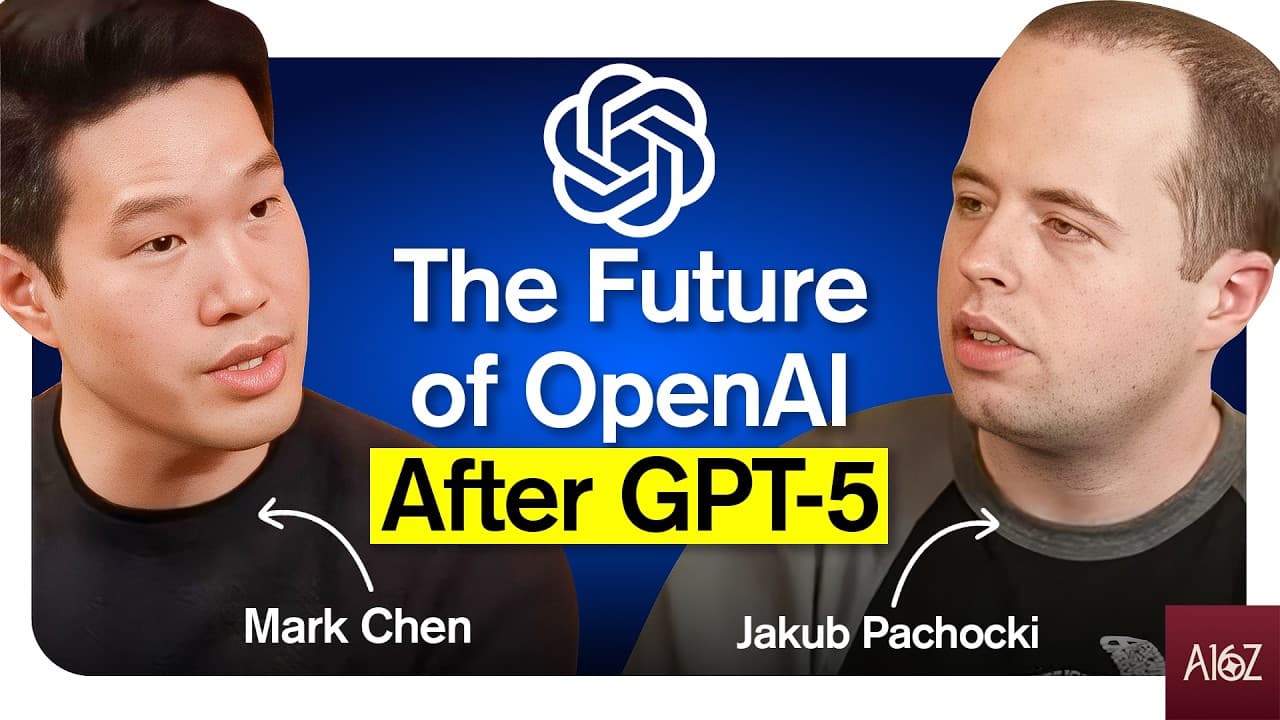
GPT-5 aims to integrate reasoning with quick responses, improving AI's ability to handle complex tasks. By focusing on agentic systems and automated research, OpenAI seeks to create models that can generate economically impactful ideas. The development of GPT-5 highlights the importance of reinforcement learning and the balance between product and fundamental research.
Transcript
The big thing that we are targeting is producing an automated researcher. So automating the discovery of new ideas. The next set of evals and milestone that we're looking at will involve actual movement on things that are economically relevant. And I was talking to some some high schoolers and they're saying, "Oh, you know, actually the default way... Read More
Key Insights
- GPT-5 integrates fast responses with long-horizon reasoning, enhancing AI's ability to tackle complex problems.
- OpenAI aims to develop an automated researcher capable of discovering new ideas with economic impact.
- Reinforcement learning continues to surprise skeptics by delivering consistent improvements in AI models.
- Agentic systems require balancing stability and depth, with reasoning being crucial for long-term operation.
- The evolution of coding with AI involves adapting models to handle real-world coding complexities.
- A great researcher combines persistence with the ability to learn from failures and adjust hypotheses.
- OpenAI's culture emphasizes protecting fundamental research while also advancing product development.
- Resource allocation at OpenAI prioritizes core algorithmic advances over immediate product research.
Install to Summarize YouTube Videos and Get Transcripts
Explore YouTube Video Summarizer or Get YouTube Transcript Extractor
Questions & Answers
Q: How does GPT-5 improve AI's reasoning capabilities?
GPT-5 enhances AI's reasoning by integrating fast responses with long-horizon reasoning, allowing it to handle complex tasks more effectively. This development aims to deliver reasoning and agentic behavior by default, making AI more adept at problem-solving and decision-making.
Q: What is OpenAI's goal with automated research?
OpenAI's goal with automated research is to create AI models that can autonomously discover new ideas with significant economic impact. This involves automating the discovery process in various scientific domains, ultimately leading to breakthroughs that can transform industries.
Q: Why is reinforcement learning important in AI development?
Reinforcement learning is crucial in AI development because it provides a versatile framework for training models to optimize specific objectives. Despite skepticism, reinforcement learning continues to yield consistent improvements, enabling AI to perform complex tasks in dynamic environments.
Q: How does OpenAI balance product and fundamental research?
OpenAI balances product and fundamental research by delineating mandates for researchers interested in product development and those focused on fundamental research. This approach allows for innovation at the frontier while ensuring that product teams can leverage research advancements effectively.
Q: What characterizes a great researcher at OpenAI?
A great researcher at OpenAI is characterized by persistence, a willingness to learn from failures, and the ability to adapt hypotheses based on empirical evidence. Researchers are encouraged to tackle ambitious problems and maintain a balance between conviction and truth-seeking.
Q: How does OpenAI prioritize resource allocation?
OpenAI prioritizes resource allocation by focusing on core algorithmic advances over immediate product research. This involves a dynamic approach to portfolio management, ensuring that long-term research goals are supported while remaining flexible to changing needs.
Q: What is the role of agentic systems in AI development?
Agentic systems in AI development involve creating models that can operate autonomously over long periods, making decisions and adapting to new information. This requires balancing stability and depth, with reasoning being essential for maintaining coherence in complex tasks.
Q: How does OpenAI's culture support research innovation?
OpenAI's culture supports research innovation by protecting fundamental research and fostering an environment where diverse ideas can flourish. By prioritizing long-term objectives and maintaining a clear vision, OpenAI ensures that research efforts are aligned with strategic goals.
Summary & Key Takeaways
-
GPT-5 combines quick responses with reasoning capabilities, aiming to improve AI's handling of complex tasks. OpenAI focuses on creating agentic systems and automated research to generate ideas with real-world economic impact. Reinforcement learning plays a key role in these advancements.
-
OpenAI's research culture balances fundamental research with product development, ensuring that long-term goals are not overshadowed by short-term product demands. Hiring focuses on talent capable of tackling ambitious problems, emphasizing persistence and adaptability.
-
The future of AI at OpenAI involves extending capabilities beyond verifiable domains, with an emphasis on reasoning and planning. Resource allocation remains flexible, prioritizing algorithmic advances while maintaining a coherent research program that integrates diverse ideas.
Read in Other Languages (beta)
Share This Summary 📚
Summarize YouTube Videos and Get Video Transcripts with 1-Click
Try YouTube Summary with ChatGPT & Claude or YouTube Transcript Generator
Explore More Summaries from a16z 📚






Summarize YouTube Videos and Get Video Transcripts with 1-Click
Try YouTube Summary with ChatGPT & Claude or YouTube Transcript Generator