New Fundamental Particle Discovered?? + Challenge Winners!
TL;DR
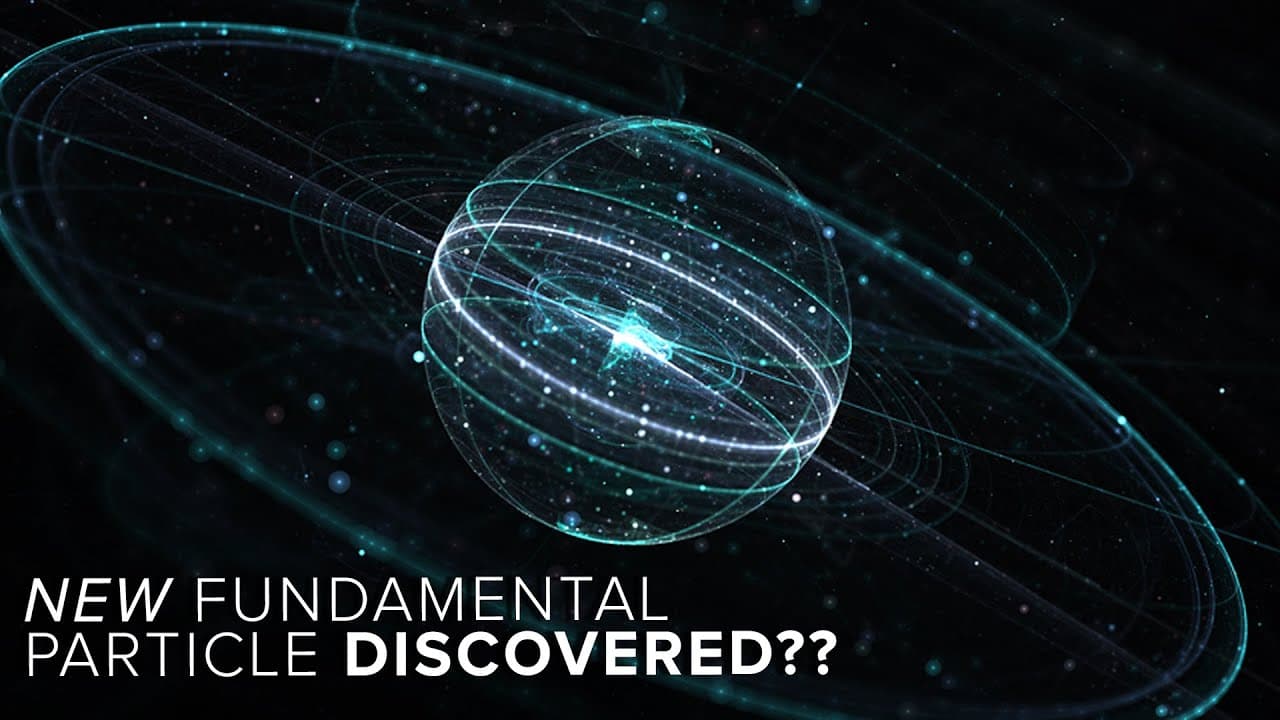
CERN may have discovered a new particle, challenging the standard model.
Transcript
In December last year, science teams at CERN's Large Hadron Collider reported a hint of evidence of a brand new particle, one that does not fit anywhere within the standard model of particle physics. If true, this would be the first clue of anything beyond the standard model from the LHC. Remember, the standard model is basically the periodic table... Read More
Key Insights
- CERN's Large Hadron Collider detected a potential new particle, challenging the standard model of particle physics.
- The discovery, if confirmed, could open new research pathways into the fundamentals of nature.
- The detected particle, indicated by a gamma ray excess at 750 GeV, might be related to dark matter or other theoretical particles.
- The significance of the discovery is still low, requiring further verification when the LHC resumes operations.
- Theoretical possibilities for the new particle include dark matter candidates, a gigantic neutrino, or a new type of Higgs boson.
- The LHC is currently offline for upgrades, with operations expected to resume after resolving a technical issue caused by a weasel.
- The discussion on climate change highlights the complex relationship between solar activity and Earth's climate, emphasizing anthropogenic factors.
- The video also includes a challenge question on dark energy and its influence on the universe's expansion, with solutions provided for participants.
Install to Summarize YouTube Videos and Get Transcripts
Explore YouTube Video Summarizer or Get YouTube Transcript Extractor
Questions & Answers
Q: What is the significance of the potential new particle discovered at CERN?
The potential new particle discovered at CERN is significant because it challenges the standard model of particle physics, which is the current framework for understanding the fundamental particles and forces in the universe. If confirmed, this discovery could open new pathways for research into the fundamentals of nature, potentially leading to a deeper understanding of the universe's building blocks.
Q: What are the theoretical possibilities for the new particle detected at 750 GeV?
Theoretical possibilities for the new particle detected at 750 GeV include it being a candidate for dark matter, a gigantic neutrino, a higher energy vibration in the Higgs field, or a graviton. It could also be a composite particle made up of smaller particles, similar to how protons are composed of quarks. Each possibility represents a potential extension to the standard model.
Q: Why is further verification needed for the new particle discovery?
Further verification is needed for the new particle discovery because the current significance level is low, around a sigma of 1.6 for CMS and lower for Atlas. In particle physics, a 5 sigma level is generally required for a confident discovery. The initial detection could be due to random fluctuations, so additional data and experiments are necessary to confirm the existence of the new particle.
Q: How does the LHC work to detect new particles?
The Large Hadron Collider (LHC) works by accelerating protons to nearly the speed of light using a ring of gigantic magnets. These protons are then collided from opposite directions, resulting in conditions similar to the universe shortly after the Big Bang. The collisions produce new particles, some of which are detected through their decay products, such as gamma rays, allowing scientists to infer their existence and properties.
Q: What is the relationship between solar activity and Earth's climate?
Solar activity, such as sunspot activity, can influence Earth's climate by increasing solar irradiance. However, this effect is relatively small compared to anthropogenic factors like greenhouse gas emissions. While solar activity did increase solar output slightly in the early 20th century, it has since decreased, yet global temperatures continue to rise, indicating other factors are driving current climate change.
Q: What was the dark energy challenge question about?
The dark energy challenge question asked participants to calculate how many times the universe doubled in size after dark energy began influencing its expansion and how many times it would double in the future before matter's influence wanes. The challenge required understanding the interplay between dark energy and matter in the universe's expansion and involved solving equations related to the universe's scale factor.
Q: What insights were gained from the discussion on climate change in the video?
The discussion on climate change highlighted the complex relationship between solar activity and Earth's climate, emphasizing that current warming trends are primarily driven by anthropogenic factors rather than solar variations. It also addressed the lag between CO2 increases and temperature rises, due to feedback cycles, and the challenges in modeling climate change accurately while still predicting long-term trends.
Q: What are the implications of the potential new particle for future research?
The potential new particle could have significant implications for future research by providing evidence of phenomena beyond the standard model. It could lead to new theories and experiments exploring dark matter, supersymmetry, or other extensions of our current understanding of particle physics. Confirming its existence would be a major breakthrough, prompting a reevaluation of fundamental concepts in physics and potentially leading to new technologies and insights into the universe's origins.
Summary & Key Takeaways
-
CERN's Large Hadron Collider has detected a potential new particle that does not fit within the standard model, sparking excitement and speculation among physicists. The particle was indicated by a gamma ray excess at 750 GeV, suggesting a mass much larger than anything currently known.
-
The discovery could have significant implications for our understanding of the universe, with possibilities including dark matter candidates, a gigantic neutrino, or a new type of Higgs boson. However, further verification is needed, as the significance of the result is still low.
-
The video also addresses climate change, discussing the impact of solar activity on Earth's climate and emphasizing the role of anthropogenic factors. Additionally, a challenge question on dark energy is presented, with detailed solutions provided for participants.
Read in Other Languages (beta)
Share This Summary 📚
Summarize YouTube Videos and Get Video Transcripts with 1-Click
Try YouTube Summary with ChatGPT & Claude or YouTube Transcript Generator
Explore More Summaries from PBS Space Time 📚
Summarize YouTube Videos and Get Video Transcripts with 1-Click
Try YouTube Summary with ChatGPT & Claude or YouTube Transcript Generator