Are UUIDs Truly Secure from Brute Force Attacks?
TL;DR
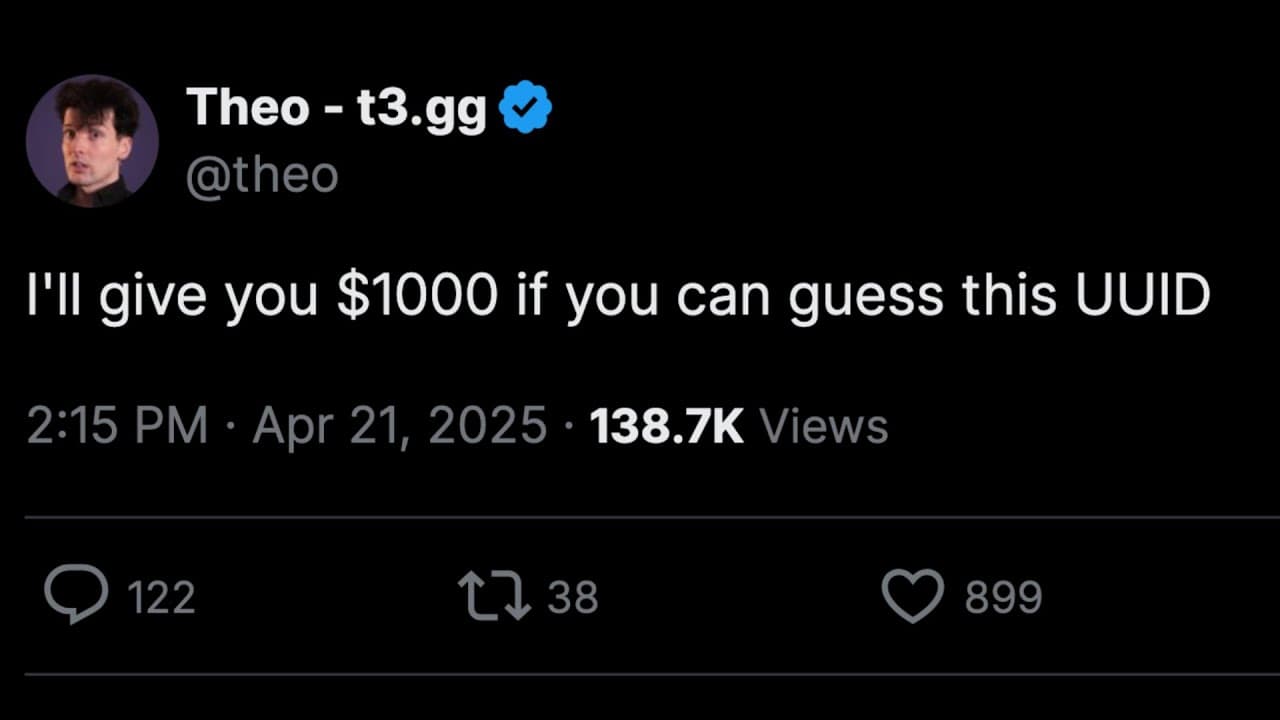
UUIDs are designed to be universally unique, making brute force attacks impractical due to the astronomical number of possible combinations. A challenge was issued to prove this, offering $1,000 for a successful brute force, but it remains unclaimed. The likelihood of guessing a UUID is akin to phasing through a wall, highlighting their security strength.
Transcript
This is not going to be the usual Theo video. Not that there is a usual Theo video to be fair, but this is going to be more of a story and a journey to utter chaos, some of the stupidest things I've ever seen anyone say on the internet, combined with fundamental misunderstandings of encryption, randomness, uniqueness, and a challenge that I present... Read More
Key Insights
- UUIDs are designed to be universally unique identifiers, making them difficult to replicate.
- Version 4 UUIDs have 5.3 x 10^36 possible combinations, making brute force attacks impractical.
- A challenge was issued to crack a UUID-generated file with a $1,000 reward, yet remains unclaimed.
- Brute forcing a UUID is likened to the chance of atoms aligning to pass through a wall.
- Some misunderstand UUIDs, believing brute force attacks are feasible despite their complexity.
- Properly implemented UUID generators ensure randomness, preventing duplicate generation.
- Older, flawed implementations of UUID generation have been addressed by modern updates.
- The challenge highlighted misconceptions about UUID security and the improbability of brute force success.
Install to Summarize YouTube Videos and Get Transcripts
Explore YouTube Video Summarizer or Get YouTube Transcript Extractor
Questions & Answers
Q: What makes UUIDs secure against brute force attacks?
UUIDs, particularly version 4, are secure against brute force attacks due to their design as universally unique identifiers. They have 5.3 x 10^36 possible combinations, making it virtually impossible to replicate a UUID through brute force methods. The astronomical number of potential UUIDs ensures that the likelihood of duplication is exceedingly low, comparable to the chance of phasing through a solid wall due to atomic alignment.
Q: How does the challenge demonstrate UUID security?
The challenge involved decrypting a file protected by a UUID, with a $1,000 reward for successful brute force. Despite claims that it could be done, the challenge remains unmet, illustrating the robustness of UUID security. The vast number of possible UUID combinations makes it impractical to guess the correct identifier, thereby confirming the effectiveness of UUIDs in safeguarding data.
Q: Why are older UUID implementations considered insecure?
Older UUID implementations might have been insecure due to insufficient randomness in their generation processes. Some implementations used predictable patterns, making them vulnerable to duplication. However, modern UUID generators have addressed these issues by ensuring that generated UUIDs are truly random, thereby restoring their security and uniqueness.
Q: Can UUIDs be brute forced using serverless architecture?
While serverless architecture allows for massive parallel processing, brute forcing UUIDs remains impractical due to the sheer number of possible combinations. The challenge issued demonstrated that even with advanced computational resources, the probability of successfully guessing a UUID is negligible, reaffirming their security against brute force attacks.
Q: What misconceptions exist about UUID security?
A common misconception is that UUIDs can be easily brute forced due to their public nature. However, the astronomical number of possible combinations makes guessing a UUID highly improbable. Misunderstandings often arise from outdated or flawed implementations, but modern UUID generators ensure sufficient randomness to prevent duplication and maintain security.
Q: How did the challenge highlight misunderstandings about UUIDs?
The challenge revealed misunderstandings about the feasibility of brute forcing UUIDs. Despite assertions that it could be done within hours, the challenge remains unmet, demonstrating the impracticality of such attacks. This highlighted the effectiveness of UUIDs in maintaining data security and the importance of understanding their design and purpose.
Q: What role does randomness play in UUID security?
Randomness is crucial to the security of UUIDs, ensuring that each identifier is unique and difficult to replicate. Properly implemented UUID generators provide sufficient randomness, preventing the generation of duplicate identifiers. This randomness is key to making brute force attacks impractical, as the likelihood of guessing a specific UUID is astronomically low.
Q: How can developers ensure the security of UUIDs?
Developers can ensure the security of UUIDs by using modern, properly implemented generators that guarantee sufficient randomness. Avoiding outdated or flawed implementations is essential. By relying on secure UUID generation methods, developers can maintain the uniqueness and security of identifiers, protecting data from potential duplication or brute force attacks.
Summary & Key Takeaways
-
UUIDs, or Universally Unique Identifiers, are designed to be unique and secure, with 5.3 x 10^36 possible combinations. This makes brute force attacks highly impractical. A $1,000 challenge was issued to crack a UUID-generated file, but it remains unclaimed, demonstrating the robustness of UUID security.
-
The video explores a debate around the security of UUIDs, specifically whether they can be easily brute-forced. Despite claims to the contrary, the astronomical number of possible UUIDs ensures their security. A challenge to prove otherwise highlighted the improbability of success.
-
Misunderstandings about UUID security were exposed when a challenge was issued to brute force a UUID-generated file. Despite assertions that it could be done, the challenge remains unmet, underscoring the effectiveness of UUIDs in maintaining data privacy and security.
Read in Other Languages (beta)
Share This Summary 📚
Summarize YouTube Videos and Get Video Transcripts with 1-Click
Try YouTube Summary with ChatGPT & Claude or YouTube Transcript Generator
Explore More Summaries from Theo - t3․gg 📚






Summarize YouTube Videos and Get Video Transcripts with 1-Click
Try YouTube Summary with ChatGPT & Claude or YouTube Transcript Generator